TL;DR: Plastic bags for food packaging must meet the needs of the food product, packaging process and target market. Buyers should compare bag styles, material structures, barrier performance, sealing options and custom printing before ordering. For food-contact compliance, check documentation for the proposed packaging structure and intended conditions of use, including any applicable migration testing. A clear specification helps food brands select suitable packaging and compare manufacturers more accurately.
What Are Plastic Bags for Food Packaging?
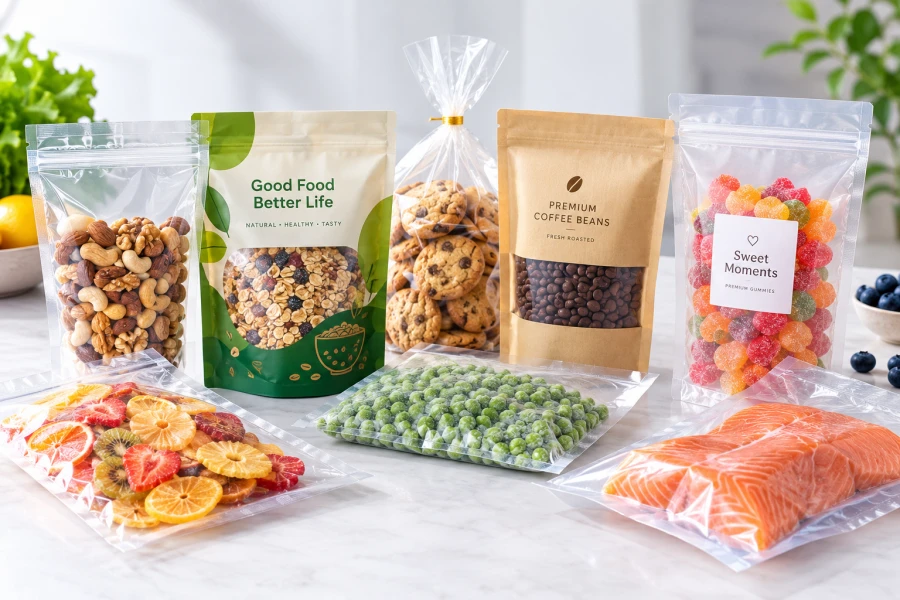
Plastic bags for food packaging are flexible packaging products used to contain, protect and present food during storage, transportation and retail sale. They are commonly used for snacks, confectionery, dried fruit, baked goods, frozen foods, food ingredients and other packaged products.
For food brands, choosing the right plastic bag involves more than selecting a size or material. The package must suit the food, perform under the expected storage conditions and meet applicable food-contact requirements in the destination market.
When sourcing custom plastic food bags, buyers should evaluate six key factors:
- Food type: Moisture content, oil content, aroma sensitivity and other product characteristics.
- Bag style: Flat bags, gusseted bags, stand-up pouches or resealable bags.
- Material structure: PE, PP, PET and suitable multilayer combinations.
- Packaging performance: Required resistance to moisture, oxygen, light or mechanical damage.
- Food-contact compliance: Relevant documentation for the intended use and target market.
- Commercial specifications: Dimensions, thickness, printing, order quantity and delivery schedule.
The best packaging solution balances product protection, packing efficiency, shelf presentation and overall cost.
Which Plastic Bag Style Is Right for Your Food Product?
The right bag style depends on the product’s shape, fill weight, packaging process and retail requirements. Four common formats are flat bags, gusseted bags, stand-up pouches and resealable bags.
1. Flat Plastic Bags
Flat plastic bags have a simple structure without an expanded bottom. They are suitable for products that do not need the package to stand upright on a shelf.
Typical applications include:
- Individually packed food portions
- Small baked goods and dry foods
- Food ingredients and components
- Lightweight products packed in bulk
Flat bags can be customized by width, length, film type, thickness and printing. Heat sealing may be available when the selected material and bag construction are compatible with the sealing process.
Best for: Straightforward food packaging applications where simple construction and efficient packing are priorities.
2. Gusseted Plastic Bags
Gusseted bags have expandable folds along the sides or bottom, allowing them to accommodate more product volume without requiring a proportionally wider front panel.
Depending on the construction, they can suit products that need additional capacity or a specific packing configuration.
Typical applications include:
- Larger quantities of dry foods
- Bakery products
- Food ingredients
- Products requiring extra packing space
Side gussets and bottom gussets serve different purposes. Buyers should confirm the filled dimensions, bag opening and intended display position before approving a design.
Best for: Products that need extra capacity or a more space-efficient packaging format.
3. Stand-Up Pouches
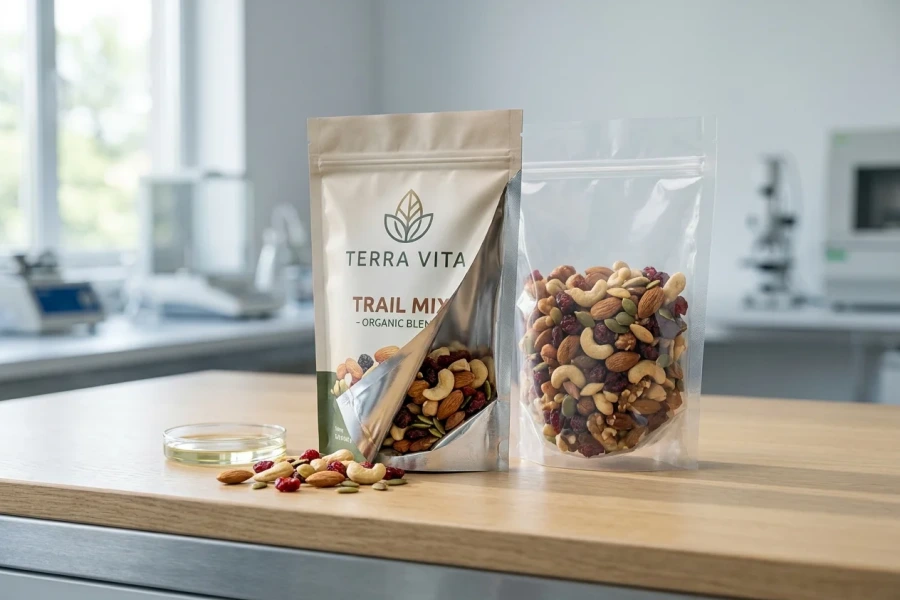
Stand-up pouches have a bottom structure designed to support the filled package in an upright position. They provide a prominent display area for branding and can be made with different material structures and closure options.
Typical applications include:
- Snacks and dried foods
- Confectionery
- Powdered food products
- Selected frozen or specialty food products when the structure is suitable
Options may include transparent windows, zipper closures, tear notches and custom printing. These features should be selected according to the product’s needs rather than added by default.
Best for: Retail food brands that need shelf visibility, flexible sizing and a larger branded display area.
4. Resealable Plastic Food Bags
Resealable food bags use a closure, commonly a press-to-close zipper, that allows consumers to open and close the package repeatedly.
They are often used for snacks, dried fruit, nuts and confectionery intended to be consumed over multiple occasions.
A zipper improves convenience, but it does not automatically make the package airtight or replace a required primary heat seal. Products with specific shelf-life requirements may need a suitable barrier structure and a separate sealing process.
Best for: Food products where repeated opening and closing are important to consumer convenience.
How Do You Choose Plastic Materials for Food Bags?
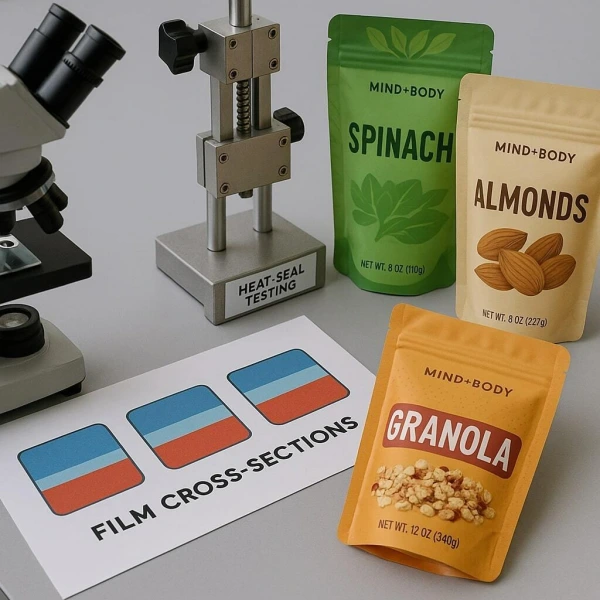
Material selection affects flexibility, clarity, stiffness, sealing performance and resistance to moisture, oxygen and other environmental factors. The correct choice depends on the product and the performance required from the finished package.
| Material | Common characteristics | What buyers should consider |
|---|---|---|
| PE (polyethylene) | Flexible and commonly used in bags and sealing layers | Check the specific grade, thickness, sealing needs and barrier requirements |
| PP (polypropylene) | Available in clear, relatively stiff film structures | Confirm the grade, clarity, sealing performance and temperature requirements |
| PET (polyethylene terephthalate) | Often used as an outer layer in printed flexible packaging | Consider printability, stiffness and compatibility with the complete structure |
| Multilayer laminates | Combine layers with different functions | Confirm the purpose of each layer and the performance of the finished construction |
These materials are not interchangeable in every application. A simple food bag may use a suitable single-material structure, while a printed pouch with higher barrier requirements may need multiple layers.
Should You Choose PE, PP or a Multilayer Structure?
Start with the intended use rather than choosing a material by name alone.
- For simple food bags: Ask whether a suitable PE or PP structure meets the product’s protection and sealing needs.
- For printed retail packaging: Consider whether an outer layer is needed to support the required print quality and package stiffness.
- For moisture- or oxygen-sensitive foods: Ask the manufacturer to recommend a structure with suitable barrier performance.
- For demanding storage conditions: Confirm temperature limits, handling requirements and compatibility of the complete structure.
Material suitability also depends on food-contact compliance. A polymer’s name alone does not establish that every grade, additive, finished bag or intended use is compliant.
What Makes Plastic Bags Safe for Food Contact?
A plastic bag marketed as “food grade” is not automatically suitable for every food product or storage condition. Food-contact suitability depends on the materials used, the finished packaging construction and the conditions under which the package will be used.
For buyers, the key question is not simply whether a supplier uses food-grade plastic. It is whether the specific packaging structure is appropriate for the intended food-contact application.
Why Does the Finished Packaging Structure Matter?
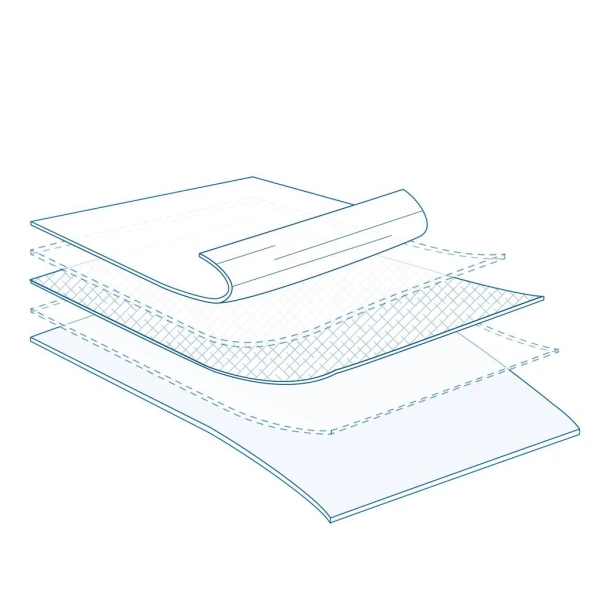
A food bag may contain more than one material. A printed or laminated package can include a printing layer, an outer film, an adhesive layer and an inner layer that contacts the food.
Each component has a different function, and the complete construction must be assessed for its intended use.
When reviewing a proposed food bag, consider:
- Which layer will directly contact the food?
- Does the structure include printing inks, adhesives, coatings or other relevant components?
- Is the package intended for dry, oily, acidic or moist food?
- Will the bag be used at room temperature, under refrigeration or in frozen storage?
- Will it be exposed to hot filling, heating or other elevated-temperature conditions?
- Is it intended for single use or repeated use?
These details help determine which compliance documentation and testing may be relevant.
What Does FDA Food-Contact Compliance Mean?
For products sold in the United States, applicable food-contact requirements depend on the substances used and the intended conditions of use. The regulatory status of relevant components must be appropriate for their intended application; the term “FDA approved” should not be used as a blanket claim for a finished bag without supporting evidence.
The U.S. Food and Drug Administration provides information about food-contact substances, food types and conditions of use. Buyers should confirm that the proposed packaging materials are suitable for the intended application rather than relying only on a general supplier statement.
For reference, see the FDA’s official guidance on food types and conditions of use and determining the regulatory status of food-contact material components.
What Should Buyers Know About EU Food-Contact Requirements?
For food packaging intended for the European Union, buyers should identify the applicable food-contact legislation and documentation requirements for the proposed materials and use conditions.
EU rules include a general framework for food-contact materials and specific requirements for plastic materials. Depending on the application, migration limits, supporting documentation and a Declaration of Compliance may be relevant.
Requirements can vary according to material type, food category and conditions of use. Buyers should verify the current rules and the documentation applicable to their actual packaging construction.
The European Commission provides an overview of food-contact material legislation.
Are Printing Inks and Adhesives Safe for Food Packaging?
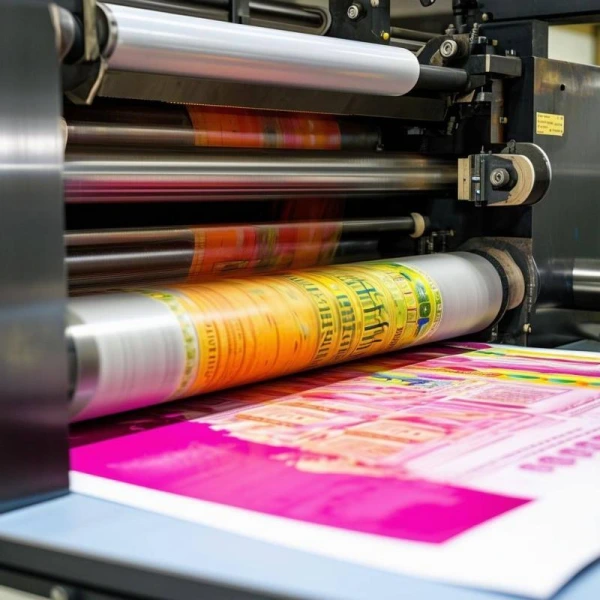
Custom printing can help food brands create distinctive packaging, but the printing and lamination process should be considered when assessing food-contact suitability.
The safety of a finished package cannot be determined simply by looking at the ink type or the name of the adhesive. The relevant materials, layer arrangement, manufacturing process and intended conditions of use all matter.
Food-Contact Layers vs. Printed Outer Layers
In many printed flexible packages, the graphics are printed on an outer layer rather than directly on the food-contact surface. Depending on the construction, the printed layer may be laminated to another film, with a separate inner layer contacting the food.
This arrangement can serve functional and presentation purposes, but it does not remove the need to assess the complete structure.
When sourcing printed plastic food bags, ask the manufacturer to clarify:
- Which layer is intended to contact the food.
- Where the printing is located in the finished construction.
- Whether lamination is used and what role the adhesive serves.
- What documentation supports the intended food-contact application.
- Whether any changes to inks, adhesives or film layers could affect compliance.
Does Water-Based Ink Automatically Make a Food Bag Safe?
No. The fact that an ink is water-based does not, by itself, demonstrate that the finished packaging is suitable for food contact.
The same principle applies to claims such as “low odor,” “non-toxic” or “food-safe ink.” These descriptions are not substitutes for evaluating the complete packaging construction against the applicable requirements.
For custom-printed food bags, request documentation relevant to the proposed materials and application, especially when the package will be used for direct food contact.
Do Plastic Food Bags Need Migration Testing?
Migration testing may be needed to evaluate whether relevant substances can transfer from packaging into food under specified conditions. Whether testing is required, and which tests are appropriate, depends on the material, regulatory requirements and intended use.
A test report should not be treated as a universal approval for every food bag made by the same supplier.
What Affects Migration Testing Requirements?
Important factors can include:
- Food type: Dry, acidic, aqueous, fatty and other foods may require different assessment conditions.
- Contact temperature: Room-temperature storage differs from hot filling or heating.
- Contact duration: The intended time in contact with the food can affect the assessment.
- Material construction: Different films, coatings, adhesives and additives can affect the relevant testing approach.
- Intended use: Frozen storage, refrigeration, hot filling and reheating may have different requirements.
For example, a bag intended for dry snacks stored at room temperature should not automatically be assumed suitable for oily food stored under elevated-temperature conditions.
Overall Migration and Specific Migration
Depending on the applicable regulatory framework and the material, testing may address overall migration, specific migration or other relevant parameters.
- Overall migration assesses the total amount of substances that migrate under the specified test conditions.
- Specific migration evaluates particular substances subject to applicable restrictions or limits.
The applicable tests, limits and conditions should be confirmed for the target market and packaging application. Buyers should not assume that every plastic bag requires the same tests or that one generic migration report covers every possible use.
What Documents Should You Request Before Ordering Food Bags?
Before approving a custom plastic food bag order, request documentation relevant to the proposed packaging structure and intended use. The appropriate documents may vary by destination market, material and food-contact application.
1. Food-Contact Declaration or Compliance Statement
Ask the supplier to provide a declaration, compliance statement or other supporting documentation appropriate to the target market.
Check whether the document identifies the material or product it covers and whether its stated conditions of use match your application.
A general statement that a factory produces “food-grade bags” is not enough to establish suitability for every product.
2. Migration Test Reports, Where Applicable
If migration testing is required or relevant, review the report’s scope and test conditions.
Check:
- The sample or material structure tested.
- The test method and relevant parameters.
- The food simulant or food category, where applicable.
- The time and temperature conditions.
- The laboratory and report identification details.
- Whether the tested sample corresponds to the proposed packaging.
A report for a different structure or different use conditions may not support your intended application.
3. Material Specifications
Ask for a clear description of the proposed construction, including relevant film layers and thicknesses. For laminated packaging, confirm the function of the layers and whether the proposed specification is consistent with the compliance documentation.
If you need a particular barrier performance, request supporting technical information rather than relying on a general material description.
4. Printing and Lamination Information
For printed bags, clarify whether the proposed construction uses printing inks, adhesives or coatings that are relevant to the food-contact assessment.
Ask the supplier to explain what documentation is available for the finished structure and what changes would require reassessment.
5. Sample and Specification Approval
Before mass production, review the sample against the agreed specification. Depending on the application, this may include dimensions, film thickness, print quality, closure performance and sealing suitability.
Where possible, evaluate samples using the intended filling and sealing equipment. A sample approval should be linked to a defined specification so that the production order can be checked against the approved version.
How Do You Choose the Right Size and Thickness?
The bag dimensions should be based on the product, fill weight and packaging process. Choosing a bag that is too small can make filling and sealing difficult, while an oversized bag can waste material and reduce packing efficiency.
Before confirming specifications, consider the following factors.
Product Dimensions and Fill Weight
Provide the product dimensions or target net weight. Foods with different shapes, piece sizes or bulk densities may need different bag dimensions even when the fill weight is similar.
Headspace and Sealing Area
Allow sufficient room for filling and sealing. The required headspace depends on the filling method, product characteristics and seal design.
Gusset and Bottom Dimensions
For gusseted bags and stand-up pouches, confirm the expanded dimensions and usable capacity. Flat measurements alone may not describe the package’s final volume.
Film Thickness and Durability
Thickness affects handling characteristics, stiffness and resistance to damage, but it should not be selected in isolation. The complete structure and its intended use are equally important.
Ask the manufacturer to recommend a suitable specification based on the food product, packaging dimensions and handling conditions.
Filling and Sealing Equipment
If the bags will be used on an automated packing line, confirm compatibility with the equipment. Relevant factors may include bag dimensions, opening characteristics, film properties and sealing conditions.
Testing samples on the intended equipment can help identify issues before production begins.
How Should You Check Plastic Food Bag Quality?
Food-contact compliance and physical packaging quality are related but separate considerations. Documentation about food-contact suitability does not automatically prove that every production batch meets your dimensional, sealing or appearance requirements.
Buyers should agree on the quality criteria that matter for the specific order.
Key Quality Checks to Discuss With Your Supplier
Dimensions and thickness: Confirm that the finished bags match the approved specification within the agreed tolerances.
Seal integrity: Where heat sealing is used, discuss appropriate checks for seal consistency and leakage risk.
Film appearance: Review whether the order requires defined standards for clarity, color, print registration or visible defects.
Zipper performance: For resealable bags, check closure operation and compatibility with the intended product and use.
Lamination quality: For laminated structures, discuss the applicable criteria for adhesion and visible defects.
Odor and product compatibility: If odor or flavor transfer is a concern, communicate the requirement and ask what evaluation is appropriate.
Batch records: Ask what inspection records or quality documentation the manufacturer can provide for the order.
Not every test is necessary for every bag style. The quality plan should reflect the packaging construction, food product, production method and agreed customer requirements.
How Do You Compare Plastic Food Bag Manufacturers?
Comparing suppliers only by unit price can be misleading when the quotations use different materials, thicknesses, printing specifications or compliance assumptions.
For a fair comparison, ask each manufacturer to quote against the same specification.
1. Confirm the Material Structure
The quotation should clearly identify the proposed bag style and relevant material specifications. Descriptions such as “premium plastic” or “high-quality food-grade material” are too vague for a technical comparison.
2. Review Customization Capabilities
Confirm whether the manufacturer can produce your required bag dimensions, material construction, printing, closure and other options.
3. Check Compliance Documentation
Ask which documents are available for the proposed packaging and whether they match the intended food type, storage conditions and destination market.
4. Understand Sampling and Approval
Clarify sample costs, sample lead time, artwork approval and whether the sample represents the proposed production structure.
5. Compare MOQ and Total Cost
Confirm the minimum order quantity, printing or setup charges, sample costs, unit price and any price differences between order quantities.
6. Agree on Quality Requirements
Discuss the quality checks that will apply to the order and what documentation will be available after production.
7. Confirm Production and Delivery Terms
Clarify production lead time, shipping arrangements, delivery destination and the terms included in the quotation.
A reliable comparison should evaluate the complete offer—specifications, documentation, quality requirements and delivery—not simply the lowest price per bag.
Frequently Asked Questions About Plastic Bags for Food
What plastic is commonly used for food packaging bags?
PE and PP are commonly used in flexible food packaging, while PET is often used as part of printed or laminated structures. The appropriate material depends on the food product, required barrier performance, sealing method and intended use.
Are all plastic bags labeled “food grade” suitable for direct food contact?
No. The label alone does not establish suitability for every food or storage condition. Buyers should verify relevant documentation for the specific packaging construction and intended application.
What is the difference between food-grade plastic and food-contact compliance?
“Food grade” is a broad commercial description. Food-contact compliance refers to whether the relevant materials and finished packaging meet the applicable requirements for a defined use. Buyers should ask for documentation that supports the intended application rather than relying on a label alone.
Does a food plastic bag need migration testing?
Not every bag requires the same testing. Whether migration testing is necessary depends on the applicable rules, material structure, food type and conditions of use. Buyers should confirm the relevant testing requirements for their target market.
Does an FDA document guarantee that a finished bag is suitable for every food?
No. Food-contact suitability depends on the relevant substances, intended use and applicable conditions. Buyers should verify that the documentation covers the proposed material structure and intended application rather than assuming that one document applies universally.
Can custom printed plastic bags be used for direct food contact?
They may be suitable when the complete packaging construction meets the applicable requirements for the intended use. The printing process, inks, adhesives and food-contact layer should be considered as part of the compliance assessment.
What information should a food bag test report contain?
Review the tested sample or structure, test methods, relevant conditions, results, laboratory details and report identification. Confirm that the report is relevant to the actual packaging and intended use. The exact information required depends on the applicable test and regulatory framework.
How thick should a plastic food bag be?
There is no universal thickness for every food product. The correct specification depends on the bag dimensions, product weight, material structure, handling conditions and required performance. Request a recommendation and evaluate samples where practical.
Request a Quote for Custom Plastic Food Bags
Choosing plastic bags for food packaging requires a balance of product protection, material suitability, food-contact compliance, packaging performance and cost. A clear specification helps manufacturers recommend an appropriate construction and allows buyers to compare quotations on an equivalent basis.
When contacting RBD Packaging, provide the following information:
- Your food product and target sales market
- Preferred bag style and approximate dimensions
- Required material or packaging performance
- Estimated order quantity
- Printing artwork or reference images, if available
- Food-contact documentation requirements
- Target delivery schedule
For custom packaging inquiries, contact [email protected].
Share your packaging requirements to discuss suitable bag formats, material options, samples and production specifications.