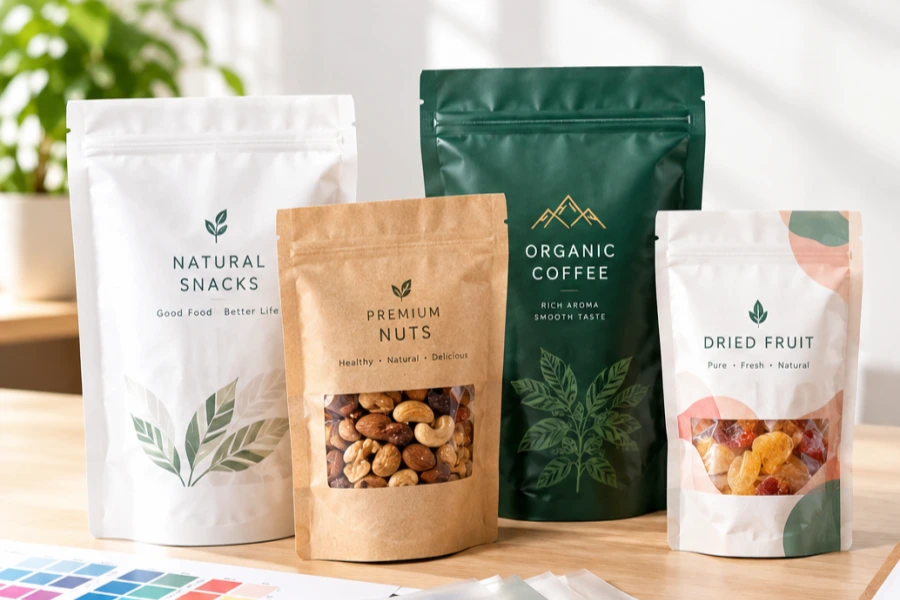
Ordering low MOQ stand-up pouches can help food brands, startups and established businesses test new products without committing to a large packaging inventory. But a low minimum order quantity does not automatically mean a low total cost—or a fast launch.
The biggest risks are comparing printing prices without including setup costs, approving a sample before confirming the pouch structure, and requesting a quote without enough information for suppliers to price the same specification.
This guide explains how to compare digital printing with conventional printing, plan sampling and production, evaluate food-contact documentation, and prepare a complete request for quotation (RFQ) before ordering custom stand up pouches.
Low-MOQ Stand-Up Pouches: Four Decisions to Make Before Ordering
| Decision | What to confirm | Why it matters |
|---|---|---|
| Printing method | Digital printing versus conventional printing for your quantity per design | Determines the balance between setup costs and unit price |
| Sampling and lead time | Sample type, artwork approval and production schedule | Helps you plan a realistic launch date |
| Material and compliance | Barrier performance, food-contact suitability and destination-market requirements | Reduces the risk of approving an unsuitable pouch |
| RFQ specification | Dimensions, fill weight, structure, features and quantity per design | Makes supplier quotations easier to compare |
The buying rule: compare the total cost of a complete packaging solution, not just the advertised MOQ or unit price.
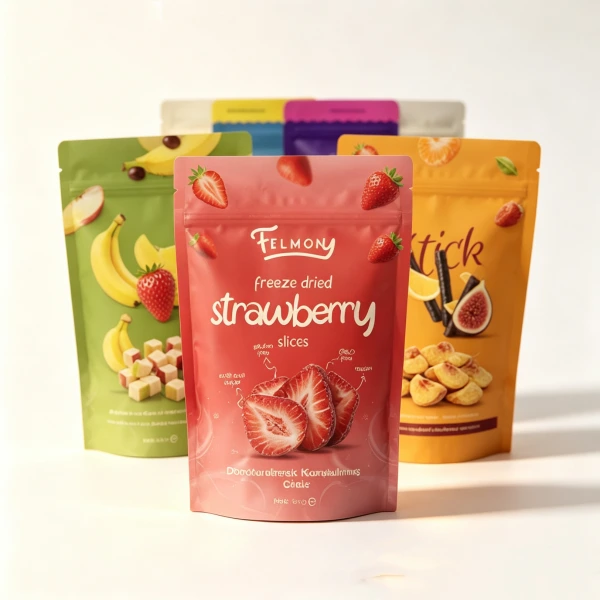
Where Your Quantity Sits Against Digital-Print Thresholds
Don’t ask which supplier has the lowest MOQ. Ask where your quantity per design falls against the threshold where digital printing becomes economically honest.
| Quantity per design | Recommended path | What the comparison actually includes |
|---|---|---|
| < 500 | Stock pouch + label | Label cost and labelling labour; digital print has not yet reached its economic floor |
| 1,000–5,000 | Digital printing becomes comparable | Once labelling time and label waste are counted, digital usually matches or beats stock + label at this band |
| ≥ 10,000 | Gravure unit cost is lowest | Plate and cylinder setup amortised across a larger run; not a low-MOQ decision |
if your quantity sits between 500 and 1,000 per design, the question is not “is the MOQ low enough?” It is whether the labour of applying labels has been priced into the stock-plus-label comparison. A digital quote that looks 20–30% higher per unit may be the cheaper path once an afternoon a week of labelling is counted.
Sampling Timelines: What the Calendar Actually Says
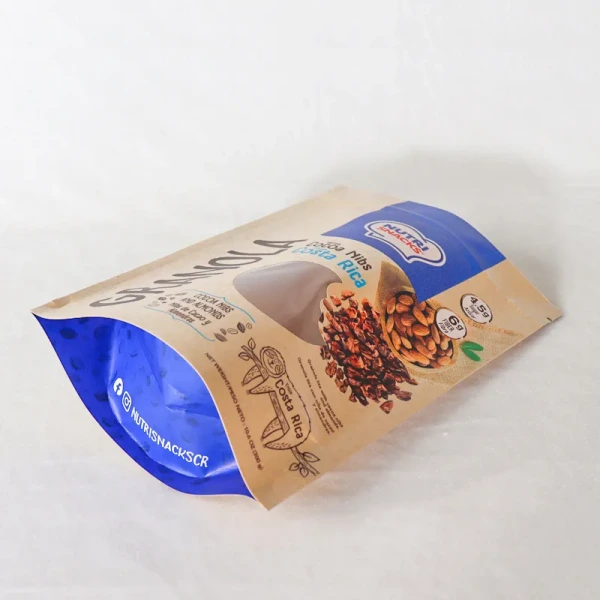
Sampling timelines are stable at the factory end. What moves them is the first RFQ missing the fields that set tooling and structure.
A white sample for a zipper stand-up pouch using a standard laminate structure is typically ready in 7–10 working days. A printed production sample runs 25–30 working days from approved artwork. Our digital production lead time is 7–15 days after artwork approval, which is faster than traditional printed-sample timelines because it skips the separate proofing cycle.
The delays that actually occur are not factory speed problems. They are missing-field problems. In our experience reviewing pouch RFQs, most briefs arrive missing at least two of five critical fields; when that happens, we either have to estimate (and the quote shifts after the first sample) or send a clarification form that adds 2–4 days before sampling even begins.
| Missing field | What it changes | Delay added |
|---|---|---|
| Zipper centreline to top seal | Seal-bar tooling offset and header space for branding | 3–5 working days if changed after the first white sample |
| Front panel × height × bottom gusset | Film yield per pouch, which drives material cost | Quote is provisional until dimensions are confirmed |
| Laminate structure | Barrier performance and unit price; a “food-grade pouch” without a laminate call is quoted to a mid-range default | First sample may miss the barrier requirement entirely |
| Fill weight / volume | Bottom gusset geometry | Structural pre-check returns the brief |
| Filling method | Seal-window assumptions | First sample risks seal failure |
a brief missing two or more of these fields typically triggers a requote cycle adding 5–10 working days. On a low-MOQ order, that is not an inconvenience—it is a launch-date risk, because there is no large production run on either side of the delay to absorb it.
PFAS Evidence: The One Item Low-MOQ Buyers Skip Most
Low-MOQ buyers often lack an in-house compliance team. That makes the PFAS document the easiest item to defer and the most expensive one to get wrong.
From 12 August 2026, food-contact packaging placed on the EU market must not contain PFAS at or above the following limits under PPWR Article 5(5):
- 25 ppb for any individual PFAS measured by targeted analysis (polymeric PFAS excluded from quantification)
- 250 ppb for the sum of PFAS measured by targeted analysis
- 50 ppm for total PFAS including polymeric PFAS, measured as total fluorine
The compliance pathway is stepwise, not a single test. Total fluorine is quantified first; if it exceeds 50 mg/kg, the supplier must provide proof of how much fluorine is attributable to PFAS versus non-PFAS. Direct targeted analysis or TOP (total oxidizable precursors) assay is then used to check against the 25 ppb and 250 ppb limits.
What this means for a low-MOQ buyer: a supplier email saying “we are PFAS-free” is not the same as a test report or supply-chain declaration covering your specific pouch structure. PFAS can enter through coatings, inks, adhesives, or the film itself—and a mono-material or “food-grade” label does not establish compliance. Indicative testing costs run €300–€800 or more per structure depending on the scope of analysis, which is why suppliers may resist passing the documentation through unless the buyer asks for it explicitly.
The RFQ Fields That Make or Break a Low-MOQ Quote
Low-MOQ quotes are not incomparable because suppliers quote differently. They are incomparable because the brief did not give suppliers enough to quote on the same basis.
Our estimating team treats a brief as “quotable” or “pending clarification” based on seven data points; a quote built without all seven is provisional and carries a price-change footnote. We reduce the minimum to four categories: exact specs, quantity with tiers, print/artwork scope, and the commercial terms you want quoted back.
For a low-MOQ stand-up pouch, the consolidated minimum looks like this:
| RFQ field | What “specific” means | Missing → consequence |
|---|---|---|
| Finished dimensions | Front panel width × overall height × bottom gusset depth (mm) | Film yield estimate is off; unit price cannot be compared |
| Zipper position | Centreline to top seal (default 30–35mm; 45–50mm for large hang hole) | Seal-bar retooling after first sample, +3–5 days |
| Laminate structure | At least layer count or barrier target; “please recommend” is acceptable if stated | Quote defaults to mid-range structure that may not match shelf life |
| Fill weight + filling method | Grams or volume, plus fill temperature and method | Gusset geometry and seal-window assumptions are wrong |
| Quantity per design, not total | Per artwork version; multiple SKUs listed separately | Digital pricing threshold cannot be applied |
| Target market + food-contact status | EU / non-EU; food-contact / non-food-contact | PFAS evidence requirement cannot be determined |
| PFAS evidence request | Explicit ask for report or declaration per specification | Quote is incomplete for EU food-contact market |
If you do not know the ideal film structure, say so explicitly. For example, request a supplier recommendation based on your product’s sensitivity to oxygen and moisture, intended shelf life and storage conditions.
This is more useful than asking for a generic “food-grade pouch” without explaining the product requirements.
Five Things to Confirm Before You Send the Next RFQ
- Confirm quantity per design against the 1,000-piece digital threshold—not against a supplier’s advertised minimum.
- Ask for white-sample and printed-sample calendars in working days from artwork approval, not from inquiry.
- Put zipper position and bottom gusset depth in the first RFQ, not the second.
- Request PFAS evidence by specification—test report or supply-chain declaration, not a statement of intent.
- Separate quantity per design from total quantity across SKUs; digital pricing applies per design, not per purchase order.
Low-MOQ orders do not become more forgiving because they are smaller. They become more expensive per mistake—because the fixed cost of a missing field, a retooled seal bar, or a requote cycle lands on fewer units, with less time before the shelf date.
Frequently Asked Questions
What is the minimum order quantity for custom stand-up pouches?
There is no universal MOQ. It depends on the supplier, pouch construction, printing method, dimensions and number of designs. Ask for the MOQ per artwork version and confirm whether different designs can be combined in one production arrangement.
Is digital printing cheaper for low-MOQ stand-up pouches?
Digital printing can reduce certain setup costs and make smaller orders more practical. However, the lowest total cost depends on the quoted quantity, unit price, setup charges, materials and other project costs. Compare complete quotations at several realistic quantities.
How long does it take to produce custom stand-up pouches?
The timeline depends on the pouch structure, printing method, artwork readiness, sample requirements, production schedule and shipping. Ask the supplier to separate sample preparation, approval, production and delivery instead of relying on one general lead-time estimate.
What information do I need to request a stand-up pouch quote?
At minimum, provide pouch dimensions, quantity per design, product type and fill weight, material or barrier requirements, zipper and other features, printing details, and destination market. If the material structure is not yet decided, explain the product requirements and request a recommendation.
What documents should I request for food packaging sold in the EU?
Identify the applicable food-contact and packaging requirements for the specific pouch. Depending on the product and market, relevant documents may include material specifications, food-contact compliance evidence, PFAS testing or declarations, and other required conformity documentation. Confirm the exact scope with the supplier and a qualified compliance professional.
Can I order different designs in one low-MOQ production run?
Some suppliers offer arrangements for multiple designs, but eligibility depends on the printing method, dimensions, materials and production process. Ask whether the MOQ and price apply per design or to the combined order, and request the terms in writing.
Request a Quote for Custom Stand-Up Pouches
When sourcing custom stand-up pouches, start with your product requirements, target quantity and packaging specification. A clear RFQ helps a manufacturer recommend a suitable structure, quote the correct printing method and identify the information needed before sampling.
Contact RBD Packaging with your product type, pouch dimensions, quantity per design and printing requirements to discuss a custom packaging solution for your next order.