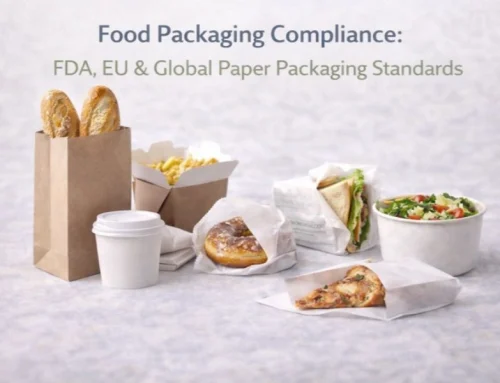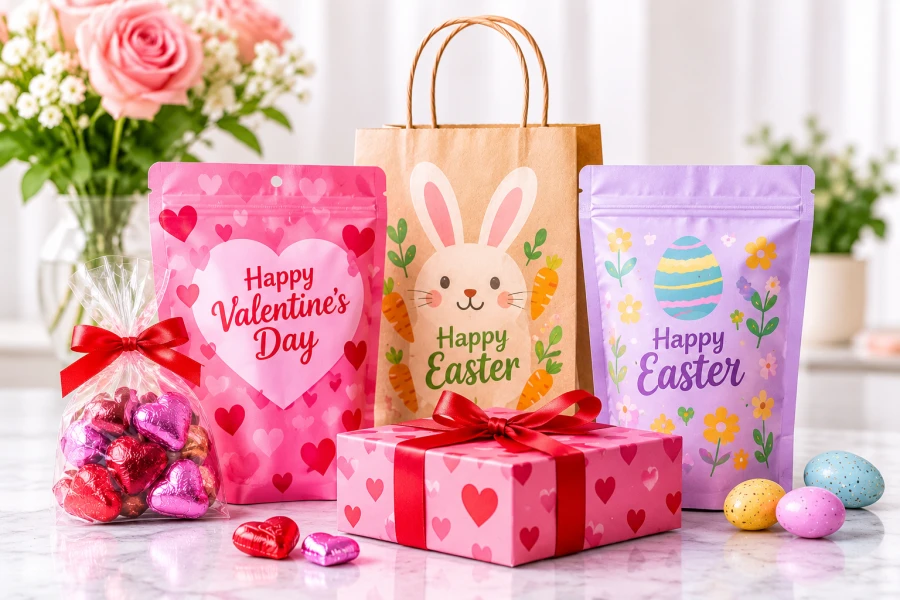
For US food brands sourcing custom packaging for Valentine’s Day (Feb 14, 2027) and Easter (Mar 28, 2027), the critical path is not artwork design—it is navigating the Chinese New Year factory shutdown (Feb 6, 2027) and securing product-specific food-contact compliance. Because the Spring Festival falls just eight days before Valentine’s Day, standard ocean freight for February stock is already closing. Brands must now evaluate expedited production, air freight, or existing stock structures to avoid a holiday stockout.
This guide is built around the four urgent decisions a US buyer faces for 2027 campaigns: the compressed production timeline, format selection, FDA/PFAS compliance documentation, and the RFQ structure that prevents costly delays.
2027 Seasonal Packaging Quick Reference
| Decision | Current starting direction (Late 2026) | What goes wrong without it |
|---|---|---|
| Production & Freight | Valentine’s: Evaluate air freight or expedited production before the Feb 6 Spring Festival. Easter: Book post-holiday production slots immediately. | Factory closures in February mean your Valentine’s stock arrives in March. |
| Artwork & MOQ | Keep the pouch/box structure identical; change only the seasonal print plates/artwork. | Changing box dimensions may require new die/tooling costs and additional sampling time. |
| FDA Compliance | Request a food-contact compliance statement or Letter of Guaranty (LOG) covering the actual structure. | A generic “food-grade” claim or factory ISO certificate is not a substitute for material-level compliance. |
| PFAS State Laws | Confirm the grease-barrier chemistry and request a supply-chain declaration for your specific destination state. | PFAS regulations vary by state; a blanket claim may not satisfy California or Minnesota requirements. |
The 2027 Timeline: Navigating the Spring Festival Bottleneck
The single biggest risk for 2027 seasonal packaging is the Chinese New Year on February 6, 2027. Most Chinese packaging factories shut down for 2–4 weeks around this date. Because Valentine’s Day is February 14, any packaging not already in production by early January will likely require air freight—which can multiply logistics costs.
| Stage | Valentine’s Day (Feb 14, 2027) | Easter (Mar 28, 2027) |
|---|---|---|
| Current Status (Late 2026) | Urgent window. Specifications must be locked immediately. | Planning window. Secure production slots before factories fill up post-holiday. |
| Bulk production | Must be completed before early January 2027. | Schedule for mid-to-late February 2027 (after factory reopening). |
| Shipping method | Ocean freight (risky) vs. Air freight (recommended for late orders). | Standard ocean freight is viable if production finishes in February. |
| Warehouse delivery | Early February 2027. | Early-to-mid March 2027. |
The buying rule: Work backward from the date packaging must be at your co-packer or fulfillment center. For Easter, explicitly ask the supplier to confirm their exact factory reopening date after February 6, as workforce shortages often cause post-holiday backlogs.
Valentine’s and Easter Format Selection
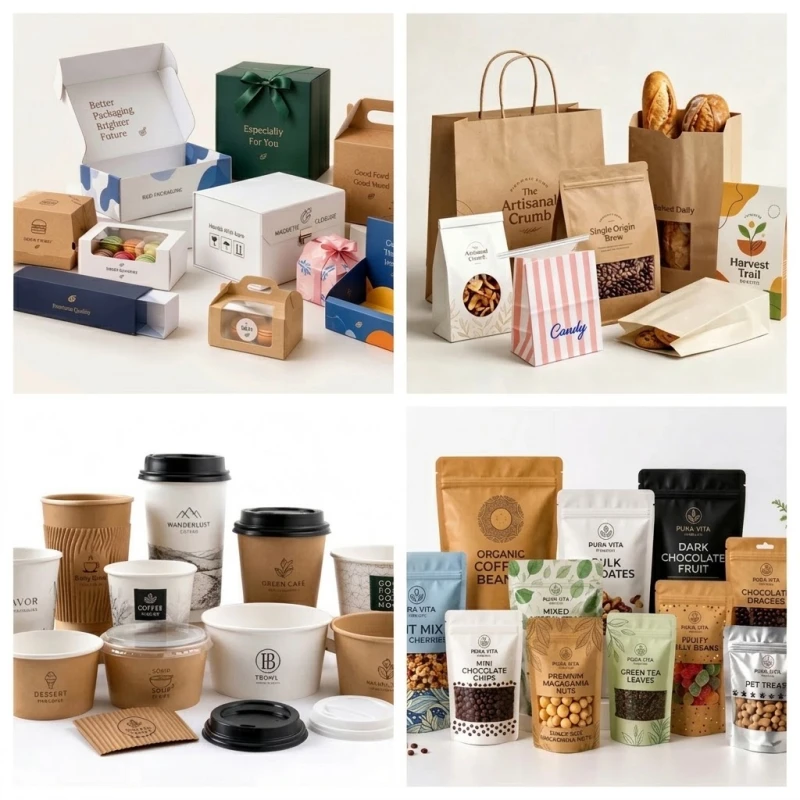
Seasonal packaging should ideally use standard structural dimensions with seasonal artwork, not a new structural design for every holiday. While changing dimensions does not always require new tooling, it may trigger additional die costs and require extra sampling time depending on the supplier’s existing equipment.
Candy & Chocolate: Pouches vs. Boxes
Custom candy bags and boxes are suitable for different confectionery applications.
| Packaging Format | Suitable Products | Specifications to Confirm |
|---|---|---|
| Stand-up pouch | Gummies, hard candy and mixed sweets | Dimensions, barrier structure, zipper and heat seal |
| Flat pouch | Small candy portions and single-serve products | Seal strength, opening method and filling requirements |
| Folding carton | Chocolate bars and candy assortments | Board specification, dimensions and folding structure |
| Window box | Chocolates, cookies and assorted treats | Window material, visibility and structural strength |
| Box with insert | Premium chocolate gifts and delicate products | Insert design, product fit and internal clearance |
For flexible packaging, buyers should consider the product’s sensitivity to moisture, oxygen and aroma loss. A pouch for gummies may require different barrier properties from one used for chocolate.
For chocolate gift boxes, internal dimensions and insert design are important. Individual pieces should fit securely without excessive movement during transportation.
If a brand plans several seasonal designs, using the same pouch dimensions or box structure with different artwork can simplify packaging management.

Bakery Packaging: Grease Resistance and Product Protection
Bakery products have different packaging requirements depending on their oil content, moisture level, shape and intended handling conditions.
| Bakery Product | Possible Packaging Format | Key Requirement |
|---|---|---|
| Cookies | Paper bags or folding cartons | Size, product protection and closure |
| Brownies | Grease-resistant paper bags or cartons | Grease resistance and paper specification |
| Pastries | Bakery paper bags or boxes | Product dimensions and handling |
| Cupcakes | Custom bakery boxes | Insert design and internal clearance |
| Assorted treats | Window boxes or gift cartons | Product arrangement and presentation |
For grease-resistant paper bags, buyers should specify the actual food application rather than relying on the general term “greaseproof.”
The required performance depends on factors such as food oil content, temperature, contact time and the paper structure. A supplier should recommend an appropriate paper grade and provide relevant technical information or test results when available.
A paper bag intended for dry cookies may not be suitable for hot, oily pastries.

FDA Food-Contact Compliance: What US Buyers Should Request
Food packaging intended for the US market must be suitable for its intended food-contact conditions. However, there is no single universal FDA certificate that automatically covers every type of paper bag, flexible pouch, coating, adhesive or printed carton.
The regulatory status depends on the substances used, their applicable authorizations, the packaging construction and the intended conditions of use.
1. Request a Food-Contact Compliance Statement
Buyers should request a written food-contact compliance statement or Letter of Guaranty from the relevant supplier when appropriate.
The document should identify the actual packaging material or structure and clarify its intended food-contact application.
For example, a buyer sourcing grease-resistant paper bags for bakery products should confirm that the paper, grease-resistant treatment, coatings and other relevant components are suitable for the intended contact conditions.
For a flexible pouch, the supplier should consider the complete structure, including the films, inks, adhesives and sealing layers as applicable.
2. Confirm the Applicable FDA Regulations or Authorizations
Depending on the material, relevant requirements may be found in different sections of FDA regulations or other applicable food-contact authorizations.
For example:
- 21 CFR Part 176 covers indirect food additives used in paper and paperboard components.
- 21 CFR Part 177 covers indirect food additives used in polymers.
- Other applicable provisions may cover specific additives, coatings or components.
These are examples, not a universal checklist for every package.
The supplier should identify the regulatory basis relevant to the actual material formulation and intended conditions of use.
3. Ask for Supporting Material Information
Depending on the product, useful supporting information may include:
- Material composition or structure.
- Relevant food-contact compliance statements.
- Applicable regulatory references or authorization information.
- Coating or liner specifications.
- Relevant test reports, where appropriate.
- Intended food types and conditions of use.
A general statement such as “food grade” is not enough to evaluate every food-contact application.
Important: A factory quality-management certificate, such as ISO 9001, is not a substitute for documentation demonstrating the suitability of a specific food-contact material.
PFAS Requirements for US Food Packaging
PFAS is an important consideration when sourcing grease-resistant paper bags, food wrappers and other paper-based food packaging for the US market.
However, buyers should distinguish between FDA food-contact requirements and state-level restrictions. Their scope and legal requirements are not identical.
What the FDA Has Said About PFAS in Paper Food Packaging
The FDA announced in February 2024 that PFAS-containing grease-proofing substances were no longer being sold by manufacturers for food-contact use in the US market. In January 2025, the FDA also determined that 35 related food-contact notifications for PFAS-containing grease-proofing substances used on paper and paperboard food packaging were no longer effective.
These actions relate specifically to PFAS-containing grease-proofing substances used in paper and paperboard food packaging. They should not be misinterpreted as a statement that every possible PFAS use in every food-contact material has the same regulatory status.
State-Level PFAS Requirements Also Matter
Some US states have additional restrictions covering food packaging. For example, California AB 1200 addresses PFAS in plant-fiber-based food packaging. Minnesota law prohibits food packages containing intentionally added PFAS. The scope and requirements differ between state laws, so buyers should identify the states where their products will be sold or distributed.
For paper-based food packaging, buyers should ask suppliers to clarify:
- Whether PFAS are intentionally added to the paper or grease-resistant treatment.
- Whether the coating or barrier system contains intentionally added PFAS.
- Whether a supplier declaration is available.
- Whether relevant test results are available for the intended application.
- Whether the documentation addresses the requirements of the destination state.
A PFAS-free claim should be supported by an appropriately defined supplier declaration or test evidence. Buyers should clarify what the claim covers and whether it refers to intentionally added PFAS, a defined group of substances or a particular analytical method.
Do not assume that one general statement automatically satisfies every state’s requirements.
Reducing Inventory Risk: Artwork Standardization & MOQ
Seasonal inventory risk is mitigated by ordering standard structures that can be reused, rather than over-ordering highly specific designs.
- Keep the structure consistent: Use the same pouch dimensions and zipper across Valentine’s Day, Easter, and Halloween to reuse existing tooling.
- Confirm MOQ per design: A supplier’s “1,000 pcs MOQ” usually means 1,000 per print design. If you have 4 Valentine’s designs, you may be ordering 4,000 units total.
- Consider printed sleeves: For folding cartons, a standard box with a printed seasonal sleeve is a lower-risk, lower-MOQ alternative to a fully printed seasonal box.
The Seasonal Packaging RFQ Checklist
A seasonal RFQ must explicitly separate the “seasonal” elements (artwork, delivery date) from the “permanent” elements (structure, compliance).
| RFQ field | What to specify | Why it matters |
|---|---|---|
| Product type | Gummies, chocolate, cookies, brownies | Determines barrier and grease resistance requirements |
| Target use date | “Must be at co-packer by Jan 25, 2027” | Forces the supplier to quote against the Feb 6 Spring Festival deadline |
| Packaging format & dimensions | Stand-up pouch (W×H+Gusset), carton (L×W×H) | Prevents structural re-quoting |
| Material & barrier | OTR/WVTR requirements, grease resistance needs | Ensures product shelf life |
| Food-contact compliance | Request FDA LOG and state-specific PFAS declaration | Avoids customs holds and retail compliance failures |
| Quantity per design | Total quantity, plus the number of seasonal designs | Prevents MOQ surprises and artwork plate costs |
| Delivery destination | City, State, ZIP | Determines freight and applicable state PFAS laws |
Choosing a US-Ready Packaging Manufacturer
A manufacturer experienced in seasonal US orders will ask for your food-contact requirements and delivery deadline before asking about the artwork. When evaluating a Chinese supplier for 2027 seasonal packaging, verify:
- Can they produce and ship around the Feb 6, 2027 Spring Festival? Confirm their exact production cutoff and post-holiday reopening date.
- Can they provide a food-contact Letter of Guaranty for the exact structure? Verify that the applicable FDA regulations are identified for your specific materials.
- Do they understand grease resistance testing? A supplier who asks about your specific food product (fat content, contact time) is more reliable than one who quotes a fixed KIT number.
- Can they quote MOQ per print design? This prevents you from over-ordering a single Valentine’s design.
At RBD Packaging, custom seasonal orders are quoted with production timelines adjusted for the Spring Festival, and MOQ separated by design. We can review your product specifications, recommend suitable structures, and provide the available material specifications to support your compliance assessment.
Frequently Asked Questions
When should US brands order Valentine’s Day 2027 packaging?
Immediately. To avoid the Chinese Spring Festival closure (Feb 6, 2027) and standard 30–45 day ocean freight, production must be finished by early January 2027. Late orders will likely require expedited production or air freight to meet the February 14 deadline.
What is the difference between Valentine’s and Easter packaging timelines?
Valentine’s Day requires shipping before the Spring Festival; Easter requires booking a production slot immediately after the Spring Festival backlog. Easter packaging ordered in January may face workforce shortages and delays as factories return from the holiday.
Do seasonal candy bags need FDA compliance documents?
Yes, buyers should request a food-contact compliance statement or Letter of Guaranty (LOG). The statement should confirm that the specific materials (paper, coating, inks, liner) are suitable for the intended food-contact use under applicable FDA regulations.
How do I avoid wasting money on seasonal packaging MOQ?
Standardize the packaging structure and change only the artwork. Limit the number of seasonal designs to avoid multiplying the MOQ. For paper boxes, consider using a standard box with a printed seasonal sleeve instead of a fully customized seasonal box.
Can I use the same packaging structure for Valentine’s and Easter?
Yes, if the product dimensions, barrier requirements, and filling method remain the same. Keeping the structure identical across holidays allows you to reuse existing cutting dies or pouch-making tools, saving on tooling fees and sampling time.