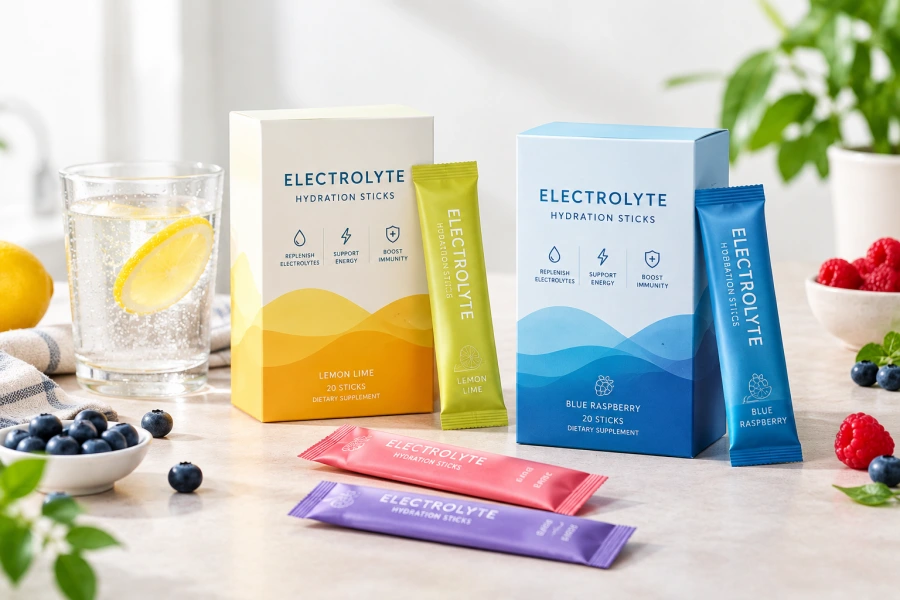
Custom electrolyte stick pack boxes are custom paperboard cartons designed to hold, organize, protect and display multiple single-serve electrolyte powder stick packs. As electrolyte powders shift from niche sports nutrition products to everyday wellness staples, these outer cartons serve as the primary retail branding surface for supplement and sports nutrition brands.
This guide covers everything brands need to specify, design, and order custom electrolyte stick pack boxes, including box styles, size calculation, paperboard selection, moisture barrier responsibilities, printing requirements, and common sourcing mistakes to avoid.
Core decisions for sourcing electrolyte stick pack boxes:
- Box capacity and stick count configuration matched to your price point
- Carton structure aligned with your sales channel (retail, DTC, dispenser)
- Size calculated from actual filled stick-pack dimensions, not empty flat film
- Paperboard grade matched to product weight, packing method and shipping conditions
- Coordinated design between primary stick pack and secondary carton
What Are Electrolyte Stick Pack Boxes?
An electrolyte stick pack box is a secondary paperboard package designed to hold, organize, and display multiple individual electrolyte powder stick packs.
The stick pack itself is the primary package that directly contains the powder. It is typically responsible for protecting the product from moisture and maintaining seal integrity. The outer carton provides secondary protection and retail functionality.
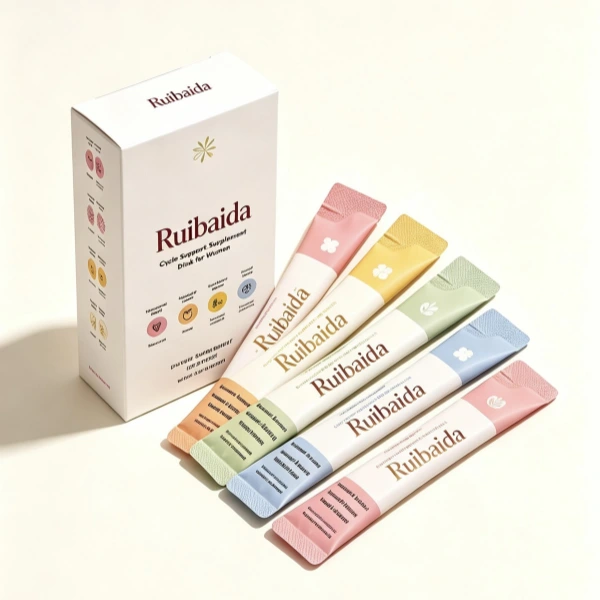
Core functions of the outer paperboard carton:
- Organized multi-pack presentation for retail shelves
- Brand and product information display
- Physical protection during storage and shipping
- Finished point-of-sale presentation
- Easier handling and consumer dispensing
- Dedicated space for regulatory and nutrition information
This distinction is critical when selecting packaging materials. The carton should not be treated as a replacement for the barrier properties of the individual stick pack. For most brands, the box and stick pack should be designed as one coordinated packaging system.
Electrolyte Stick Pack Box Capacity: How Many Sticks Per Box?
There is no single standard box count for electrolyte products. The right quantity depends on the serving format, target price point, sales channel, and how often customers are expected to use the product.
| Sticks Per Box | Typical Application |
|---|---|
| 10 sticks | Trial packs, sample sets, and smaller retail formats |
| 15 sticks | Compact retail or introductory starter packs |
| 20 sticks | Standard retail multi-pack format (most common) |
| 30 sticks | Regular-use or monthly-oriented product packs |
| 60 sticks | Value packs and larger-format bulk products |
The final carton size should never be selected from stick count alone. For example, two brands may both sell 20 sticks per box but require different carton dimensions because their stick packs have different lengths, widths, and filled thicknesses. Always finalize actual stick-pack dimensions before designing carton dimensions.
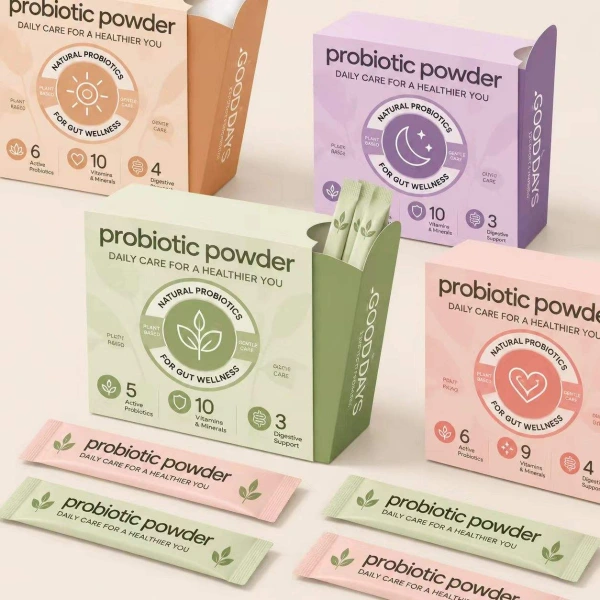
Box Styles for Electrolyte Stick Packs: Which Structure to Choose?
Different carton structures deliver different benefits for electrolyte products. The best choice depends on the number of sticks, packing method (manual or automated), retail environment, and desired brand appearance.
| Box Style | Best For | Key Benefits | Ideal Sales Channel |
|---|---|---|---|
| Tuck-End Carton | Standard retail multi-packs with moderate stick counts | Cost-effective, versatile, conventional retail appearance, works with manual or automated packing | Grocery retail, DTC e-commerce |
| Auto-Lock Bottom Box | Higher stick counts, heavier cartons, faster packing lines | Stronger base structure, faster assembly, more secure bottom closure | High-volume retail, fulfillment centers |
| Sleeve Box | Premium hydration lines, gift-oriented packaging | Minimalist premium presentation, clean branding surface | Gift sets, premium wellness brands |
| Dispenser Box | Daily single-serve use, office and gym placement | Easy individual stick removal, one-at-a-time dispensing | Office pantries, gyms, countertop displays |
| Display Carton | In-store shelf placement and endcap displays | Combined storage and shelf presentation, high brand visibility | Retail endcaps, checkout counters |
Key design notes:
- Dispenser boxes: The opening should be tested with actual filled stick-pack dimensions to ensure individual sachets remove smoothly without remaining sticks falling out.
- Sleeve boxes: May require an additional inner tray or divider structure to organize stick packs and prevent shifting.
How to Size Electrolyte Stick Pack Boxes: Calculation Guide
One of the most common sourcing mistakes is choosing carton size based only on the number of sticks. Finished box dimensions must be calculated from actual stick-pack dimensions and arrangement inside the carton.

Basic sizing formula
Stick-pack dimensions + quantity + arrangement + required clearance = finished carton dimensions
To calculate accurate dimensions, a supplier will need:
- Stick-pack length
- Stick-pack width
- Approximate filled thickness
- Number of sticks per box
- How the sticks will be arranged (rows × columns)
- Whether sticks will stand vertically or lie horizontally
- Whether an insert or divider is required
- Whether the box needs a dispenser opening
Standard clearance tolerance
Add 1.5–2.0 mm of internal clearance per dimension above the filled sachet stack to prevent carton bulging and seam splits. For automated packing lines, tighten tolerance to ±0.5 mm for consistent machine feeding.
Why Filled Stick-Pack Thickness Affects Carton Fit
A stick pack may look very thin when empty, but the filled package forms a rounded, pillow-like profile with measurable thickness. Designing based on empty flat film will always result in an undersized box.
If the box is too tight:
- Sticks are difficult to insert during packing
- Carton side walls bulge outward
- Closing flaps do not align correctly
- Automated packing efficiency drops by 30% or more
If the box is too large:
- Sticks shift excessively inside during shipping
- Package appears underfilled to consumers
- Unnecessary paperboard increases material cost
- Shipping density and efficiency decrease
The best approach is to finalize the stick pack first, then test actual filled packs inside a carton sample before locking in production specifications.
Paperboard for Electrolyte Stick Pack Boxes: Grades & Selection
Electrolyte cartons are generally made from folding carton paperboard selected for stiffness, printability, surface appearance, and handling requirements.
Common paperboard options
| Board Type | Best For | Key Characteristics |
|---|---|---|
| SBS / Folding Boxboard | Premium retail presentation, high-quality printing | Smooth coated surface, excellent color reproduction, clean crisp finish |
| Natural Kraft Paperboard | Natural, wellness, or sustainable branding | Uncoated natural finish, strong tear resistance, earth-conscious aesthetic |
| Recycled Paperboard (CCNB) | Brands with sustainability commitments | FSC-certified options available, post-consumer recycled content |
Recommended GSM ranges by application
- 10–20 stick standard retail boxes: 300–350 GSM (16–18pt) SBS paperboard
- 30+ stick or shipping-heavy boxes: 320–380 GSM (18–22pt) natural unbleached kraftboard
- Dispenser and display cartons: 350 GSM minimum for structural rigidity
The final choice should depend on carton size, total stick count, product weight, packing method, shipping conditions, desired appearance, and printing requirements. For many retail electrolyte products, board stiffness and carton construction are just as important as the paper grade itself.
Moisture Protection for Electrolyte Stick Pack Boxes
This is one of the most important distinctions in electrolyte packaging design.
The individual stick pack provides the primary moisture barrier for the powder. The outer paperboard carton primarily provides secondary physical protection, organization, branding, and retail presentation.
Electrolyte powders are sensitive to ambient humidity because moisture exposure affects powder flow properties and can cause clumping. However, brands should not rely on a standard paperboard carton alone to protect the powder from moisture.
Two-layer packaging system
| Packaging Layer | Primary Function |
|---|---|
| Primary: Stick pack / sachet | Powder containment, moisture barrier, seal integrity |
| Secondary: Paperboard carton | Organization, branding, physical protection, retail presentation |
If your product has specific moisture, oxygen, or light sensitivity requirements, address those when selecting the stick-pack film structure and barrier layers, rather than simply making the outer carton thicker.
Printing & Labeling Requirements for Electrolyte Cartons
The outer carton often provides significantly more printable space than an individual stick pack, making it the primary branding and information surface.
Depending on the product and target market, the carton may include:
- Brand name and product name
- Flavor variant identification
- Number of servings and net weight
- Supplement Facts panel or applicable nutrition information
- Ingredients list
- Directions for use
- Warnings and precautions
- Storage instructions
- UPC/EAN barcode with quiet zone clearance
- Lot or batch information imprint area
- Best-by or expiration date stamp zone
- QR code for digital engagement
- Company and contact information
Leave sufficient blank space for variable information such as lot numbers and dates if these will be added post-printing. For products entering regulated markets, have final artwork and required labeling reviewed for compliance with destination market regulations (FDA 21 CFR, EU 10/2011, etc.) before mass production.
Finishing & Branding Options for Electrolyte Stick Pack Boxes
The carton is often the main branding surface consumers see before opening the package. For electrolyte brands, printing and finishing choices communicate flavor, formula positioning, brand identity, product benefits, and price tier.
Common finishing options
- CMYK process printing
- Pantone spot color matching
- Matte coating
- Gloss coating
- Soft-touch finishes
- Spot UV accents
- Foil stamping
- Embossing / debossing
More finishing does not necessarily mean better packaging. For high-volume retail products, the most effective approach prioritizes strong shelf visibility, clear product information, consistent brand colors, and efficient production cost. A clean carton with strong typography often outperforms an over-designed package with excessive finishing.
How to Source Custom Electrolyte Stick Pack Boxes Step by Step
Before requesting a quotation, prepare as much of the following information as possible. The more complete your specifications, the faster and more accurate your quote will be.
1. Stick-Pack Dimensions
Provide exact measurements:
- Length
- Width
- Filled thickness
If the stick pack has not been produced yet, provide target powder weight and filling format so the packaging supplier can help coordinate both structures.
2. Quantity per Box
Specify how many sticks per box: 10, 15, 20, 30, 60, or a custom quantity.
3. Box Structure
Tell the supplier your preferred style: tuck-end carton, auto-lock bottom, sleeve box, dispenser box, or display carton. If you are unsure, describe your intended sales channel and let the supplier recommend a suitable structure.
4. Printing Requirements
Provide:
– Artwork files (if available)
– Number of print colors
– Brand color specifications (Pantone values)
– Desired finish (matte, gloss, soft-touch)
– Any special effects required (spot UV, foil, embossing)
5. Order Quantity
Your total required quantity and number of SKUs affects the most economical production approach. For new products, always request a physical sample before approving mass production.
What to Provide Suppliers for an Electrolyte Box Quote
For a faster and more accurate quotation, send these specifications:
- Product: Electrolyte powder stick packs
- Stick pack size: Length × Width × Filled Thickness
- Stick count: e.g., 20 sticks per box
- Box style: Tuck-end / Auto-lock / Dispenser / Sleeve / Display
- Paperboard: Grade and GSM (if known)
- Printing: CMYK / Pantone colors
- Finish: Matte / Gloss / Soft-touch / Special finish
- Quantity: Total boxes and number of SKUs
- Target market: USA / Canada / UK / EU / Australia / Other
- Sample required: Yes / No
If you do not know the ideal box dimensions or structure yet, that is not a problem. An experienced packaging manufacturer can recommend the optimal carton structure based on your actual stick-pack dimensions and packing requirements.
Frequently Asked Questions About Electrolyte Stick Pack Boxes
What paperboard is used for electrolyte stick pack boxes?
Folding carton paperboard grades such as SBS, kraft-based board, or recycled paperboard are standard. Recommended ranges are 300–350 GSM for standard 10–20 stick retail boxes, and 320–380 GSM for larger or heavier packs. The appropriate grade depends on carton size, stiffness requirements, printing needs, packing method, and shipping conditions.
Can electrolyte stick pack boxes be custom printed?
Yes. Custom cartons can be printed with brand graphics, product information, regulatory content, barcodes, QR codes, and full artwork. Options include CMYK process printing, Pantone spot colors, and various coatings and specialty finishes.
Can electrolyte boxes have a dispenser opening?
Yes. Dispenser-style cartons are designed for products where consumers remove one stick at a time. The opening should be tested using actual filled stick-pack dimensions before production to ensure smooth single-serve dispensing.
Is the box enough to protect electrolyte powder from moisture?
Generally, no. The individual stick pack should provide the primary moisture barrier. The outer carton mainly provides secondary physical protection, organization, branding, and retail presentation. Address moisture sensitivity at the primary packaging level.
What is the MOQ for custom electrolyte stick pack boxes?
Factory MOQs typically start at 1,000–5,000 units for digital printing runs, and 10,000+ units for high-volume flexo or offset production. Exact minimums depend on box structure, paperboard grade, and number of print colors.
What is the difference between a sachet box and a stick pack box?
The terms are sometimes used interchangeably, but they refer to different primary package formats. A stick pack is typically a narrow, elongated single-serve sachet. A stick pack box is a paperboard carton specifically dimensioned to hold multiple stick packs arranged in rows.
Custom Electrolyte Stick Pack Boxes From RBD Packaging
RBD Packaging provides custom printed stick pack and retail carton solutions for electrolyte powders, protein supplements, sports nutrition products, and other powdered supplements. We support full customization of box structure, paperboard grade, printing, and finishing, with both low-volume digital runs and high-volume flexo production available.
We can also coordinate both stick pack and outer carton production with a single point of contact, streamlining your specification, sampling, and production process.
To get a tailored quotation for your custom electrolyte stick pack boxes, send us your stick-pack dimensions, sticks per box, artwork files, estimated order quantity, and target market. Our team will evaluate your requirements and recommend the optimal packaging structure for your product.