Choosing the right pretzel paper bag can make a real difference in how your product looks and feels when served. The bag needs to fit your pretzels, handle grease from butter or toppings, and showcase your brand. This guide explains how to choose pretzel paper bags by size, paper performance, bag style, and printing requirements. It also covers the specifications buyers should prepare when requesting a custom packaging quote.
Key Takeaways:
- The right pretzel bag size depends on the largest dimension of the finished product at serving temperature — not on a universal standard.
- Grease resistance is determined by the paper’s barrier treatment and Kit rating, not by paper weight alone.
- Double-open bags speed up counter service; flat bags suit simple single-portion packaging.
- Custom printing, wholesale pricing, and MOQs vary by order quantity and print method. Prepare a complete specification before requesting a quote.
Pretzel Bag Sizes: How to Measure and Choose
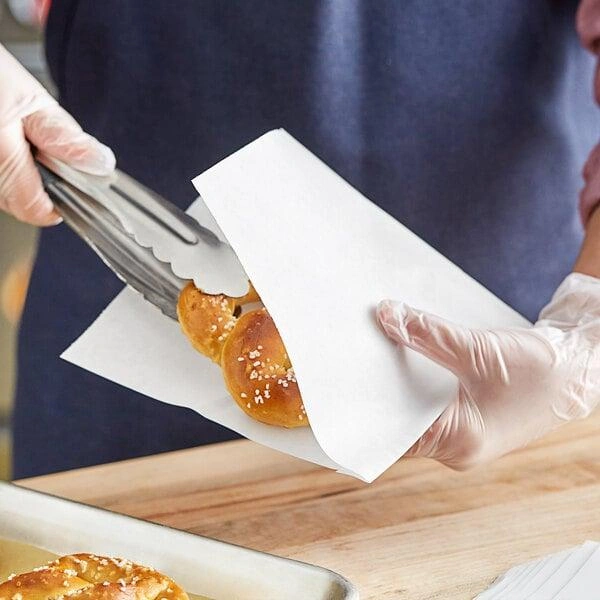
The right pretzel bag size depends on the largest dimension of the finished product at serving temperature, not on a universal “standard” size. Measure the widest point of the pretzel, the total length, and the thickness including toppings, then test with a physical sample before ordering. Market listings show sizes from roughly 5.9″ × 5.9″ to 7″ × 7″ and beyond, often with double-open or flat construction, but these specs describe what exists, not what fits your product.
Start with four measurements:
- Maximum width of the pretzel, especially the widest point of a twisted or knotted shape.
- Maximum length and thickness, including any salt, butter or topping that adds bulk.
- Opening width required for the pretzel to slide in without forcing. For double-open bags, the entry side is usually the limiting dimension, not the total bag length.
- Bagging direction: whether staff will insert the pretzel horizontally, vertically, or through a side opening. This determines which dimension is most critical.
Test at serving temperature. A soft pretzel straight out of the oven can be wider, softer and more pliable than a cooled sample. If the product carries coarse salt or melted butter, include that surface condition in the trial.
How to Choose Grease-Resistant Paper for Pretzels
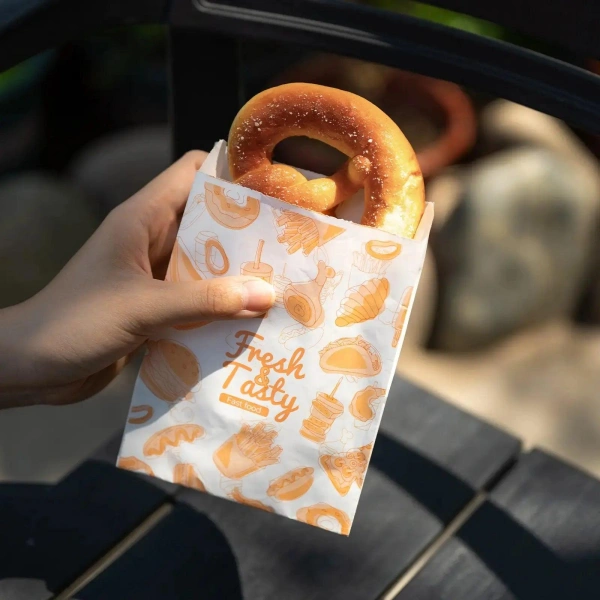
The right grease-resistant paper for pretzel bags depends on the product’s oil content, serving temperature, and contact time. Paper weight alone does not determine grease resistance. A heavier sheet can still allow oil to wick through if the fiber structure is porous and no barrier treatment is present.
Three material families appear most often in food-service paper bags:
| Material Type | How It Works | Typical Pretzel Fit |
|---|---|---|
| Glassine / dense greaseproof | Fibers are super-calendered until pores close; naturally grease-resistant without coating | Best for high-fat, hot pretzels where no plastic layer is acceptable |
| Mechanically greaseproof | Heavy pulp refining creates a dense sheet; less transparent than glassine, more economical | Mid-range option for buttered or oil-brushed pretzels |
| Coated paper (aqueous, bio-based, PE) | A barrier coating is applied over a kraft or MG base sheet | Highest control over Kit rating; coating type affects recyclability |
The single most useful procurement spec is the Kit rating under TAPPI T 559. Kit values run from 1 to 12, with higher numbers indicating greater resistance to aggressive oils. For light snacks, a Kit rating of 4 to 6 is typically sufficient; medium-grease foods call for Kit 7 to 9; heavy fried or oil-saturated products require Kit 10 to 12. A supplier that advertises “grease resistant” without a Kit rating is making a claim without a standardized threshold behind it. For food-contact compliance in the U.S., verify that the paper and coating meet FDA 21 CFR 176.170 requirements for aqueous and fatty foods.
For pretzels specifically, the practical question is not simply the Kit number but the combination of:
- Serving temperature: A hot soft pretzel releases oil and steam simultaneously, which stresses seams and folds.
- Fat load and contact time: A light brush of butter behaves differently from a pretzel that has been dipped or sprayed.
- Moisture: Steam softens paper and can accelerate oil migration at folds and seams.
Why increasing paper weight alone often fails: A 50 g/m² sheet with no barrier treatment can still show oil staining within minutes under a hot, buttered pretzel. Increasing basis weight adds structural strength but does not close the fiber pores that allow oil to travel. If oil staining is the problem, the fix is a barrier — not more paper.
| Use Case | What to Check When Buying |
|---|---|
| Dry hard pretzels, low oil | Paper strength, size fit, print surface |
| Freshly baked soft pretzels | Heat contact, steam behavior, seam integrity |
| Butter-brushed or oil-sprayed pretzels | Kit rating, contact time, outside staining |
| Pretzels held for takeaway or delivery | Real-product bagging test, breathability, transport conditions |
Supplier verification checklist: Before approving a grease-resistant bag, request: (1) the Kit rating of the specific paper grade, not the product family; (2) confirmation of coating chemistry if PFAS-free or fluorine-free claims matter to your market; (3) a sample for real-product testing at your serving temperature; and (4) a technical data sheet that identifies basis weight, coating type, and recommended use conditions.
Open-Side vs. Flat Pretzel Bags
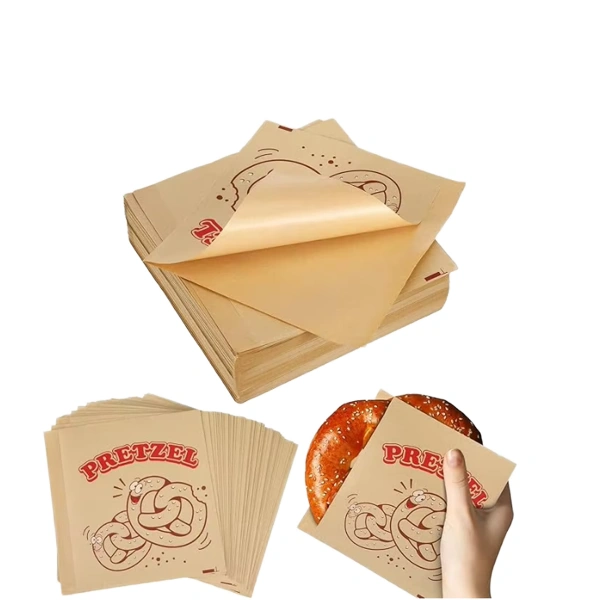
Two bag structures cover most pretzel-service scenarios: double-open / open-side bags and flat paper bags. Double-open bags allow faster insertion and easier customer access, while flat bags suit simple single-portion service. The decision should be driven by your actual counter motion, not by a generic “best bag type” recommendation.
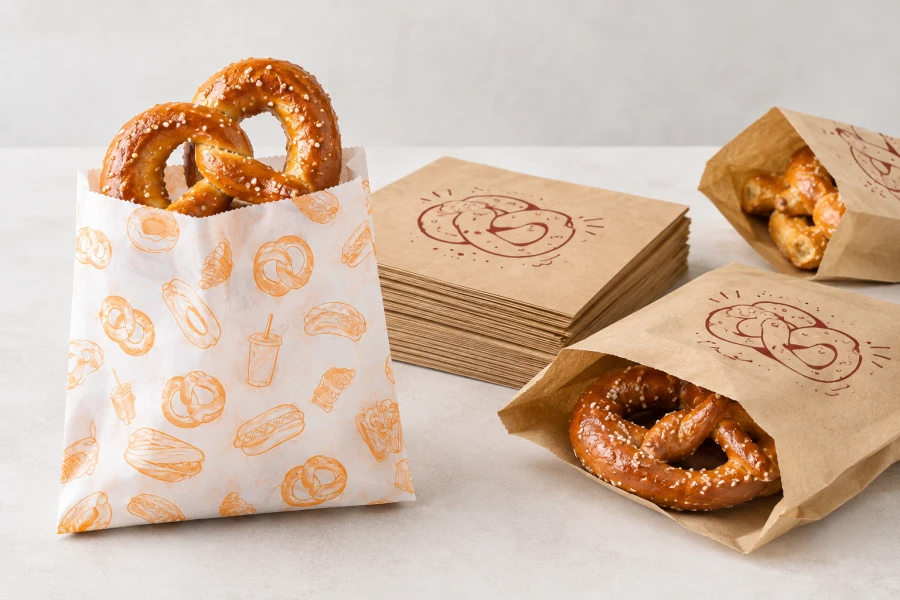
Double-open / open-side bags have openings on two opposite sides. This design lets staff slide a pretzel in from either direction and lets the customer access the product without tearing the bag open. The format is common for soft pretzels, sandwiches, and other flat or moderately thick items served on the go. Key verification points: opening height relative to your widest pretzel, whether the bag stays closed during handoff, and whether the paper holds its shape when the product is warm.
Flat paper bags have a single opening at the top and a sealed bottom. They suit single-portion service where the product is not wide enough to require a side-loading motion. For pretzels, the critical check is whether the top opening is wide enough to accept the widest part of the product without crushing it — a bag that measures 7″ × 7″ flat may have an effective opening of only 6″ or less once the paper is held open.
Neither structure is universally better. A high-volume pretzel counter with a queue benefits from the faster insertion of a double-open bag. A bakery selling pre-wrapped pretzels for retail display may find a flat bag easier to seal or label.
Can Pretzel Paper Bags Be Custom Printed?
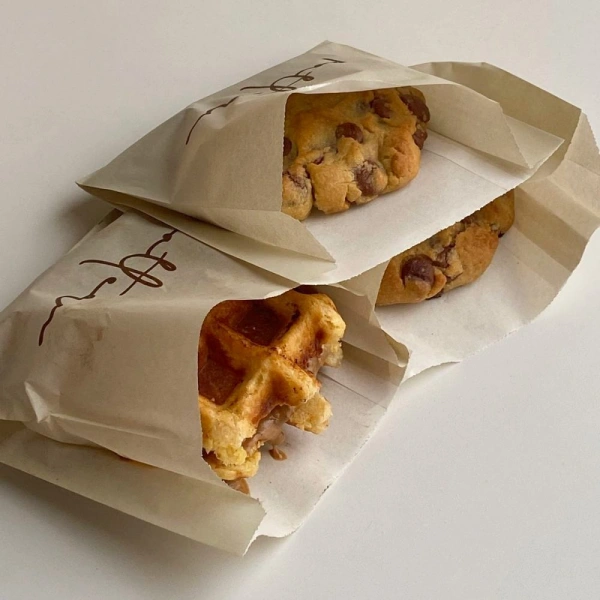
Yes. Custom-printed paper bags can help pretzel shops, bakeries, food-service chains, and snack brands create consistent packaging across locations.
Depending on the bag structure and printing method, customization may include a brand logo, colors, product name, promotional artwork, or other suitable packaging information.
Before finalizing the design, consider the following points.
Artwork and print area
Provide a high-resolution logo or vector artwork when available. Ask the supplier to confirm the printable area and how the design will align with the finished bag.
A design that looks balanced on a flat artwork file may appear different after the bag is folded or assembled. Check the artwork proof carefully, especially around folds, seams, and openings.
Paper color and print appearance
The natural color and surface of the paper can affect the appearance of printed colors. For example, artwork printed on kraft paper may look different from the same artwork printed on white paper.
If exact brand colors are important, request a print proof or sample and confirm the acceptable color variation before production.
Food-contact requirements
Packaging intended for direct food contact must use materials and printing arrangements suitable for the intended application and destination market.
Discuss food-contact requirements with your supplier, including whether the printed area could come into contact with the food. Do not assume that every ink, coating, or paper grade is suitable for every food application.
What Affects the Cost of Custom Pretzel Paper Bags?
The cost of a custom pretzel bag depends on more than the size of the bag. The material, construction, printing requirements, and order quantity can all affect the final quotation.
The main factors to review are:
- Bag dimensions: Larger bags generally require more paper.
- Paper specification: Paper grade, weight, and any grease-resistant treatment affect material selection and cost.
- Printing requirements: Artwork complexity, the number of colors, print coverage, and setup requirements may affect production costs.
- Bag construction: Different opening styles or structural features may require different production processes.
- Order quantity: Setup costs and material purchasing can affect the unit price at different order volumes.
- Shipping requirements: Destination, shipment method, carton dimensions, and order volume can affect the delivered cost.
When comparing quotations, make sure the suppliers are pricing the same specifications. A lower unit price may reflect a different paper grade, bag dimension, printing scope, or order quantity.
For a meaningful comparison, request a quotation based on the same bag size, material requirements, artwork, quantity, and delivery destination.
What Should You Send a Manufacturer for a Quote?
Providing clear specifications helps a manufacturer assess your requirements and reduces unnecessary back-and-forth during quotation and sampling.
For a custom pretzel paper bag project, prepare the following information:
| Specification | What to provide |
|---|---|
| Product type | Soft pretzels, hard pretzels, pretzel sticks, or another product |
| Product dimensions | Maximum width, length, and thickness |
| Bag style | Preferred structure or a reference photo |
| Food conditions | Warm or cold serving, butter, oil, or other toppings |
| Paper requirements | Preferred paper type or required grease-resistance performance |
| Printing | Logo artwork, colors, and preferred print placement |
| Order quantity | Estimated quantity per order and expected repeat orders |
| Destination | Country or market where the bags will be used |
If you are unsure about the ideal size or paper specification, provide a product photo and physical measurements first. A supplier can then review the application and advise which options should be sampled.
Before approving bulk production, confirm the final dimensions, artwork, material specification, and sample performance in writing.
Frequently Asked Questions
What size paper bag is best for a soft pretzel?
The right size depends on the pretzel’s maximum width, length, thickness, and the way it is inserted into the bag. Measure the finished product and test the proposed bag with a representative sample before ordering in bulk.
Can paper bags prevent grease from buttered pretzels?
Suitable grease-resistant paper can help reduce oil penetration, but performance depends on the paper specification, the amount of grease, temperature, and contact time. Test the bag with your actual product rather than relying on paper weight alone.
Are kraft paper bags suitable for pretzels?
Kraft paper bags can be suitable for some pretzel applications, particularly when strength and a natural appearance are priorities. For buttered or oily products, confirm that the selected paper has the required grease resistance.
Can I order custom-printed pretzel bags in bulk?
Custom printing may be available depending on the supplier’s production capabilities, bag structure, and order requirements. Provide your artwork, dimensions, preferred paper, and estimated quantity to request a quotation.
What should I test before approving a bulk order?
Check bag dimensions, opening size, ease of filling, grease resistance, handling strength, and print appearance. For warm or buttered pretzels, test the bag under normal serving conditions for the expected contact period.
Request Custom Pretzel Paper Bag Packaging
Choosing the right pretzel paper bag starts with understanding your product, serving conditions, and packaging requirements. The right combination of bag dimensions, paper performance, and printing can help improve serving efficiency and maintain a consistent brand presentation.
RBD Packaging works with businesses looking for customized paper packaging solutions. To discuss your pretzel bag requirements, share your product dimensions, preferred bag style, grease-resistance needs, artwork, estimated order quantity, and destination market.
Explore our greaseproof paper bags to learn more about customized paper packaging options, or contact RBD Packaging to discuss your project.