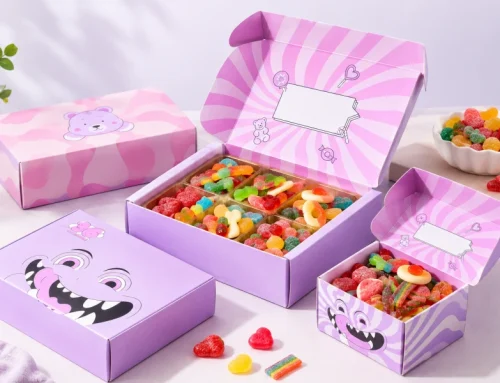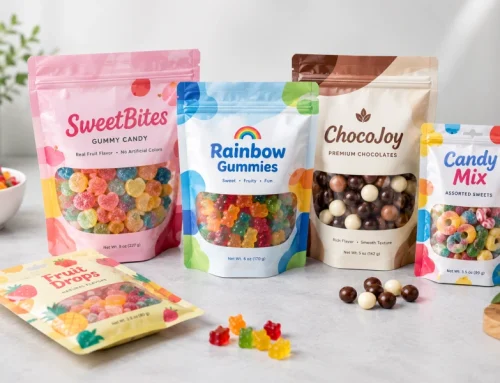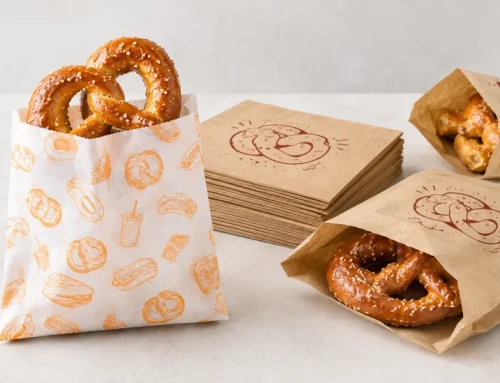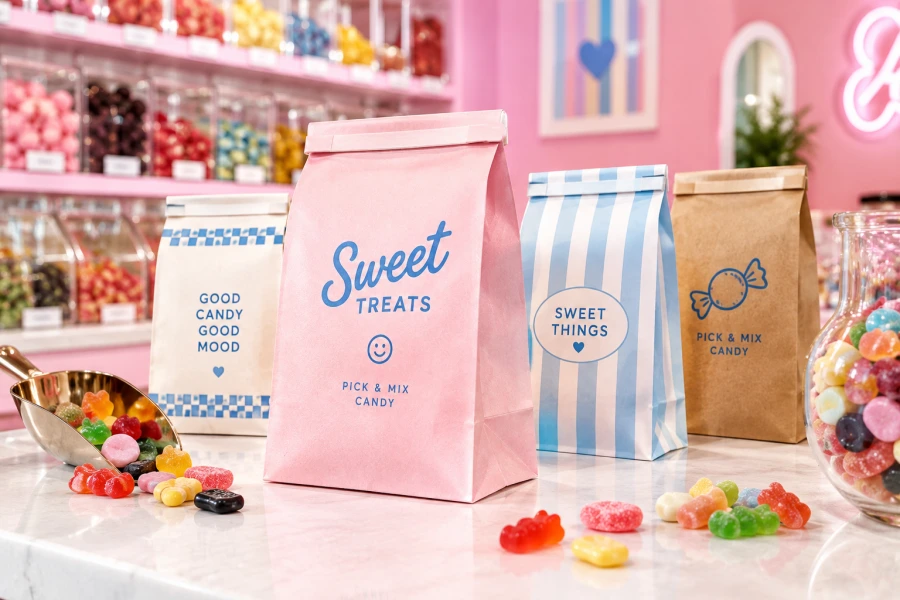
Pick-and-mix candy shops need packaging that is easy to fill, convenient to carry, and recognizable enough to become part of the customer experience. For stores selling Swedish candy, gummies, sour sweets, chocolates, and mixed confectionery, tin tie bags offer a practical paper packaging option with a built-in fold-over closure and room for custom branding.
The right bag depends on more than appearance. Retailers and candy brands should consider bag dimensions, gusset style, paper grade, inner lining, closure performance, printing, and order quantity before choosing a supplier.
This guide explains how to select custom tin tie bags for pick-and-mix candy shops, what brands can learn from the visual success of BonBon, and which specifications to confirm before placing a wholesale order.
Why Tin Tie Bags Work for Pick-and-Mix Candy Shops
Tin tie bags are paper bags with a flexible closure strip near the opening. Customers fold the top of the bag down and press it around the integrated tie to close it again after opening.
For candy retailers, this structure offers several practical advantages.
- Convenient closing: Customers can reopen and close the bag without needing a separate clip.
- Retail-friendly presentation: Paper surfaces provide space for logos, colors, illustrations, and product information.
- Flexible sizing: Bags can be developed for individual purchases, larger candy selections, or gift-oriented packaging.
- Custom branding: Printed designs help stores create a consistent look across in-store purchases, takeaway orders, and seasonal promotions.
- Multiple material options: Depending on the candy and intended use, buyers can discuss kraft paper, white paper, and suitable inner linings with their packaging manufacturer.
Tin tie bags are particularly worth considering when customers may not finish all the candy in one sitting. However, a tin tie closure is not an airtight or hermetic seal. If the product requires a specific moisture, oxygen, or aroma barrier, the complete bag structure must be evaluated separately.
What Makes BonBon’s Candy Packaging Stand Out?
BonBon, the New York-based Swedish candy brand, became widely recognized for its pick-and-mix candy experience. Its brand story describes the growth of its stores and the viral attention its Swedish candy received on TikTok in 2024.
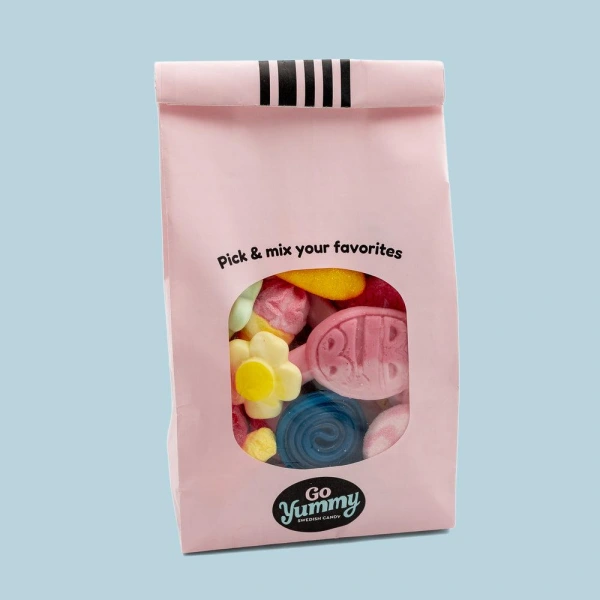
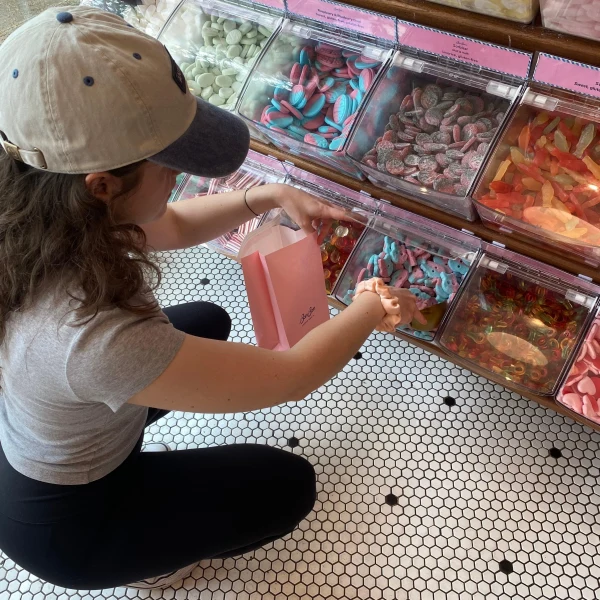
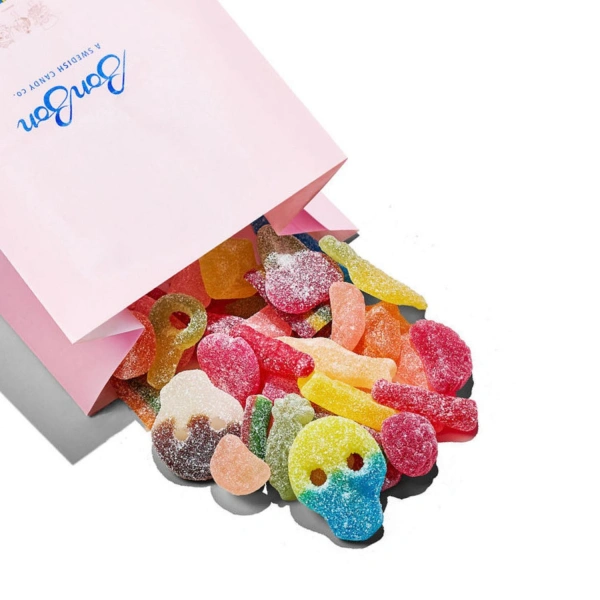
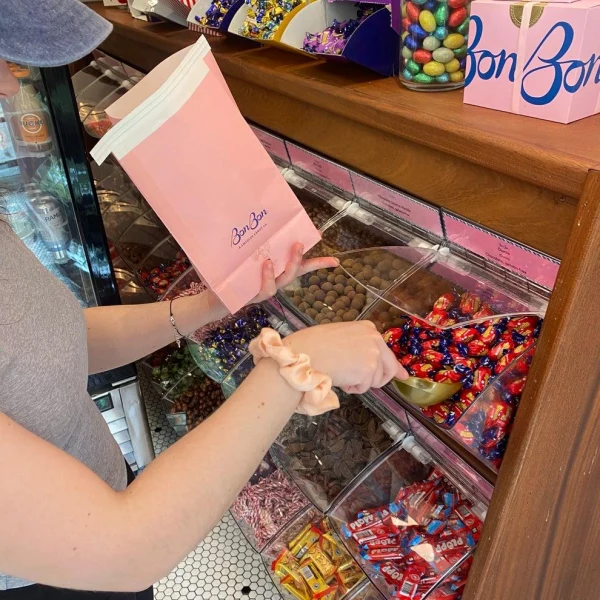
A September 2026 Fast Company feature describes BonBon’s pick-and-mix candy in a light pink stand-up tin tie bag with whimsical blue script. The packaging is part of a broader visual identity built around playful design and Swedish candy culture.
For other candy retailers, the useful lesson is not to copy BonBon’s exact design. It is to understand how packaging can support a memorable retail experience.
1. A distinctive color combination
A light pink bag paired with contrasting blue lettering creates a recognizable visual combination. For a candy shop, a consistent palette can help connect the physical store, packaging, social media content, and promotional materials.
Other brands could choose pastel yellow, mint green, lavender, cream, or kraft brown depending on their positioning. The goal is to create a visual identity customers can associate with the shop.
2. Typography that reflects the brand personality
Playful lettering can suit a candy brand built around nostalgia, discovery, and fun. A premium confectionery shop might instead prefer restrained typography and a minimal logo.
When designing custom tin tie bags, choose typography that remains readable at the actual printed size. A design that looks attractive on a computer screen may become difficult to read when printed on a small bag.
3. Packaging that complements the shopping experience
Pick-and-mix shopping is interactive. Customers browse different sweets, make their own combinations, and leave with a personalized selection.
A well-designed bag carries that experience beyond the store. It can appear in customer photographs, gift exchanges, and social media posts, giving the brand additional opportunities to be recognized.
This does not mean packaging alone makes a candy shop go viral. Store design, product selection, customer experience, and marketing all contribute. Packaging is one controllable part of the overall brand experience.
4. Consistency across the brand
A recognizable bag works best when it matches the shop’s other visual elements. Logo proportions, colors, typography, and illustration style should follow the same design direction across packaging and store materials.
For a new candy shop, developing a consistent visual system before ordering printed bags can reduce the risk of producing packaging that looks disconnected from the brand.
How to Design Custom Tin Tie Bags for Your Own Candy Shop
You do not need to copy a well-known candy brand to create packaging with a similar sense of personality. Start with the shopping experience you want to offer and translate that into a bag design.
Choose a color that customers can recognize
Consider your store interior, logo, candy selection, and target audience before choosing the bag color.
| Design direction | Possible visual approach | Suitable brand personality |
|---|---|---|
| Playful and colorful | Pastel background with contrasting lettering | Trend-led pick-and-mix shops |
| Bold and energetic | Bright colors and large graphic elements | Youthful candy brands |
| Natural and simple | Kraft paper with a clean logo | Artisan confectionery retailers |
| Minimal and premium | White or cream paper with restrained printing | Gift-oriented candy shops |
| Seasonal collection | Limited-edition colors or themed illustrations | Holiday and promotional ranges |
These are design directions rather than guaranteed sales formulas. Request printed samples where color accuracy and the finished appearance matter.
Decide how the logo should appear
For most custom candy bags, the logo should remain recognizable when the bag is filled and held in one hand.
Consider whether the front panel needs only a logo or a larger graphic treatment. Keep important text away from folds, the gusset, and the closure area. If you plan to include a website, social media handle, or other printed information, confirm that it will remain legible at the finished size.
Select a bag construction that presents well
A flat bag and a gusseted stand-up bag can create different retail presentations. For a shop where customers choose loose candy and carry it away, consider the opening width, bottom structure, and how the bag looks when filled.
A stand-up style may suit counter displays and product photography, but its performance depends on the actual construction and contents. Confirm the finished bag dimensions and test a sample with your candy assortment.
Make the design original
Use BonBon as inspiration for the broader principles of recognizable color, playful typography, and consistent branding—not as a template to duplicate.
Create your own logo, illustrations, and type treatment. Do not reproduce another company’s trademark or distinctive artwork without authorization.
What Size Tin Tie Bags Do Pick-and-Mix Shops Need?
The right bag size depends on the amount of candy customers buy, the shape of the sweets, and how much space is needed to close the top.
A 250 g selection of small, dense hard candies may occupy a different volume from 250 g of large gummies or lightweight marshmallows. For that reason, there is no universal bag dimension that fits every target weight.
Use the following retail scenarios to plan sample testing.
| Pick-and-mix order type | What to prioritize when selecting the bag |
|---|---|
| Small individual selection | Easy filling, compact dimensions, and a comfortable opening |
| Regular customer purchase | Enough room for a mixed assortment and a neat folded closure |
| Large or sharing selection | Greater usable volume, appropriate gusset depth, and sufficient closure space |
| Gift or promotional selection | A presentation-friendly shape, visible branding, and room for the intended contents |
Before confirming an order, test the actual candy mix in a sample bag.
Check that the opening is wide enough for efficient filling, the bag has enough volume for the intended purchase, and there is sufficient space above the candy to fold and secure the closure. If the shop sells several standard portions, test each one rather than assuming a single size will suit every order.
When requesting a quotation, provide the supplier with your target fill weight, candy type, preferred dimensions, and intended bag style. If you do not know the exact dimensions yet, ask for sample recommendations based on the actual product.
Which Tin Tie Bag Style Fits Your Candy Shop Brand?
For pick-and-mix retailers, material and construction decisions should support both the design and the way customers use the bag.
Kraft paper tin tie bags
Kraft paper provides a natural brown background that can suit artisan candy stores, independent retailers, and brands using a simple visual identity. Dark printing or a minimal logo can work well with its natural appearance.
Because kraft paper is not white, printed colors may look different from the same artwork on white stock. Review a sample if the final color is important to your branding.
White paper tin tie bags
White paper offers a clean background for colorful illustrations, contrasting typography, and bright brand colors. It can be a suitable option for candy shops that want a playful or modern appearance.
Ask the manufacturer to confirm available paper specifications, printing options, and the finished bag construction.
Custom printed tin tie bags
Custom printing allows a candy retailer to develop a consistent packaging identity rather than use a generic bag. Depending on the supplier’s production capabilities, options may include a printed logo, a custom color scheme, repeated patterns, or larger graphic elements.
When evaluating a design, look at the finished bag rather than only the flat artwork. The gusset, folded top, and filled shape can all affect how the printed design appears to customers.
Do Pick-and-Mix Candy Bags Need an Inner Lining?
The answer depends on the candy and how the packaging will be used.
- Unlined Paper Bags: Suitable for dry, non-greasy items like hard candies, wrapped caramels, or marshmallows.
- PE or PLA Lined Bags: Essential for soft gummies, sugared sours, oiled licorice, and chocolates. The thin interior barrier prevents butter/oil migration and blocks ambient humidity from softening your sweets.
Before selecting a paper structure, consider:
- Direct food contact: Confirm that the paper, inks where relevant, adhesives, and any inner layer are suitable for the intended food-contact application.
- Moisture sensitivity: Some candies may require additional moisture protection. A standard paper bag should not be assumed to provide a moisture barrier.
- Oil or residue: Chocolate or other products that leave residue may need a different material structure from dry hard candy.
- Storage and distribution: The intended storage period, climate, transport conditions, and retail handling can affect material selection.
- End-of-life requirements: If recyclability or compostability is a priority, evaluate the complete bag structure and the disposal infrastructure in the target market.
A lining should be selected for a specific packaging requirement, not added automatically. Ask the manufacturer to recommend suitable options and confirm the relevant food-contact documentation for the destination market.
How to Source Custom Tin Tie Bags for a New Candy Shop
If you are opening a pick-and-mix store, launching a Swedish candy concept, or expanding an existing candy brand, prepare a clear specification before requesting bulk pricing.
A useful tin tie bag quotation should be based on the finished dimensions, paper structure, closure, printing requirements, order quantity, and delivery destination.
1. Share your intended retail use
Tell the manufacturer whether the bags are for a physical pick-and-mix shop, online candy orders, gift packs, or multiple sales channels. Explain how customers will fill and carry the bags.
2. Confirm the dimensions and closure
Provide your preferred width, height, and gusset if known. If you are still deciding, share your target fill weight and candy type and ask for sample options.
Confirm the closure position and check that the bag leaves enough space for customers to fold the top down comfortably after filling.
3. Prepare your artwork
Provide your logo and print files, preferred colors, and any design references. Explain which parts of the bag should carry printing and whether color matching is important.
If you are inspired by a particular retail aesthetic, describe the general qualities you want—such as pastel colors, playful lettering, or a minimal look—rather than asking to reproduce another brand’s protected artwork.
4. Confirm the paper and product requirements
Discuss paper selection and any need for a lining based on the candy and its storage conditions. If the bag will directly contact unwrapped sweets, confirm the suitability of the complete material structure for the intended use.
5. Request a sample before mass production
A sample lets you check the finished dimensions, opening, closure, print quality, and appearance when filled with actual candy. Approve the sample before committing to a large order.
6. Confirm quantity, price, and delivery
Ask for a quotation based on the same specification you intend to approve. Confirm the minimum order quantity, sample arrangements, production lead time, packaging method, shipping terms, and delivery destination.
For small shops, it is particularly important to check the manufacturer’s MOQ before finalizing the design. A visually attractive custom bag is only a practical option if the order quantity and total budget fit the business plan.
Custom Tin Tie Bags for Pick-and-Mix Candy Shops from RBD Packaging
RBD Packaging manufactures custom printed tin tie paper bags for food brands, retailers, and distributors. For a pick-and-mix candy shop, the goal is to develop a bag that supports your own brand identity while providing a practical format for filling, carrying, and closing candy selections.
Customization can be discussed around bag dimensions, paper choice, printing, and selected structural requirements. The appropriate specification depends on your candy, intended use, and order quantity.
Explore our custom printed tin tie bags to discuss your packaging requirements.
To help us assess your project, include:
- Your candy shop or brand name
- The type of candy and target fill weight
- Preferred bag size or estimated dimensions
- Paper color and printing requirements
- Estimated order quantity
- Delivery country and required timeline
Planning a BonBon-inspired pick-and-mix candy concept? Develop your own recognizable packaging with custom tin tie bags designed around your brand colors, logo, and retail needs. Contact RBD Packaging to discuss specifications, samples, and bulk pricing.
Frequently Asked Questions
What bags do pick-and-mix candy shops use?
Pick-and-mix candy shops may use flat paper bags, gusseted paper bags, tin tie bags, or other formats depending on the store concept and product requirements. Tin tie bags are useful when the retailer wants a printable paper surface and a fold-over closure that customers can close again after opening.
What type of bag does BonBon use for its pick-and-mix candy?
Viral pick-and-mix brands often utilize custom light-pink block-bottom tin tie bags paired with playful, custom script lettering. This aesthetic demonstrates how colored paper stocks and distinctive typography can create a memorable retail experience, serving as strong design inspiration for new sweet shops looking to establish their own visual identity.
Can I order pink tin tie bags with my own candy shop logo?
Custom printed tin tie bags can be developed in different colors and designs, subject to the manufacturer’s materials, printing process, and order requirements. Provide your logo and color references, then review a sample to check the final appearance.
What size tin tie bag do I need for 250 g of pick-and-mix candy?
The size depends on the candy’s shape, density, and the space needed to close the bag. Share the target fill weight and candy assortment with your supplier, then test a sample before confirming the finished dimensions.
Are tin tie bags reusable after opening?
A tin tie bag can generally be opened and folded closed again, provided the bag and closure remain in good condition. However, repeated closing does not make it airtight, and the bag’s suitability for reuse depends on the material, product, and handling conditions.
Are tin tie bags airtight for candy?
No. A standard tin tie closure is not an airtight seal. If your candy requires a specific moisture or oxygen barrier, discuss the complete bag structure and any additional sealing requirements with the packaging manufacturer.
Can a small candy shop order custom printed tin tie bags wholesale?
Yes, depending on the manufacturer’s minimum order quantity and available production options. Before finalizing artwork, confirm the MOQ, unit pricing, sample cost, lead time, and shipping arrangements so the packaging order fits your business requirements.