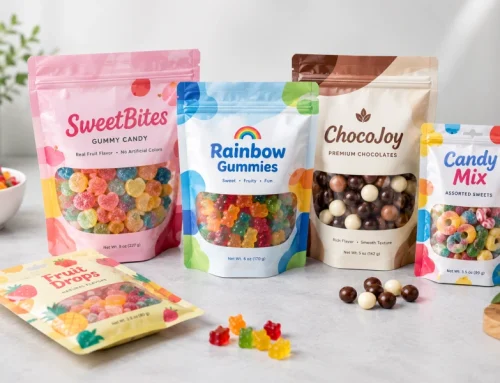
Custom candy boxes help confectionery brands present products professionally, organize assorted sweets, and create packaging that fits their retail or gifting strategy. Choosing the right box involves more than selecting a shape or printing a logo. Buyers need to consider candy size, inner packaging, insert design, material, printing, shipping conditions, order quantity, and production requirements.
This buyer’s guide explains how to choose custom candy gift boxes, when to use candy gift boxes with inserts, and what to consider when sourcing custom gummy candy boxes. It is designed for candy manufacturers, brand owners, wholesalers, importers, and confectionery gift businesses planning custom packaging orders.
What Should You Consider When Buying Custom Candy Boxes?
The best custom candy boxes are designed around the product, sales channel, and required presentation. Before choosing a box style, define what the packaging needs to hold, how customers will receive it, and whether the box is intended for retail display, gifting, e-commerce, or wholesale distribution.
Start with these five questions:
- What type of candy will the box contain? Hard candies, chocolate pieces, gummy bears, individually wrapped sweets, and mixed assortments have different size and handling requirements.
- How will the candy be packed inside? Products may be individually wrapped, placed in an inner bag, arranged in a tray, or separated into compartments.
- Where will the box be sold? Retail shelves, gift counters, subscription shipments, and seasonal promotions require different packaging priorities.
- What presentation does your brand need? A simple folding carton may suit everyday retail products, while a rigid gift box may be appropriate for premium assortments.
- What order quantity and budget are available? Structural complexity, materials, finishing, and order volume all affect the final quotation.
Prepare a product sample, target piece count, approximate packed weight, and intended sales channel before requesting a quote. These details help a packaging supplier recommend a practical structure instead of estimating from the product name alone.
Which Custom Candy Gift Box Style Is Right for Your Product?
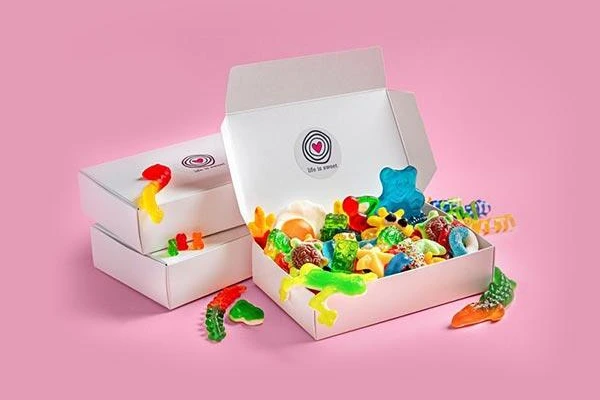
Custom candy gift boxes are available in different structures, from lightweight folding cartons to more substantial gift boxes. The right choice depends on the product’s weight, the desired unboxing experience, shipping requirements, and target price point.
| Box style | Suitable applications | Main purchasing consideration |
|---|---|---|
| Folding carton | Everyday retail candy, small assortments, promotional packs | Balance of structure, print area, and unit cost |
| Tuck-end box | Individually wrapped sweets, small retail packs | Closure design and ease of assembly |
| Window box | Selected candy assortments and gift products | Window material, visibility, and product protection |
| Gift box with lid | Premium confectionery gifts and seasonal collections | Presentation, rigidity, and storage space |
| Drawer-style box | Curated candy selections and premium assortments | Tray fit, sliding clearance, and assembly |
| Box with custom insert | Mixed candy collections and organized gift sets | Compartment dimensions and product stability |
Folding Cartons for Retail Candy
Folding cartons are worth considering when brands need printed packaging for retail products, promotional collections, or individually wrapped candy. They can be customized with brand colors, product information, and graphics.
When comparing quotations, ask about the paperboard specification, finished dimensions, printing method, folding structure, and packing method. The lowest unit price is not necessarily the best value if the carton is difficult to assemble or does not fit the product correctly.
Premium Custom Candy Gift Boxes
Premium gift boxes are often selected for holiday collections, corporate gifts, limited editions, and assorted confectionery sets. Depending on the design, options may include a separate lid, a hinged lid, a drawer structure, or a more rigid construction.
Before choosing decorative features, confirm how the box will be packed, stored, shipped, and opened. A visually attractive design still needs practical dimensions and a structure appropriate for the finished product weight.
Custom Candy Boxes with Windows
A window can allow customers to see the candy without opening the package. This may be useful for selected retail and gift applications, particularly when the product assortment is part of the visual appeal.
The window size and position should be considered alongside the printed artwork and required product information. If the candy needs a separate primary package, the window should showcase the intended presentation without suggesting that the outer box itself provides a food barrier.
Do Candy Gift Boxes Need Custom Inserts?
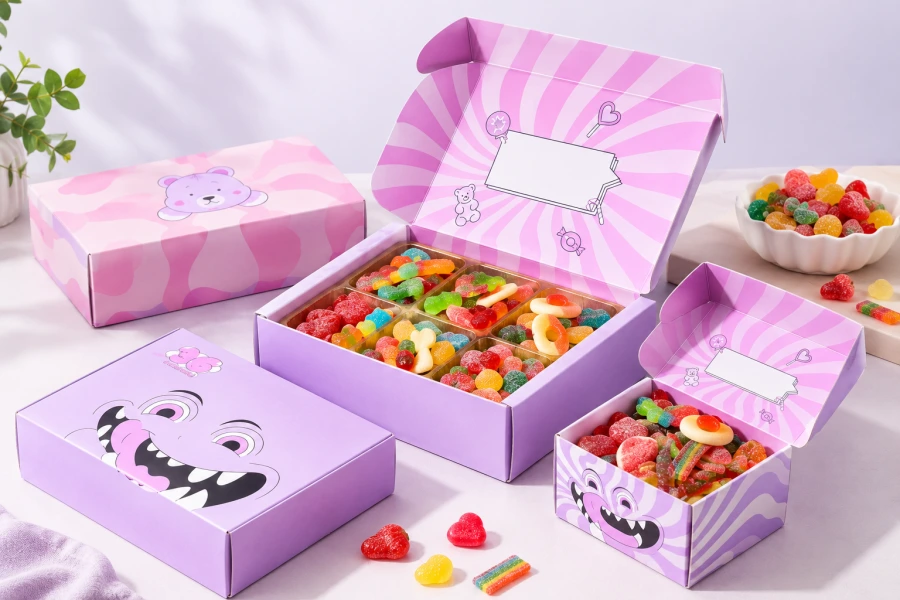
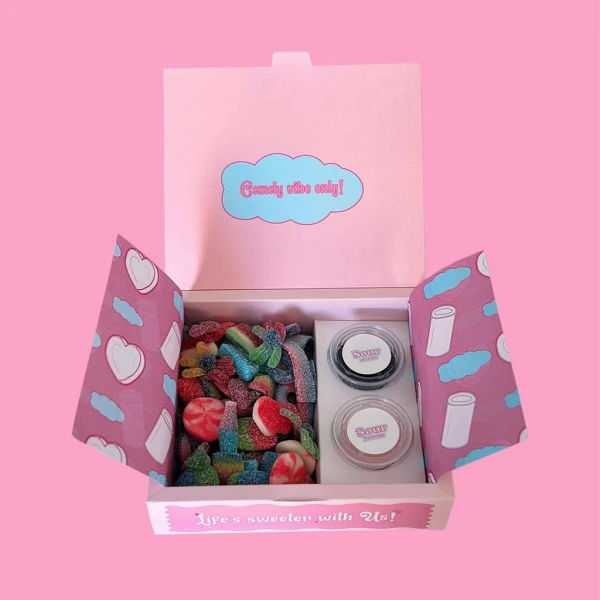
Candy gift boxes with inserts are useful when products need to stay organized, separated, or positioned in a specific arrangement. Inserts can also create a more deliberate presentation for premium gift sets and mixed assortments.
However, not every candy box needs an insert. For individually wrapped sweets packed in a simple retail carton, an insert may add unnecessary material and assembly work. For a box containing several flavors, delicate pieces, or individually presented candies, a custom insert may improve organization and reduce movement.
Common Insert Options
| Insert type | Potential use | What to confirm |
|---|---|---|
| Paperboard insert | Lightweight candy assortments and divided layouts | Stiffness, folding design, and cavity dimensions |
| Molded pulp insert | Selected products requiring shaped support | Cavity fit, surface finish, and compatibility with the candy’s primary packaging |
| Plastic tray | Precisely arranged pieces or individual compartments | Material specification, food-contact suitability where applicable, and recyclability in the destination market |
| Dividers | Separating flavors, product types, or individual packages | Divider height, stability, and available internal space |
The appropriate insert depends on the candy shape, weight, packaging layer, and presentation requirements. Material suitability should be confirmed for the actual application rather than assumed from the insert’s appearance.
How to Design Candy Gift Boxes with Inserts
Start by arranging the actual candy or its primary packages in the desired layout. Count the compartments, measure the largest pieces, and consider how customers will remove each item.
Check the following before approving the design:
- Each compartment accommodates the intended product and any wrapper or inner container.
- Dividers do not interfere with the box lid or closure.
- Products are easy to remove without damaging neighboring pieces.
- The insert fits securely inside the box during normal handling.
- The complete packed set fits the intended shipping carton.
For mixed assortments, provide the supplier with a layout drawing or a photograph showing the intended arrangement. This makes it easier to discuss compartment positions and avoid repeated sample revisions.
What Should Buyers Know About Custom Gummy Candy Boxes?
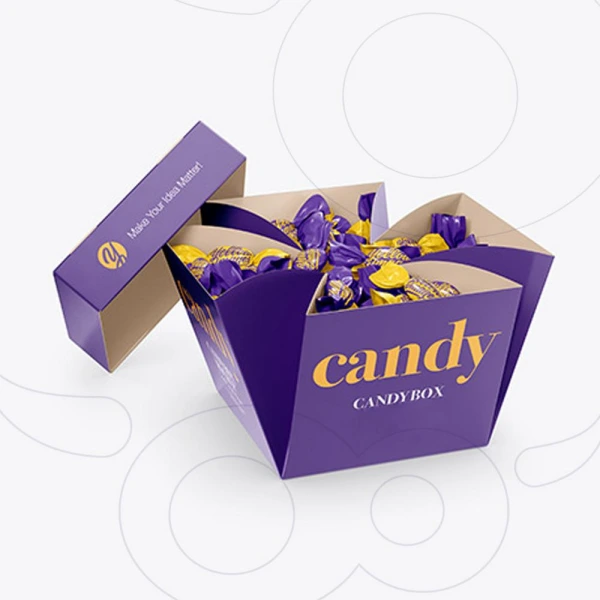
Custom gummy candy boxes require special attention to the packaging layer inside the carton. Gummies can differ in shape, surface texture, sugar coating, and sensitivity to storage conditions. The outer box primarily provides structure, branding, and presentation; it should not automatically be treated as the primary freshness or moisture barrier.
Choose the Inner Packaging Before Finalizing the Box
Gummies may be individually wrapped, packed in a sealed pouch, placed in a suitable inner tray, or supplied in another product-specific format. The choice depends on the formulation, expected storage conditions, handling process, and food-safety requirements.
If gummies are packed in a sealed bag inside a printed carton, the carton dimensions should be based on the filled bag—not just the loose candy dimensions. Allow space for seals, folds, and any closures that affect the finished package.
If the gummies will contact a tray or other packaging component directly, confirm that the material and intended use meet the applicable food-contact requirements.
Box Styles for Gummy Candy Products
Different gummy products may require different structures:
- Retail gummy boxes: Suitable for selected individually wrapped or inner-packed gummy products.
- Gummy gift boxes: Useful for themed assortments, seasonal collections, and premium confectionery gifts.
- Gummy boxes with inserts: Appropriate when multiple flavors or shapes need separate compartments.
- Display cartons: Worth considering when the package must present products clearly at a retail counter or shelf.
- Multipack cartons: Useful when several smaller, individually packed gummy products are sold together.
When selecting a structure, consider the actual filled package weight, stacking, retail shelf dimensions, and shipping route. A large box is not automatically better; excessive unused space may increase material use and make the product less stable during transport.
Protect Product Quality with the Right Packaging System
The outer carton and the inner package perform different functions. Depending on the product, the inner packaging may need to address moisture transfer, exposure to air, contamination control, or other product-specific requirements.
Do not rely on a decorative paperboard box alone to protect sensitive gummies. Ask the candy manufacturer or food-safety team to define the necessary primary packaging performance, then coordinate the outer box dimensions and presentation around that specification.
How Do You Choose Candy Box Materials and Printing?
Material selection affects the box’s stiffness, appearance, print quality, folding performance, and cost. The appropriate specification depends on box size, product weight, structure, distribution conditions, and the brand’s visual requirements.
Compare Materials by Application
Paperboard is commonly considered for folding cartons and lightweight retail boxes. Kraft-style paperboard may suit brands seeking a natural visual appearance, while coated or smoother paperboard may be preferred for detailed graphics and stronger color presentation. More substantial board constructions can be considered for premium gift packaging.
Do not choose material based on thickness alone. Ask the supplier to recommend a suitable board specification based on the finished box dimensions, weight, closure, insert, and intended handling conditions.
If the candy touches the packaging directly, confirm whether the selected material, coating, ink, adhesive, and any window or insert components are suitable for the intended food-contact use. If the candy is fully enclosed in a primary package, make that packaging arrangement clear in the specification.
Printing and Finishing Options
Custom printed candy boxes can be tailored to brand guidelines, product variants, and seasonal campaigns. Common options include:
- Full-color printing for product graphics and brand artwork.
- Spot colors for more controlled brand-color reproduction.
- Matte or gloss finishes, where appropriate for the selected material.
- Foil stamping for selected logos or decorative details.
- Embossing or debossing for tactile brand elements.
- Window features for product visibility.
The final result depends on the board, artwork, printing process, and finishing combination. Ask for a physical sample or an approved production proof when color matching, surface appearance, or structural fit is important.
For multiple flavors or SKUs, confirm which elements remain consistent and which change between versions. A clear artwork and SKU approval process helps reduce confusion during production.
How Do You Calculate the Right Candy Box Size?
The correct custom candy box size starts with the finished product arrangement. Buyers should confirm usable internal dimensions rather than relying only on the external dimensions of a reference box.
Use this process:
- Measure the product or inner package. Record the maximum length, width, and height, including wrappers, seals, folds, or closures.
- Define the pack count. Confirm the number of pieces, bags, trays, or individual packages per box.
- Create the layout. Decide whether the products will be arranged in rows, layers, individual compartments, or a mixed assortment.
- Allow for the insert and closure. Account for divider walls, tray edges, lid depth, and any features that occupy internal space.
- Confirm the finished dimensions. Ask the supplier to specify whether quoted dimensions are internal or external and how they are measured.
- Test a physical sample. Pack the actual product and check fit, closure, removal, stacking, and handling.
Do not add arbitrary clearance without considering the structure. Excessive space may allow products to move, while insufficient space can cause difficult assembly or damage. A sample packed with the actual product is the most practical way to confirm the design before mass production.
What Should You Include in a Custom Candy Box RFQ?
A complete request for quotation (RFQ) helps suppliers estimate the right structure and reduces avoidable clarification during sampling and production.
Include the following information whenever possible:
| RFQ item | Information to provide |
|---|---|
| Product | Candy type, individual dimensions, and packed weight |
| Packaging arrangement | Loose candy, individually wrapped pieces, inner pouch, tray, or mixed assortment |
| Box style | Folding carton, window box, gift box, drawer box, or another reference structure |
| Dimensions | Target internal or external dimensions, if known |
| Insert | Required compartments, layout, material preference, or reference drawing |
| Material | Preferred paperboard or request for a supplier recommendation |
| Printing | Artwork, logo, brand colors, and number of artwork versions |
| Finishing | Desired coating, foil, embossing, window, or other features |
| Quantity | Initial order quantity and likely repeat-order volume |
| Destination | Country, delivery address or port, and required delivery date |
| Compliance | Applicable food-contact and labeling requirements for the intended use and market |
| Sampling | Whether a structural sample, printed sample, or production sample is required |
If you do not know the exact material or structure, provide product samples, photographs, target dimensions, and budget expectations. A capable packaging supplier should be able to discuss feasible options and explain the trade-offs.
How to Compare Wholesale Candy Box Quotes
Compare quotations on the same specification, not just the unit price. Check whether each quotation includes the same box structure, board specification, insert, printing, finishing, sample charges, packaging method, and delivery terms.
Also confirm the minimum order quantity, production lead time after approval, payment terms, shipping costs, and how artwork or structural changes affect the price.
For projects with multiple SKUs, request a clear breakdown by design and quantity. This makes it easier to evaluate whether shared box structures or common components are practical without compromising the fit of each product.
How Do You Evaluate a Custom Candy Box Manufacturer?
A reliable manufacturer should be able to discuss structural feasibility, material choices, artwork preparation, sampling, quality checks, and delivery requirements—not just provide a price from a reference image.
Before placing an order, confirm:
- Whether the supplier can produce the requested box structure and insert.
- How dimensions, materials, and artwork will be documented and approved.
- Whether a sample can be checked with the actual candy or inner package.
- What inspection criteria will be used for finished boxes.
- How the supplier handles color variation, defects, and specification changes.
- Whether production and shipping schedules match your launch or promotional date.
For food-related packaging, request documentation relevant to the actual material and intended use. Do not assume that a paperboard box is suitable for direct food contact simply because it is described as food packaging.
A written, approved specification is especially important for repeat orders. It gives both parties a reference for dimensions, printing, materials, finishing, and packaging method.
Frequently Asked Questions
What is the best box style for custom candy gift boxes?
The best style depends on the product and presentation goal. Folding cartons can suit retail candy, while separate-lid, drawer-style, or more rigid boxes may suit premium assortments. Choose the structure after confirming product dimensions, packed weight, and distribution requirements.
Do candy gift boxes need inserts?
Not always. Inserts are useful when candies need separate compartments, a fixed arrangement, or additional support. For simple individually wrapped products, an insert may be unnecessary. Evaluate the product layout, handling requirements, assembly work, and added cost before deciding.
Are custom gummy candy boxes suitable for loose gummies?
They can be used as the outer carton, but the complete packaging system must be appropriate for the gummies. Depending on the product, a suitable inner pouch, tray, or other primary packaging may be needed. Confirm product-protection and food-contact requirements before choosing the final structure.
What affects the price of custom candy boxes?
Pricing depends on order quantity, box dimensions, board specification, structural complexity, insert design, printing, finishing, sampling, and delivery terms. To compare suppliers accurately, request quotations using the same approved specifications.
What information is needed to request a candy box quotation?
Provide the candy type, packed dimensions and weight, box style, quantity, insert requirements, artwork, finishing preferences, destination, and delivery timeline. If some specifications are undecided, share product samples or photographs so the supplier can recommend suitable options.
Can custom candy boxes be designed for seasonal gift collections?
Yes. Brands can develop box structures, artwork, inserts, and finishes for seasonal or limited-edition collections. Confirm the number of SKUs, artwork approval schedule, sample requirements, and delivery deadline early enough to accommodate production and shipping.
Source Custom Candy Boxes for Your Brand
RBD Packaging supports custom packaging development for food brands, confectionery businesses, and wholesale buyers. Share your candy type, preferred box style, target quantity, artwork, and insert requirements to discuss a suitable packaging specification.
If you are planning custom candy gift boxes, candy gift boxes with inserts, or custom gummy candy boxes, start with the actual product and its inner packaging. A clear specification makes it easier to evaluate materials, compare quotations, approve samples, and prepare for repeat orders.