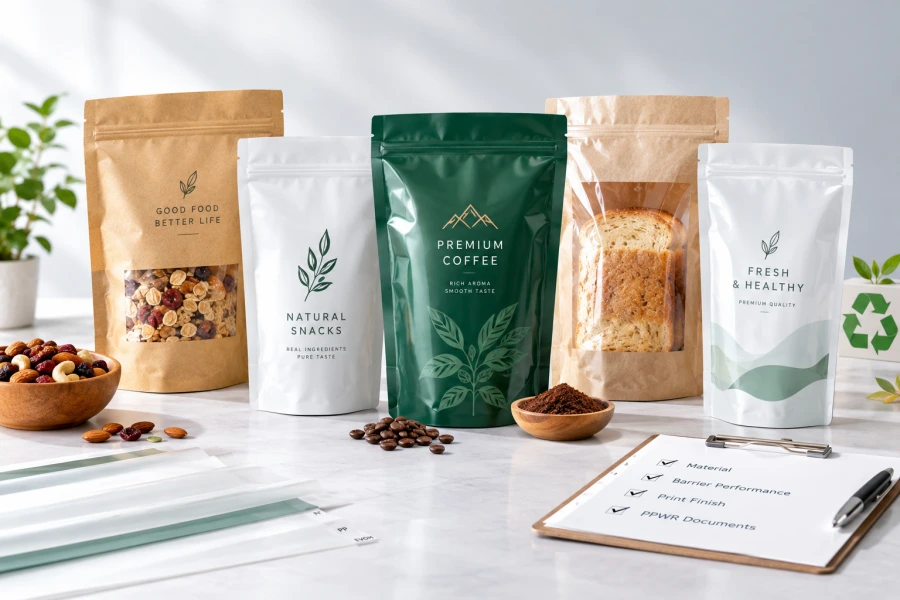
Choosing mono-PE when your product needs mono-PP—or the reverse—can cost you more than a material mismatch. It can show up as a failed seal, limp shelf presentation, and a recyclability claim you cannot document. This checklist is built around five decisions a buyer makes before approving a mono-material stand-up pouch: sealing window, stiffness, barrier benchmark, print finish, and PPWR documentation.
Five-Decision Quick Reference
| Decision | Default starting direction | Evidence to request before approval |
|---|---|---|
| Sealing window | PE if line speed is high and window is narrow; PP if heat resistance matters | Recommended temperature range, dwell time, pressure, seal-strength and hot-tack data |
| Stiffness and shelf presence | MDO-PE/BOPE if mono-PE looks limp; PP if a crisp feel is required | Samples in the same pouch format, not different constructions |
| Barrier benchmark | OTR/WVTR data against the ranges in Section 2 before accepting “high barrier” | Test method, conditions, raw-film vs. finished-pouch, shelf-life validation plan |
| Print finish | PE and PP both support matte, gloss, paper-touch and high-resolution print | Production-representative printed sample, not a digital mock-up |
| PPWR documentation | DoC, PFAS evidence, full layer structure and recyclability grade | Documents identified by exact specification, not a generic factory certificate |
Mono-PE vs. Mono-PP: Which Stand-Up Pouch Should You Choose?
Mono-PE and mono-PP stand-up pouches can both support flexible packaging designs intended for material recycling. Neither is automatically the better choice for every product. The right structure depends on sealing conditions, mechanical performance, barrier requirements and the recycling systems available in your target market.
Decision 1: What sealing window does your filling line require?
Choose a pouch structure that performs reliably on your actual filling line, rather than selecting PE or PP based on a generic material description.
Seal performance depends on the film grade, sealant layer, thickness, machine settings, line speed, product contamination and sealing method. Some PE structures offer useful sealing flexibility, while certain PP structures can provide higher-temperature performance. However, the exact operating window must be confirmed for the proposed film construction.
| Filling-line requirement | What to evaluate in mono-PE | What to evaluate in mono-PP |
|---|---|---|
| High-speed filling | Seal initiation, seal strength and operating tolerance | Seal initiation, seal strength and operating tolerance |
| Product contamination risk | Seal integrity with representative contamination | Seal integrity with representative contamination |
| Higher-temperature filling | Confirm the specific PE structure’s temperature limits | Evaluate suitable PP grades and the actual sealant construction |
| Narrow process window | Test performance across the intended machine settings | Test performance across the intended machine settings |
Before approving a material, ask for the recommended sealing temperature range, dwell time, pressure, seal-strength results and any relevant hot-tack data. Run trials using the actual pouch, product and filling equipment whenever possible.
Decision 2: Does your pouch need flexibility or shelf-ready stiffness?
Mono-PP structures may offer a relatively crisp feel and good dimensional stability, depending on the film grade and construction. Mono-PE structures can offer flexibility and impact resistance, while oriented PE films such as MDO-PE or BOPE can improve stiffness and appearance compared with conventional blown PE.
The stiffness difference is material, not marginal. BOPE films have demonstrated 20–25% higher bending and Young’s modulus compared with blown PE at comparable thickness, with 1% secant modulus values of roughly 640 MPa (MDO) and 420 MPa (BOPE) in the machine direction versus approximately 160 MPa for blown film in published film-property comparisons. If the primary concern is that mono-PE will look limp on shelf, ask for an MDO-PE or BOPE sample in the same pouch format before ruling PE out.
| Brand or operational priority | What to compare |
|---|---|
| Soft, flexible pouch | PE film grade, flexibility and puncture performance |
| More upright shelf presentation | Mono-PP versus oriented mono-PE samples |
| Premium matte appearance | Surface finish, glare and printed colour |
| Frequent handling or transport | Puncture resistance, flex-crack performance and seal integrity |
Request physical samples of the competing structures in the same pouch size and design. Comparing two different pouch constructions makes it difficult to identify whether a difference comes from the base polymer, thickness, orientation or overall design.
Decision 3: Which recycling stream is relevant to your target market?
Mono-PE packaging is generally designed around PE recycling streams, while mono-PP packaging is generally designed around PP streams. However, a predominantly single-polymer structure is not automatically recyclable in practice.
Collection infrastructure, sorting capability, barrier layers, inks, adhesives, closures and local recycling guidance can all influence the outcome.
Before choosing, ask:
- Is the intended pouch compatible with the relevant PE or PP recycling design guidance?
- Can the complete pouch, including its zipper, valve and printed layers, meet the relevant criteria?
- Is the intended recycling stream available in the destination market?
- What evidence supports the proposed recyclability claim?
The EU Packaging and Packaging Waste Regulation (PPWR, Regulation (EU) 2025/40) establishes requirements for packaging recyclability, with design-for-recycling criteria and later recycled-at-scale assessment introduced in stages. The regulation has applied directly in all member states since 12 August 2026.
PE vs. PP: Quick buying decision
| Decision factor | Mono-PE may be a suitable starting point when… | Mono-PP may be a suitable starting point when… |
|---|---|---|
| Sealing | The proposed PE structure meets the line’s sealing requirements | The proposed PP structure meets the line’s sealing requirements |
| Mechanical feel | Flexibility and a suitable oriented-PE option are priorities | A crisp feel or specific stiffness is a priority |
| Barrier performance | Test data confirm the required shelf life | Test data confirm the required shelf life |
| Recycling design | The full structure aligns with the intended PE stream | The full structure aligns with the intended PP stream |
Neither column is a final specification. The decision should be based on verified performance and full-structure compatibility.
Barrier Performance: Benchmark the Data Before You Add Layers
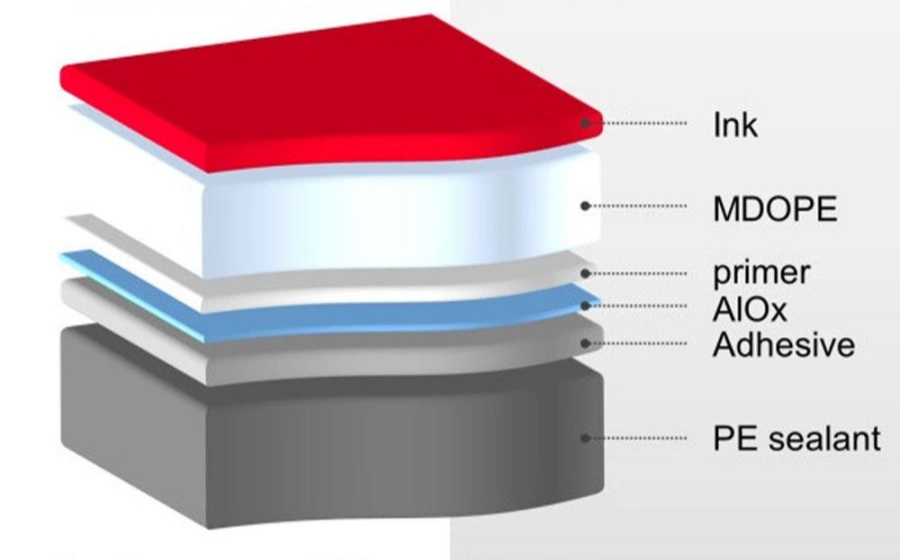
A mono-material pouch must protect the product adequately throughout its intended shelf life. A supplier’s description of a film as “high barrier” or “mono-material” does not establish whether it is suitable for your product.
Request OTR and WVTR data—and compare it against a benchmark
Two measurements are particularly useful when evaluating flexible packaging:
- OTR (oxygen transmission rate): Measures how quickly oxygen passes through the tested material under specified conditions.
- WVTR (water vapour transmission rate): Measures how quickly water vapour passes through the tested material under specified conditions.
Lower transmission rates generally indicate stronger resistance. The required values depend on the product’s sensitivity, formulation, pack size, storage environment and intended shelf life. A film test result is not the same as a shelf-life guarantee. Seals, folds, closures, flex cracking and the finished pouch structure can affect real-world protection.
As a screening reference, not a specification, the following published ranges give buyers a way to judge whether a supplier’s proposed structure sits in a plausible performance band:
| Structure | OTR (cm³/m²/24hr) | WVTR (g/m²/24hr) | Test conditions |
|---|---|---|---|
| 17 μm MDO-PE barrier film, EVOH <1 μm | 1–3 | 5–8 | 23 °C / 50% RH (ASTM F1927-07); 38 °C / 90% RH (ASTM F1249-06) |
| Metallised version, same film family | 0.30–1 | 0.90–3 | Same methods |
These are reference ranges, not grounds for outright rejection—test conditions and product requirements vary.
If a supplier cannot provide relevant OTR/WVTR data, or cannot explain how the proposed structure will be validated beyond a raw-film test, the barrier claim is not yet sufficient evidence for approval.
Include these questions in your technical review:
- Are the reported values for the raw film, laminate or finished pouch?
- What test method, temperature and relative humidity were used?
- What are the target shelf life and storage conditions?
- Will the supplier test the finished pouch or support a product-specific shelf-life study?
- How will barrier performance be checked after filling, sealing and handling?
EVOH barrier layers: compatibility is a design question, not a single percentage
EVOH is used in some flexible packaging structures to improve oxygen barrier performance. Its compatibility with a PE or PP recycling stream depends on the complete construction and the applicable design-for-recycling criteria.
CEFLEX guidelines identify a 5% by-weight threshold per coating or barrier layer for barrier materials including EVOH, PVOH, acrylic, SiOx and AlOx in polyolefin flexible packaging, provided the polyolefin content itself exceeds 90% of total packaging weight. This is a design-guide figure applied to the complete structure—not a standalone legal safe harbour. Do not treat “EVOH at or below 5%” as a universal pass that guarantees recyclability across every guidance and packaging category.
When a supplier proposes an EVOH-containing structure, request:
- The complete layer structure, including each layer’s material and nominal thickness.
- The EVOH percentage by weight of the total packaging structure, with the calculation basis clearly stated.
- The applicable PE or PP design-for-recycling guidance and the relevant compatibility limit.
- Supporting technical documentation or a third-party assessment, where available.
- Confirmation that adhesives, tie layers, printing and closures have also been considered.
The CEFLEX Designing for a Circular Economy guidelines provide industry guidance for polyolefin-based flexible packaging, including the assessment of barrier materials, inks, adhesives, coatings and other components. A barrier layer that is compatible with one recycling design may not be suitable for another.
Match the barrier strategy to the product
Different products have different protection needs. A dry snack with a moderate shelf-life target may not require the same structure as an oxygen-sensitive product or one that will undergo heat treatment.
| Product requirement | Initial evaluation approach | Evidence to request |
|---|---|---|
| Dry snacks or powders with moderate barrier needs | Compare suitable mono-PE and mono-PP structures with required mechanical properties | OTR/WVTR data against the benchmark ranges, seal results and storage assumptions |
| Coffee or other oxygen-sensitive products | Evaluate the complete barrier structure against the intended shelf life | Full layer specification, barrier test data and shelf-life validation plan |
| High-fat products | Assess oxygen protection, aroma retention and product-specific compatibility | Product-specific testing and comparison with the existing packaging |
| Hot-fill or retort applications | Confirm whether the proposed pouch is designed and validated for the actual process | Temperature limits, seal performance and process validation |
| Long shelf-life products | Compare the proposed mono-material design against the current packaging benchmark | Defined acceptance criteria and comparative shelf-life results |
These categories are screening prompts, not universal material prescriptions. A supplier should demonstrate that the proposed pouch meets your product’s performance requirements before you trade away barrier performance for a recyclability claim.
Print Finish and Shelf Appeal: Mono-Material Does Not Automatically Mean Lower Quality
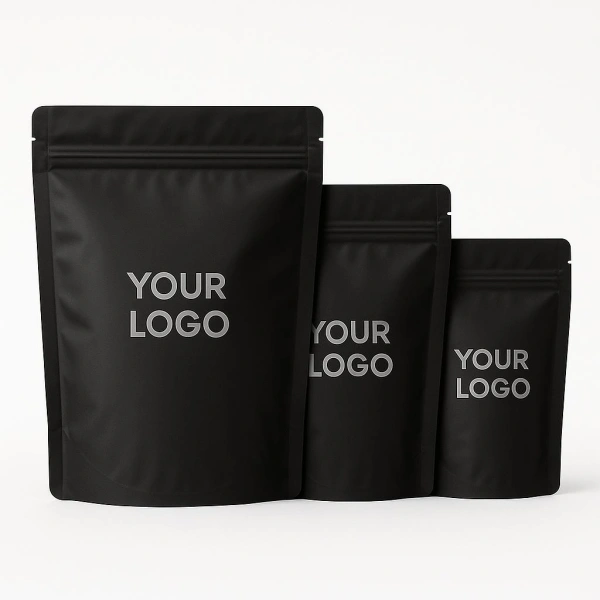
Switching to a mono-material structure does not automatically require plain artwork or a basic finish. Printed PE and PP films can support a range of brand presentations, subject to the specific film, printing process and surface treatment.
However, print quality and recycling compatibility are separate questions. A pouch may look premium while still requiring further evaluation of its coatings, inks, adhesives and overall structure.
| Brand requirement | What to evaluate | What to ask the supplier |
|---|---|---|
| Matte finish | Glare, colour consistency and scuff resistance | Is the matte effect created by a coating, film surface or another treatment? |
| High-gloss finish | Colour saturation, reflectivity and abrasion resistance | Does the finish change the structure or its recycling assessment? |
| Paper-like or soft-touch feel | Tactile quality and coating durability | What material or coating creates the effect? |
| High-resolution multicolour printing | Fine text, gradients, registration and colour consistency | Can you provide a production-representative printed sample? |
| Consistent branding across orders | Repeatability of colours and surface appearance | What colour standard and approval process will be used? |
Do not approve artwork from a digital mock-up alone. Review a printed sample made using the proposed film and finish. For repeat orders, establish an approved colour reference and acceptable tolerances.
The buying question is not simply whether a premium finish can be produced. It is whether the finished pouch delivers the required appearance and performance while supporting the claims you intend to make. Ask the supplier to document whether the chosen finish is included in the relevant recycling assessment and compliance documentation.
PPWR: Which Documents Should You Request Before Approval?
For packaging intended for the EU market, PPWR documentation should be part of the procurement process—not an afterthought once the pouch design and purchase order have been finalised.
Regulation (EU) 2025/40 has applied since 12 August 2026, although individual provisions have their own implementation timelines and conditions. The regulation places obligations on relevant economic operators, including manufacturers and importers. A brand that has packaging manufactured or designed under its own name may also have manufacturer obligations, depending on the circumstances. Confirm your specific responsibilities with a qualified compliance professional.
Request an EU Declaration of Conformity where required
The PPWR sets out conformity-assessment and EU Declaration of Conformity requirements for packaging within the applicable scope. The declaration must follow the required structure and identify the packaging to which it applies. A generic factory statement or an unrelated certificate does not establish compliance for your specific pouch.
Ask the supplier to confirm:
- The exact pouch format, specification or product identifier covered.
- The responsible manufacturer’s name and address.
- The applicable legislation and requirements covered by the declaration.
- The relevant standards or technical specifications used, where applicable.
- Whether the document matches the final approved material structure and components.
The PPWR’s Annex VIII provides the model structure for the declaration. The applicable technical documentation and conformity-assessment requirements should be checked against the actual packaging and its intended use.
Request evidence addressing PFAS requirements for food-contact packaging
From 12 August 2026, Article 5(5) of the PPWR restricts the placing on the EU market of food-contact packaging containing PFAS at or above the following limits:
- 25 ppb for any individual PFAS measured by targeted PFAS analysis, excluding polymeric PFAS from quantification.
- 250 ppb for the sum of PFAS measured by targeted analysis, where applicable following prior degradation of precursors, excluding polymeric PFAS from quantification.
- 50 ppm for PFAS including polymeric PFAS, measured as total fluorine.
Where total fluorine exceeds 50 mg/kg, the regulation provides for proof of the quantity of fluorine attributable to PFAS or non-PFAS to support the required technical documentation. These limits are not interchangeable, and a total-fluorine result is not the same as a targeted PFAS result.
For practical procurement, request a relevant test report or supply-chain declaration covering the proposed packaging materials. Confirm the test method, sample identity, laboratory details and whether additional analysis is needed.
Request the complete material structure and recycling evidence
If the pouch will be marketed as mono-PE, mono-PP or recyclable, request evidence that supports the specific claim. Your document request should include:
- A complete material and layer specification.
- The main polymer and the weight contribution of relevant components.
- Details of EVOH, other barrier layers, tie layers, coatings and adhesives.
- Information about zippers, valves and other closures.
- The applicable recycling design guidance or assessment, including any stated limitations.
- Evidence supporting any consumer-facing recyclability claim.
A mono-material label is not, by itself, proof that every component is compatible with the intended recycling stream.
Plan against the PPWR’s recyclability performance grades
The PPWR introduces recyclability performance grades based on the share of packaging weight that can actually be recycled:
- Grade A: ≥95%
- Grade B: ≥80%
- Grade C: ≥70%
Packaging below 70% is treated as technically non-recyclable. From 1 January 2030, only packaging in grades A, B or C may be placed on the market. From 1 January 2038, Grade C falls away—only Grades A and B remain permissible.
This means a mono-material structure that only meets the Grade C floor today is not a long-term specification. It is a structure that will need to be redesigned before 2038. When requesting a quote, ask the supplier to explain the proposed pouch’s current design-for-recycling position against these grade thresholds, and whether the structure is expected to remain marketable after the 2038 grade-C phase-out. Do not ask for a guarantee of a future grade without a valid assessment basis—but do ask for a documented rationale.
PPWR supplier document checklist
| Document or information | Why it matters | Who to ask |
|---|---|---|
| Applicable EU Declaration of Conformity | Identifies the packaging and relevant conformity basis where required | Responsible packaging manufacturer |
| Technical documentation or supporting compliance evidence | Supports the conformity assessment and traceability | Manufacturer and relevant material suppliers |
| PFAS test report or supply-chain declaration | Addresses Article 5(5) limits for food-contact packaging | Film, coating, ink and packaging suppliers |
| Full layer structure and material composition | Allows assessment of barrier performance and recycling compatibility | Film producer or pouch converter |
| EVOH and other component percentages | Supports assessment against the applicable design-for-recycling criteria | Film producer or pouch converter |
| Zipper, valve, ink, coating and adhesive information | Helps evaluate the complete packaging unit | Component and packaging suppliers |
| Design-for-recycling assessment against A/B/C grades | Substantiates the intended recycling claim and 2038 readiness | Packaging supplier or qualified assessor |
A supplier’s inability to provide a particular document immediately does not automatically prove non-compliance. It does mean you should identify the gap, establish who is responsible for closing it, and avoid making unsupported claims in the meantime.
Minimum information to include in your RFQ
| RFQ field | What to specify |
|---|---|
| Product profile | Product type, oxygen/moisture/light/aroma sensitivity, target shelf life, storage conditions, filling temperature |
| Filling-line conditions | Filling method, line speed, sealing temperature/dwell/pressure ranges, contamination risks, current seal-performance requirements |
| Pouch specification | Dimensions, fill weight, zipper/valve/window, PE or PP preference, print and finish, order quantity per artwork version |
| Technical & compliance | Required OTR/WVTR against the Section 2 benchmark, destination market, DoC, PFAS evidence, full layer structure, PPWR grade position and 2038 readiness |
| Commercial | Unit price assumptions, MOQ, tooling/setup costs, sample type and lead time, production lead time, QC standards for repeat orders |
Final Buyer’s Checklist
Before approving a mono-material stand-up pouch, confirm five things: the sealing window matches your filling line; the barrier data is benchmarked with test conditions stated; the full structure—not just the EVOH percentage—has been assessed against CEFLEX or equivalent guidance; the print finish has been approved from a production-representative sample; and the PPWR documentation, including the A/B/C grade trajectory, has been mapped against your destination market.
The most reliable mono-material pouch is not the one with the simplest material description. It is the one that meets the product’s performance needs, works on the filling line, supports the intended packaging claims, and comes with evidence that it will still be marketable after the 2038 grade-C phase-out.
Frequently Asked Questions
Is mono-PE better than mono-PP for stand-up pouches?
Mono-PE is the more natural starting point when sealing-window width and flexibility are priorities; mono-PP enters the comparison when stiffness, heat resistance or a crisp shelf presentation is required. BOPE and MDO-PE have narrowed the stiffness gap, but the specific film construction and sealing trials determine the final choice, not the polymer family alone.
Does mono-material packaging automatically qualify as recyclable?
No. Mono-material describes a design approach, not a verified recycling outcome. CEFLEX compatibility depends on the full structure: barrier layers, coatings, adhesives, closures and printing all count. A pouch can be “mono-PE” on the data sheet and still fail a design-for-recycling assessment once the zipper and EVOH layer are included.
Is EVOH below 5% always compatible with mono-PE recycling?
No universal rule makes every structure with 5% or less EVOH recyclable. CEFLEX guidelines treat 5% per coating or barrier layer as a compatibility reference for polyolefin structures with more than 90% polyolefin content, but the assessment applies to the complete packaging, not the EVOH percentage in isolation.
What are OTR and WVTR in flexible packaging?
OTR measures oxygen transmission and WVTR measures water-vapour transmission through a tested material under specified conditions. For screening, a 17 μm MDO-PE barrier film with sub-1 μm EVOH has reported OTR of 1–3 cm³/m²/24hr and WVTR of 5–8 g/m²/24hr under ASTM F1927/F1249 conditions. These are reference ranges, not guarantees of finished-pouch shelf life.
Can mono-material stand-up pouches have premium printing and matte finishes?
Yes—suitable PE and PP structures support matte, gloss, paper-touch, soft-touch and high-resolution multicolour printing. The buying question is not whether the finish can be produced, but whether the chosen coating or treatment is included in the recycling assessment and the PPWR documentation. Ask for a production-representative printed sample and confirmation that the finish has been considered in the full-structure evaluation.
Need a Custom Stand-Up Pouch Specification?
When requesting quotes for custom stand-up pouches, provide your product type, target shelf life, filling conditions, pouch size, printing requirements and destination market. Include a request for OTR/WVTR data against a benchmark, the full layer structure, and the pouch’s position against PPWR recyclability grades. These details help packaging suppliers evaluate the appropriate structure and identify the technical evidence needed before sampling and production.
Request a specification-based quotation rather than choosing a pouch on material name or price alone.