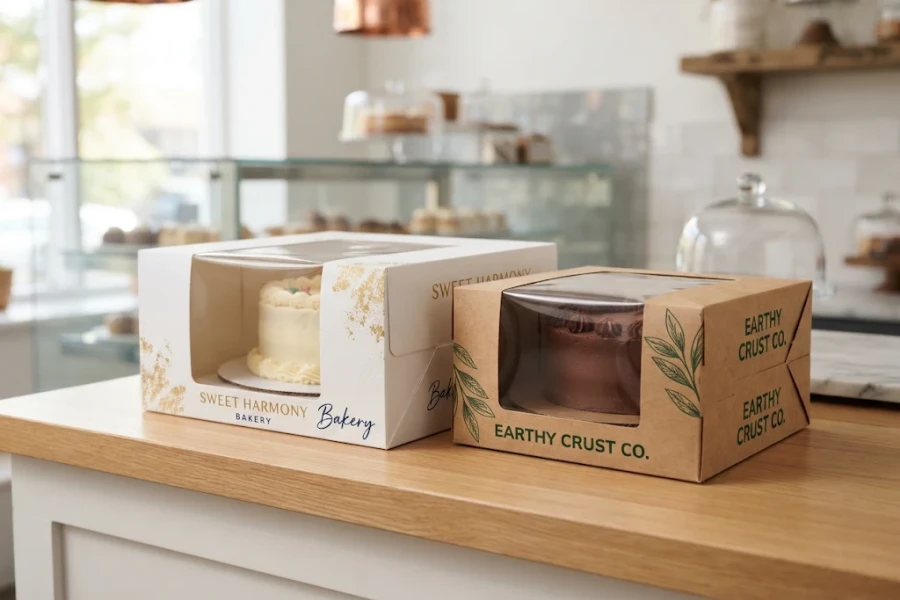
Cake boxes collapse during delivery when the packaging system—comprising the paperboard grade, structural locking design, cake board rigidity, and moisture barrier—fails to match the cake’s weight and transit conditions. Simply ordering “thicker paperboard” rarely solves the problem if the box geometry or locking tabs are poorly engineered.
This guide breaks down the five primary engineering causes of cake box failure, compares folding carton vs. corrugated structures, and provides a pre-production testing checklist for bakery chains and packaging buyers.
Understanding the Mechanics of Cake Box Failure
In commercial bakery logistics, a cake box functions as a protective enclosure rather than a primary load-bearing platform. Unlike corrugated shipping cartons engineered for vertical stacking, standard folding carton cake boxes rely on tension between the sidewalls, corner locks, and the interior cake board to maintain geometry.
When one component in this system fails, it triggers a chain reaction:
-
Base Deflection: Concentrated weight in the center of the box causes the bottom panel to bow downward.
-
Inward Sidewall Pull: As the bottom panel sags, it pulls the lower edges of the sidewalls inward.
-
Corner Lock Disengagement: Tension concentrates at the corner tabs, causing friction locks to pop open.
-
Top-Panel Collapse: Without vertical corner support, the lid drops onto delicate buttercream, fondant, or fruit toppings.
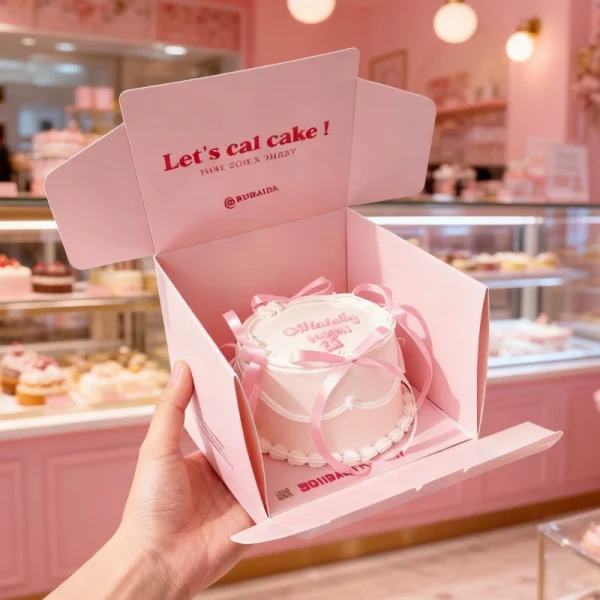
5 Common Reasons Cake Boxes Lose Their Shape
Before increasing material costs, identify where the box is deforming. A sagging center indicates a base-support failure, whereas inward-buckling walls point to low panel rigidity or humidity exposure.
1. Unsupported Base Span & Undersized Cake Boards
When a heavy cake (such as a multi-tier wedding cake, dense cheesecake, or fruit-topped sponge) is lifted by the sides of the box, the center of the bottom panel experiences maximum bending stress. If the cake board is smaller than the box’s interior footprint, the board slides during transit and fails to transfer weight to the box perimeter.
Engineering Solution:
- Zero-Gap Board Sizing: Match the cake board diameter or width to the exact interior base dimension of the box (leaving less than 2–3 mm clearance). A snug cake board acts as an internal structural brace that prevents sidewalls from bowing inward.
- Upgrade Board Rigidity: For cakes under 1.5 kg (3.3 lbs), use a 3 mm compressed greyboard or white corrugated cake pad. For cakes over 2.0 kg (4.4 lbs), mandate a 12 mm (1/2-inch) wrapped Cake Drum paired with an Auto-Lock (Crash-Lock) Bottom box.
2. Sidewall Buckling on Large-Footprint & Tall Boxes
As box dimensions exceed 10″ × 10″ (250 × 250 mm) or heights exceed 6″ (150 mm), flat paperboard panels lose resistance to lateral buckling. Even minor external pressure during van loading or courier handling causes tall walls to crease inward.
Engineering Solution:
- Switch to Front-Loading (Drop-Front) Structures: For tall or tiered cakes, top-loading forces staff to reach deep into the box, often flexing the sidewalls. A drop-front box allows the cake drum to slide in horizontally on a flat plane while maintaining full-height corner rigidity.
- Double-Wall Reinforced Side Folds: Specify roll-over side panels (similar to bakery tray locks) that double the paperboard thickness along the vertical load-bearing walls.
3. Selecting Paperboard by Thickness (Caliper) Instead of Stiffness (Taber/Bending Resistance)
A common procurement mistake is ordering “400 GSM paperboard” without specifying fiber composition. Low-density recycled duplex board at 400 GSM has significantly lower bending stiffness than 350 GSM virgin SBS (Solid Bleached Sulfate) or FBB (Folding Box Board), leading to premature sagging under identical loads.
Engineering Solution: Specify paperboard by fiber grade and bending stiffness, not weight alone:
- Virgin Long-Fiber Kraft / SBS: Offers superior tear resistance and clean folding without fiber cracking.
- Micro-Flute Corrugated (E-Flute / F-Flute): For boxes larger than 12 inches or loads exceeding 3 kg, transition from solid paperboard to E-flute (1.5 mm thickness) or F-flute (0.8 mm thickness) corrugated board, which increases edge crush resistance by over 200% compared to solid carton board.
4. Score-Line Cracking & Weak Friction Corner Locks
During die-cutting, excessive creasing rule pressure fractures the outer cellulose fibers along fold lines. Once those fibers crack, the corner loses up to 50% of its structural rigidity. Furthermore, basic slit-lock corners easily disengage when a delivery driver carries the box with one hand.
Engineering Solution:
- Hooked Ear-Lock Tabs: Replace straight friction slits with angled, barbed locking tabs that mechanically hook into the sidewall slots and resist vibration.
- Matrix Creasing Calibration: Require your manufacturer to use precision phenolic creasing matrices matched to the exact board caliper so fold lines hinge cleanly without surface cracking.
5. Cold-Chain Condensation & High-Humidity Softening
Cellulose fibers are hygroscopic. When a cake chilled at 2°C–4°C (35°F–39°F) enters a warm delivery vehicle or humid ambient environment (25°C+ / 70%+ RH), moisture condenses on the box exterior and wicks into raw cut edges. Within 20 minutes, uncoated paperboard can lose 30%–40% of its dry compression strength.
Engineering Solution:
- Two-Sided Moisture Barriers: If cakes are refrigerated inside the box, single-side interior grease coating is insufficient—external condensation will still soften the outer wall. Specify interior PE (Polyethylene) extrusion coating combined with an exterior matte/gloss BOPP lamination or aqueous barrier varnish.
- Sealed Bottom Edges: Use auto-lock glued bases rather than open-slit corners for chilled cakes to minimize exposed raw paper edges where moisture wicks fastest.
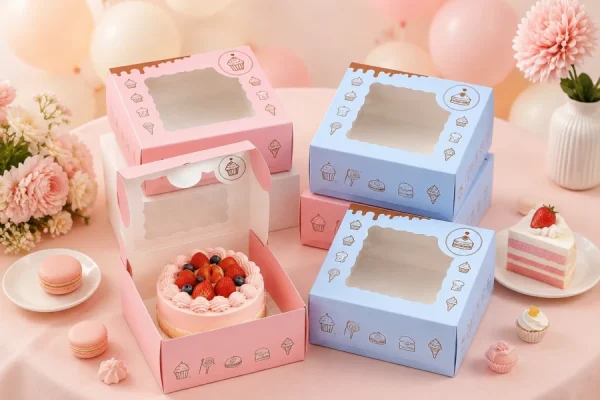
Cake Box Material & Structure Selection Matrix
Use this engineering reference table to match your cake specifications to the right structural configuration:
| Cake Category & Weight | Recommended Box Structure | Paperboard / Flute Specification | Required Cake Board | Moisture / Grease Treatment |
| Cupcakes & Small Pastries (< 0.8 kg / 1.8 lbs) | One-Piece Tuck-Top Folding Carton (with PET/PLA Window) | 300–320 GSM Virgin SBS or Natural Kraft | Optional insert tray (250–300 GSM) | Interior grease-resistant aqueous coating |
| Standard 6″–8″ Layer Cakes (1.0–2.0 kg / 2.2–4.4 lbs) | Auto-Lock Bottom + Tuck-Top or Two-Piece Lid & Base | 350–400 GSM Virgin FBB / SBS White Board | 3–4 mm Compressed White Cake Board | Interior PE lining or food-grade barrier coat |
| Large 10″–14″ Sheet & Celebration Cakes (2.5–4.5 kg / 5.5–10 lbs) | Two-Piece Telescope Box or Reinforced Lock-Corner Tray | F-Flute or E-Flute Corrugated (250 GSM Liner + 120 GSM Medium) | 10–12 mm Foil/White Wrapped Cake Drum | Exterior BOPP lamination + interior PE coat |
| Tall / Multi-Tier Wedding Cakes (4.5 kg+ / 10 lbs+) | Front-Loading (Drop-Front) Heavy-Duty Corrugated Box | Double-Wall E-Flute or B-Flute Corrugated | 12–15 mm Heavy-Duty Masonite / Drum | Full moisture-barrier lamination for cold storage |
Folding Carton vs. Micro-Flute Corrugated: Procurement Trade-Offs
Choosing between solid folding carton board and micro-flute corrugated board requires balancing structural protection, print aesthetics, and warehouse logistics:
| Evaluation Factor | Folding Carton (Solid Paperboard) | Micro-Flute Corrugated (E-Flute / F-Flute) |
| Structural Rigidity | Moderate; relies heavily on cake board bracing | High; internal fluted arches resist vertical and side crushing |
| Print & Branding Quality | Superior; supports direct offset printing, hot foil stamping, spot UV, and embossing | Good; requires litho-lamination for high-resolution graphics (flexo is more economical) |
| Stacking Capability | Not stackable when filled without rigid delivery crates | Supports 2–3 high stacking for short-haul van transit (depending on cake height) |
| Warehouse Storage Volume | Ultra-compact flat packing (approx. 1,000 pcs per pallet) | Bulky flat packing (approx. 300–450 pcs per pallet; 2.5× higher freight volume) |
| Unit Cost Benchmark | Lower unit cost for standard sizes (6″–9″) | 20%–45% higher unit cost due to multi-ply material and laminating steps |
Critical Sizing & Internal Clearance Standards
Incorrect internal dimensions are a leading cause of both transit damage and structural stress:
Horizontal Footprint (Length × Width):
- Size the box interior to match the cake board outer dimension plus 2–4 mm ease of insertion.
- Example: An 8-inch cake placed on a 10-inch cake drum requires a 10.1″ × 10.1″ (256 × 256 mm) internal box footprint. Leaving 2 inches of empty space around the cake board allows the board to slam against the sidewalls during vehicle braking, breaking corner locks.
Vertical Clearance (Height):
- Measure from the bottom of the cake board to the highest decorative element (toppers, macarons, piped rosettes).
- Add 25–40 mm (1.0″–1.5″) of headspace. If your menu includes seasonal tall toppers, order modular height-extender collars rather than over-sizing standard boxes, which wastes material and weakens sidewall stability.
For a more detailed discussion of dimensions, see our Bakery Box Sizes Guide for Cakes, Pastries and Donuts.
4-Step Pre-Production Quality & Transit Testing Protocol
Before authorizing a bulk production run of custom cake boxes, request white structural samples (blank die-cut prototypes) and execute these four physical verification tests:
1. The Loaded Corner-Lift Deflection Test
Place a dummy weight equal to your heaviest cake (e.g., 3 kg) onto the cake board inside the assembled box. Lift the box by its side edges—simulating how retail staff hand boxes to customers.
Pass Criteria: Center bottom deflection must remain under 4 mm, and all corner locking tabs must stay fully engaged without popping.
2. The Cold-Chain Condensation Test (Cobb / Humidity Simulation)
Place the assembled box containing a chilled product in a 4°C (39°F) refrigerator for 2 hours, then transfer it to a 25°C (77°F) room for 45 minutes.
Pass Criteria: Surface condensation must bead on the outer coating rather than soaking into the paper fibers, and bottom corner glue joints must show zero delamination.
3. Window Film Adhesion & Fogging Check
If your box features a clear display window (PET, OPP, or compostable PLA film), verify that adhesive strips stay bonded under refrigerated humidity and that anti-fog treatment prevents condensation from obscuring product visibility.
4. Short-Haul Vehicle Transit Simulation
Place the boxed cake on a flat delivery vehicle floor or trunk mat and drive a 15-minute route featuring standard speed bumps, roundabouts, and firm braking.
Pass Criteria: Zero sliding of the cake board, zero contact between frosting and interior walls, and intact lid closure.
What Should Buyers Specify When Ordering Custom Cake Boxes?
When requesting a quotation from a cake box manufacturer, providing only the cake diameter or box dimensions may not be sufficient. The manufacturer needs to understand the product, weight, structural requirements, and delivery conditions to recommend a suitable packaging design.
| Specification | Information to Provide |
|---|---|
| Cake dimensions | Diameter or length, width and height |
| Cake weight | Approximate finished weight |
| Cake board | Required board size and type, if applicable |
| Box structure | Folding carton, corrugated, or preferred design |
| Material requirements | Preferred paperboard or performance requirements |
| Window | Whether a transparent display window is required |
| Printing | Custom artwork, colors and finishing |
| Storage conditions | Ambient, refrigerated or other conditions |
| Delivery requirements | Stacking, carrying and transportation conditions |
| Order quantity | Estimated production quantity |
If you are unsure which material or structure to choose, provide the cake details and intended application first. A packaging manufacturer can then assess the dimensions, board options, bottom support, and structural design before samples are produced.
Frequently Asked Questions About Cake Box Strength
Why Does the Bottom of a Cake Box Sag?
The bottom of a cake box may sag when the base structure cannot adequately support the cake’s weight. An unsuitable cake board, a large unsupported base area, or weak bottom locking features can contribute to the problem. Evaluating the cake board and box base together is an important first step.
How Thick Should Paperboard Be for Cake Boxes?
There is no single paperboard thickness suitable for every cake box. The appropriate material depends on the cake’s weight, box dimensions, structural design, and transportation conditions. Buyers should evaluate the finished box rather than selecting material based on thickness alone.
Are Corrugated Cake Boxes Stronger Than Folding Carton Boxes?
Corrugated cake boxes can provide additional structural support for certain applications because of their fluted construction. However, actual performance depends on board grade, flute structure, box geometry, and manufacturing quality. Folding carton boxes may be suitable for many standard bakery applications.
Can Cake Boxes Be Stacked During Delivery?
Some cake boxes can be stacked when their structure and stacking conditions have been properly evaluated. However, stacking should not be assumed safe for every design. Box strength, cake weight, lid construction, and the number of stacked packages all matter.
How Do You Prevent Cake Boxes from Collapsing in Refrigerated Storage?
Choose a box structure suitable for the expected moisture and temperature conditions. Evaluate the paperboard, surface treatment, folds, and base construction, and test the assembled box under representative refrigerated storage and delivery conditions.
Does Using Thicker Paperboard Always Prevent Cake Box Collapse?
No. Thicker paperboard may improve rigidity in some applications, but it cannot automatically correct weak locking structures, insufficient bottom support, oversized panels, or poor internal fit. Structural design and material selection must work together.
Engineer Custom Cake Boxes Built for Safe Delivery
Preventing cake box collapse requires aligning board stiffness, locking geometry, cake board fit, and moisture barriers with your exact bakery menu and delivery conditions.
RBD Packaging manufactures custom folding carton and micro-flute corrugated cake boxes for commercial bakeries, patisserie chains, and food-service distributors. Send your cake dimensions, finished weight, storage conditions, and estimated order volume to our structural engineering team to request die-line templates, physical prototypes, and a bulk factory quote.