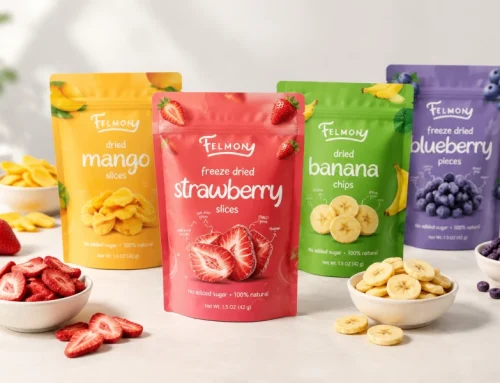
TL;DR: For many food and retail applications, 3.5–5 mil (89–127 microns) is a useful starting range for Mylar-type bags. Thicker options may be suitable for heavier or sharper contents that need additional puncture resistance. However, thickness alone does not determine oxygen or moisture protection. The laminate structure, barrier layer, seal quality, and product requirements must all be considered before choosing a specification.
Choosing the right Mylar bag thickness is not simply a matter of selecting the highest mil number. Buyers need to understand how thickness affects durability, how different laminate structures protect products, and which specifications suppliers should provide in a quotation.
This guide explains mil, micron, and gauge measurements, compares common thickness ranges, and shows how to specify a custom Mylar bag for your product.
What Does Mylar Bag Thickness Mean?
Mylar bag thickness refers to the overall thickness of the finished laminated pouch, which is typically measured in mils in North America or microns (μm) in many international markets.
The table below provides a direct conversion reference for standard packaging gauges:
| Mil (Thousandths of an Inch) | Common gauge equivalent | Microns (μm) |
| 2.0 mil | 200 gauge | 50.8 μm |
| 3.0 mil | 300 gauge | 76.2 μm |
| 3.5 mil | 350 gauge | 88.9 μm |
| 4.0 mil | 400 gauge | 101.6 μm |
| 5.0 mil | 500 gauge | 127.0 μm |
| 6.0 mil | 600 gauge | 152.4 μm |
| 7.0 mil | 700 gauge | 177.8 μm |
Important: Gauge conventions can vary between suppliers and packaging industries. Always confirm the unit and measurement method rather than comparing gauge numbers without clarification.
Does the quoted thickness refer to the whole bag or one layer?
For a laminated flexible packaging bag, the quoted thickness should normally identify the total laminate thickness of one bag wall, rather than the thickness of just one material layer.
A flexible packaging structure may combine several materials, such as:
- PET: Provides a printable outer surface and contributes to mechanical strength.
- VMPET: Metallized PET that contributes to barrier performance.
- AL: Aluminum foil, used when a higher barrier structure is required.
- PE: Commonly used as the inner heat-seal layer.
The exact materials and layer thicknesses depend on the bag design and product requirements.
When comparing supplier quotations, ask whether the stated thickness refers to the total laminate thickness, a single layer, or another measurement. Also confirm whether the value is nominal or based on a measured sample.

Which Mylar Bag Thickness Is Suitable for Your Product?
The appropriate Mylar bag thickness depends on product weight, handling conditions, puncture risk, bag dimensions, and the required packaging structure. The following ranges are preliminary selection references, not universal industry standards or guaranteed performance ratings.
| Preliminary thickness range | Micron equivalent | Potential applications | What to check |
|---|---|---|---|
| 2–3 mil | 51–76 µm | Lightweight samples, small portions, and short-term packaging applications | Seal integrity and handling requirements |
| 3.5–5 mil | 89–127 µm | Retail snacks, coffee, dry foods, spices, and similar products | Laminate structure, seal strength, and puncture resistance |
| 5–7 mil | 127–178 µm | Heavier fills, bulk dry goods, or products with sharper edges | Puncture resistance, seal performance, and bag dimensions |
| Above 7 mil | Above 178 µm | Selected heavy-duty or industrial packaging applications | Whether the additional thickness is necessary and compatible with the filling and sealing process |
These ranges are intended to help buyers start a specification discussion. They should not be treated as proof that a particular thickness will support a specific product weight or shelf life.
What thickness should you choose for coffee bags?
Coffee bag thickness should be selected according to the bag format, coffee weight, distribution conditions, and required aroma and oxygen protection.
For roasted coffee, the laminate structure is especially important because coffee quality can be affected by oxygen, moisture, and aroma loss. Buyers should also consider whether the bag needs a one-way degassing valve, zipper, or other closure feature.
When requesting a quotation, specify:
- Coffee type and fill weight.
- Bag format, such as flat bottom, side gusset, or stand-up pouch.
- Whether a one-way degassing valve is required.
- Required barrier structure.
- Target shelf life and storage conditions.
- Whether the bag will be heat-sealed above the zipper.
Do not select a coffee bag based on mil alone. Ask the supplier to recommend a complete laminate structure and provide relevant material or barrier data where available.
What thickness is suitable for snacks and dry foods?
For snacks, cookies, dried fruit, and other dry foods, the required thickness depends on product weight, shape, sharp edges, packaging dimensions, and distribution handling.
Lightweight products may not need a heavy laminate, while products with hard or sharp edges may require additional puncture resistance. The seal and laminate structure should also be checked to ensure the finished bag suits the product’s storage requirements.
Do heavier products always need thicker bags?
Not necessarily. Product weight is only one part of the specification. Bag dimensions, gusset design, material structure, sealing conditions, and the way the product is packed all affect performance.
For heavier contents, ask the supplier to evaluate the complete bag design and test a sample with the intended fill weight. Increasing thickness without reviewing the seal and overall structure may not solve the actual packaging problem.
What Mylar Bag Thickness Is Suitable for Cannabis Packaging?
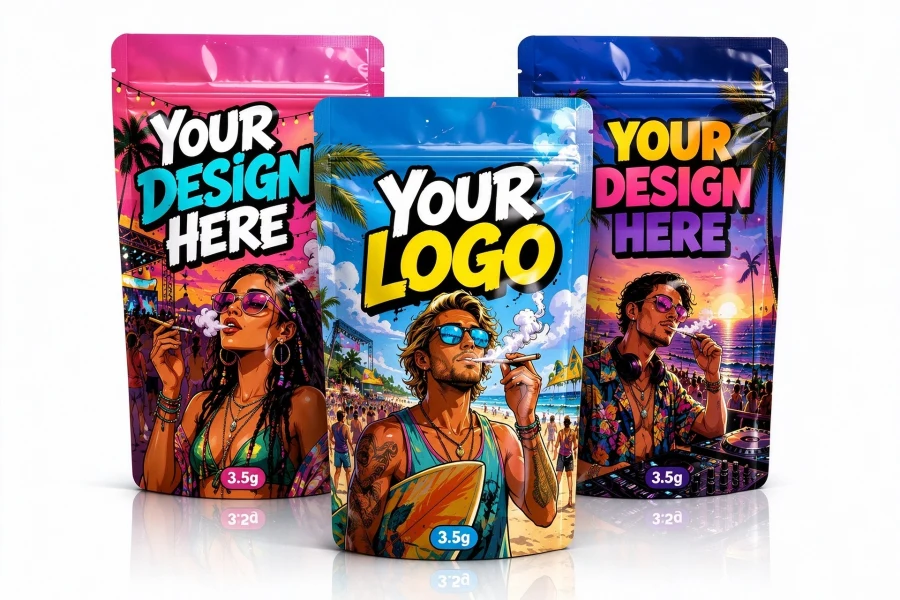
Cannabis packaging requires more than choosing a thicker pouch. The right Mylar bag specification depends on the product type, aroma-control requirements, moisture sensitivity, handling conditions, and applicable packaging regulations.
Different cannabis products may need different packaging structures:
| Cannabis product | Main packaging considerations | What to evaluate |
|---|---|---|
| Cannabis flower | Aroma retention, moisture protection, and light protection | Laminate barrier, seal integrity, and storage conditions |
| Pre-rolls | Protection against bending, crushing, and punctures | Bag dimensions, material durability, and closure design |
| Cannabis edibles | Product protection and packaging compatibility | Food-contact suitability, moisture barrier, and sealing |
| Cannabis concentrates | Material compatibility and leak prevention | Inner sealant layer, closure design, and compatibility testing |
| Cannabis gummies | Moisture control and product protection | Water vapor barrier, inner material, and seal integrity |
Should cannabis flower use a thicker Mylar bag?
Not necessarily. Cannabis flower packaging should be selected according to the required aroma and moisture protection, bag dimensions, fill weight, and storage conditions. A thicker laminate may improve mechanical durability, but it does not automatically provide better aroma retention or moisture protection.
The barrier structure and seal integrity should be evaluated together. Buyers should request the proposed laminate specification and relevant material test data instead of relying on the mil rating alone.
What should buyers consider when choosing Mylar bags for pre-rolls?
Pre-roll packaging needs to protect the product during filling, storage, and transportation. The bag should be sized to reduce unnecessary movement and should provide sufficient resistance to handling damage.
Depending on the product format, buyers may consider flat pouches, custom printed pouches, or other packaging formats designed for pre-roll products. Material thickness should be selected after evaluating the actual dimensions, contents, and transportation conditions.
Are thicker Mylar bags enough for compliant cannabis packaging?
No. Material thickness alone does not establish regulatory compliance. Depending on the product and destination market, cannabis packaging may have requirements related to child resistance, tamper evidence, opacity, labeling, and other packaging characteristics.
These requirements vary by jurisdiction and product category. Buyers should confirm the applicable rules before approving the packaging design and should not assume that a standard Mylar pouch automatically meets cannabis packaging requirements.a
Does a Thicker Mylar Bag Always Provide Better Barrier Protection?
No. A thicker Mylar-type bag does not automatically provide better oxygen or moisture protection. Total thickness can contribute to mechanical durability, while barrier performance depends heavily on the materials and structure used in the laminate.
This distinction matters because two bags with similar total thickness can have different barrier properties.

Aluminum foil vs. metallized PET
Two common flexible packaging structures are:
| Laminate structure | Main barrier material | General characteristics | Typical consideration |
|---|---|---|---|
| PET/AL/PE | Aluminum foil | High-barrier structure when the foil and laminate are intact | Suitable for products requiring strong protection from oxygen, moisture, and light |
| PET/VMPET/PE | Metallized PET | Provides barrier performance through a metallized layer | Often considered where a balance of appearance, barrier, and cost is required |
| PET/PE | No foil or metallized layer | Provides a printable outer layer and heat-sealable inner layer | Barrier requirements should be evaluated for the specific product |
These are simplified examples. Actual performance depends on the material grade, layer thickness, manufacturing quality, bag design, and seal integrity.
When should you choose an aluminum foil laminate?
An aluminum foil structure may be appropriate when the product requires strong protection from oxygen, moisture, and light. It is worth evaluating for products that are particularly sensitive to environmental exposure or require demanding storage conditions.
However, the presence of foil alone does not guarantee the performance of the finished package. Pinholes, flex cracking, poor lamination, damaged seals, or unsuitable storage conditions can affect the overall protection.
When is metallized PET sufficient?
Metallized PET may be suitable for applications where its barrier performance meets the product’s actual requirements and a foil structure is not necessary.
The decision should be based on the product’s sensitivity, target shelf life, storage conditions, and available material data—not simply on the assumption that a thicker bag will provide a higher barrier.
What are OTR and WVTR?
OTR and WVTR are two important measurements used to evaluate packaging barrier properties.
- OTR (Oxygen Transmission Rate): Measures the rate at which oxygen passes through a material under specified test conditions.
- WVTR (Water Vapor Transmission Rate): Measures the rate at which water vapor passes through a material under specified test conditions.
When a supplier provides OTR or WVTR data, buyers should check the test method, temperature, relative humidity, specimen structure, and units. Results from different test conditions should not be compared as if they were directly equivalent.
If your product requires a specific barrier level, include the target in the RFQ or ask the supplier to provide available test data for the proposed laminate structure.
What Other Factors Affect Mylar Bag Durability?
Mylar bag durability depends on more than total thickness. The laminate structure, bag format, seals, closures, and converting quality all affect how the finished package performs.
Laminate structure
Different material combinations provide different mechanical, sealing, and barrier properties. A supplier should identify the proposed material layers rather than quoting only a total thickness.
Heat-seal quality
The heat-seal layer and sealing process affect whether the finished bag can maintain a reliable closure. Seal performance depends on material compatibility, temperature, pressure, dwell time, and production conditions.
A thicker bag does not automatically have a stronger seal. The complete structure and sealing process must be evaluated together.
Bag dimensions and format
A flat pouch, stand-up pouch, and flat-bottom bag have different construction requirements. Gussets, corners, side seals, and bottom seals can affect how the bag handles its contents.
The dimensions should be matched to the product’s volume and shape. An unsuitable bag size can create unnecessary stress during filling, sealing, and transportation.
Zippers, valves, and other features
Additional features can change the construction and usable space of a bag.
For example:
- A zipper provides a resealable opening but does not replace the initial heat seal.
- A one-way degassing valve may be required for certain coffee applications.
- A tear notch can make the bag easier to open but should be positioned without compromising the seal.
- A transparent window changes the material structure and should be evaluated against the product’s barrier requirements.
Specify these features before sampling so the supplier can evaluate the complete packaging design.
What Should You Include in a Custom Mylar Bag RFQ?
| RFQ item | Information to provide | Why it matters |
|---|---|---|
| Product | Coffee, snacks, dried fruit, supplements, or other contents | Helps determine material and packaging requirements |
| Fill weight | Actual product weight per bag | Helps assess bag dimensions and mechanical requirements |
| Bag dimensions | Width × height × gusset or bottom dimensions | Defines the finished bag size |
| Bag format | Flat pouch, stand-up pouch, side gusset, or flat bottom | Determines the construction |
| Total thickness | Preferred mil or micron range, if known | Provides a starting point for material selection |
| Laminate structure | PET/AL/PE, PET/VMPET/PE, or supplier recommendation | Identifies the actual material combination |
| Barrier requirements | Oxygen, moisture, or light sensitivity; OTR/WVTR targets if known | Helps determine the barrier layer |
| Closure | Heat seal, zipper, valve, or tear notch | Affects design and sealing requirements |
| Printing | Artwork, colors, finish, and surface requirements | Defines the appearance and printing specification |
| Order quantity | Estimated order volume | Helps determine production and pricing options |
At RBD Packaging, buyers can discuss custom bag dimensions, laminate structures, printing, and packaging features according to their product requirements. Providing the fill weight, intended application, and barrier needs helps the team evaluate a suitable specification before sampling and production.
Frequently Asked Questions
Are thicker Mylar bags always better?
No. Thicker Mylar bags cost more to purchase, increase freight expenses, and require higher sealing temperatures which can slow down production lines. If the underlying material formulation lacks a high-barrier layer like aluminum foil, simply increasing thickness will not effectively extend shelf life.
Is a 5 mil Mylar bag better than a 4 mil bag?
Not always. A 5 mil bag offers greater puncture resistance, but a 4 mil high-barrier laminate may provide equal or better product protection depending on the application.
Does a thicker Mylar bag provide a longer shelf life?
Not necessarily. Shelf life depends primarily on the barrier properties of the laminate, including resistance to oxygen, moisture, and light. Thickness contributes to durability but is only one factor.
Which thickness is best for coffee packaging?
Most roasted coffee products perform well in 4–5 mil aluminum foil pouches equipped with one-way degassing valves.
Can Mylar bag thickness be customized?
Yes. Most custom packaging manufacturers offer multiple thickness options and laminate structures tailored to different products and production requirements.
How do I choose the right Mylar bag thickness for my business?
Calculate the total weight of your product, identify any sharp edges, define your target shelf life, and review the specifications of your filling and sealing equipment. Ordering a physical sample kit with varying mil levels allows your team to perform real-world testing prior to committing to a bulk production contract.
Request a Custom Mylar Bag Specification
The right Mylar bag specification balances mechanical durability, barrier requirements, sealing performance, and cost. Instead of choosing a bag based on thickness alone, define what the package needs to protect and ask the supplier to recommend a complete laminate structure.
RBD Packaging provides custom flexible packaging solutions, including printed pouches and bags with different material structures, sizes, and closure options.
To discuss your project, send us your product type, fill weight, bag dimensions, preferred structure, and estimated order quantity.