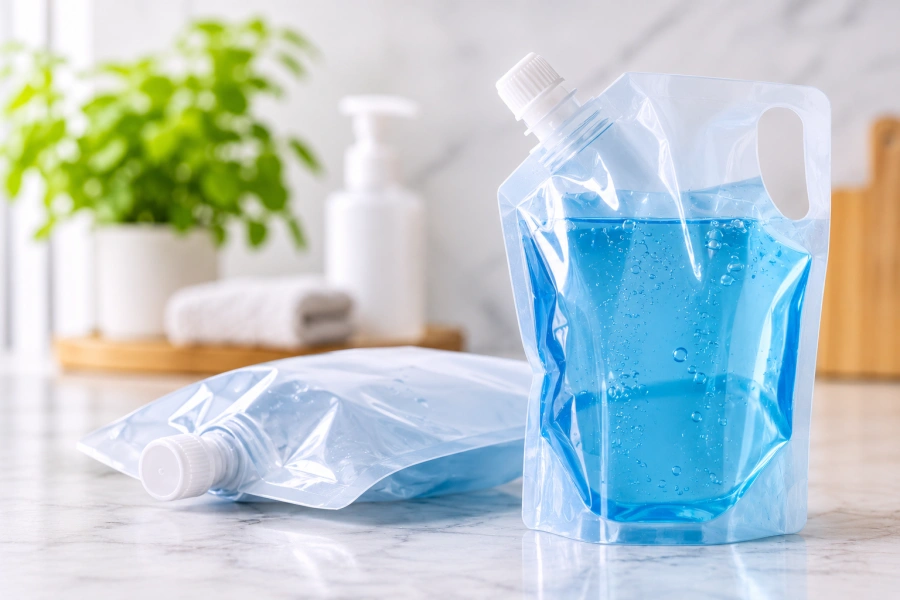
Spout pouch leakage can damage an entire shipment, trigger customer complaints, and create costly returns for liquid refill brands. However, the film itself is not always the problem.
Most leakage issues are related to mismatched specifications, including spout-to-film compatibility, cap torque, seal design, filling conditions, or structural stress. Identifying the exact failure point is the first step toward building a more reliable liquid packaging solution.
This guide explains five common causes of spout pouch leakage, how to prevent them, and what to test before placing a bulk order.
Quick Reference: Spout Pouch Leak Location, Cause and Solution
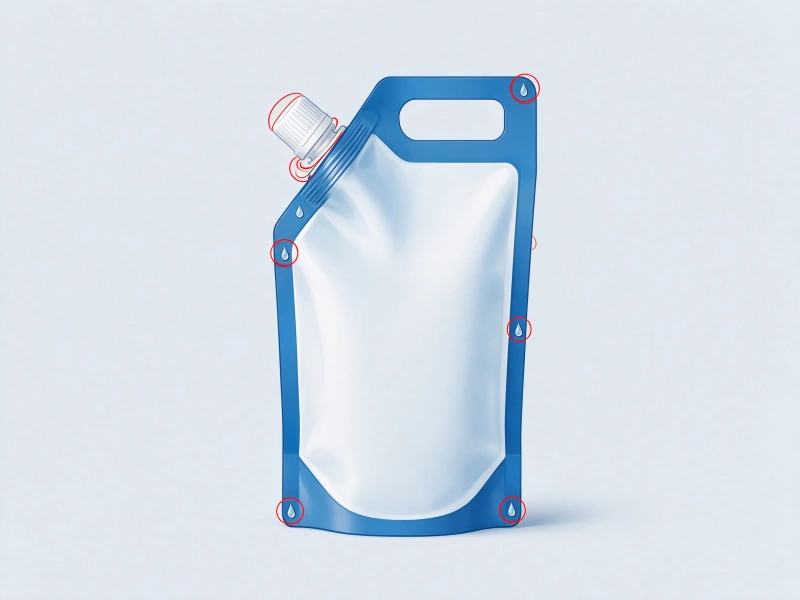
The location of a leak often provides the first clue to its underlying cause.
| Leak Location | Likely Root Cause | Recommended Action |
|---|---|---|
| Around the spout base | Spout-to-film weld failure | Check alignment, flange compatibility and weld strength |
| Under the cap | Thread, liner or torque mismatch | Validate cap fit and closing torque |
| Random side or top seal | Seal contamination or inconsistent sealing | Inspect seal bars and filling conditions |
| Bottom corners | Gusset stress or drop impact | Review gusset construction and filled-pouch performance |
| Along handle edges | Die-cut stress or insufficient reinforcement | Review handle geometry and reinforcement |
| Repeated leaks at the same position | Filling line or equipment damage | Map leak locations against machine contact points |
A leak around the spout base requires a different solution from one caused by cap threads or contaminated side seals. Replacing the entire film structure without identifying the failure point may increase costs without resolving the problem.
1. Spout-to-Film Weld Failure: A Common Cause of Leakage
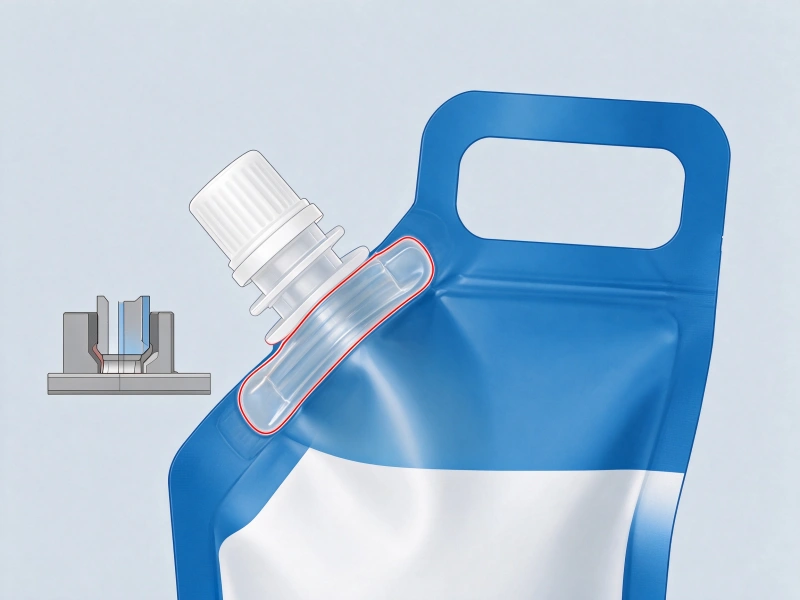
What You See
The pouch arrives at the warehouse without visible damage but begins leaking around the spout base after transportation, stacking, or handling.
Sometimes the failure appears as a slow seep rather than an immediate burst. Small amounts of liquid may accumulate around the spout flange or inside the outer packaging.
Why It Happens
The spout fitment is attached to the pouch through a heat-welding process. The quality of this connection depends on material compatibility and controlled welding conditions.
Common causes include:
- Misaligned spout placement: Uneven positioning can result in inconsistent welding around the flange.
- Incorrect welding parameters: Temperature, pressure and dwell time that are not properly matched to the materials may create incomplete fusion.
- Incompatible materials: The spout material and the pouch’s inner sealant layer must be suitable for the intended welding process.
- Contamination: Liquid, dust or other residues around the welding area can interfere with the bond.
- Insufficient welding area: An unsuitable flange design may not provide adequate bonding area for the application.
A spout connection can appear visually acceptable while still having insufficient mechanical strength. This is why visual inspection alone cannot establish weld integrity.
How to Prevent Spout-to-Film Weld Failure
The spout flange, pouch film and welding parameters should be evaluated as one connected system.
For liquid refill applications, consider the following:
- Use appropriate positioning fixtures to maintain consistent spout alignment during welding.
- Match the spout material to the pouch’s inner sealant layer.
- Evaluate flange dimensions and available welding area according to pouch capacity and expected mechanical stress.
- Validate welding conditions through suitable seal-strength and package-integrity tests.
For larger liquid pouches, a wider flange design may provide additional welding area. For example, 10–12 mm flange options can be evaluated for certain heavy-fill applications, but the final dimension should depend on the spout design, film structure and test results rather than being treated as a universal requirement.
Testing consideration: ASTM F88/F88M is a recognized method for measuring the seal strength of flexible barrier materials. It can help evaluate suitable seal specimens, although a complete spout-to-film connection also requires application-specific evaluation. ASTM F88/F88M
2. Cap and Thread Leakage: Why Does a Spout Pouch Leak After Reclosing?
What You See
The pouch passes initial inspection but leaks after the customer opens and recloses the cap.
Common complaints include:
- The cap does not tighten properly.
- Liquid drips around the spout after opening.
- The pouch leaks when stored horizontally.
- The closure becomes loose after repeated use.
This type of failure is particularly important for refill packaging because consumers may open and close the pouch many times.
Why It Happens
Cap leakage is often caused by a mismatch between the closure components or incorrect closing conditions.
1. Thread incompatibility
The cap and spout must have compatible thread dimensions and tolerances. Components that appear similar may not form a reliable closure when paired incorrectly.
2. Incorrect closing torque
Too little torque may prevent the cap from seating properly. Excessive torque may damage threads, distort closure components or affect the sealing interface.
3. Liner or sealing interface problems
Some closures use an inner liner or integrated sealing feature. If this component is missing, damaged, incorrectly positioned or unsuitable for the application, leakage may occur.
4. Temperature and internal pressure changes
Hot filling, temperature fluctuations and product characteristics can affect internal pressure and closure performance. These conditions should be considered when selecting the cap and spout combination.
How to Prevent Cap and Thread Leakage
A reliable closure requires more than simply choosing a cap that fits the spout.
Before bulk production, evaluate:
- Thread compatibility between the cap and spout.
- The sealing mechanism, including any liner or integrated seal.
- Recommended closing torque for the selected closure.
- Leakage performance after repeated opening and reclosing.
- Performance under the intended storage and temperature conditions.
RBD Packaging can help match spout and cap options to the pouch structure and intended application. For customers with existing filling equipment, the recommended closure specification should also be checked against the machine’s torque settings.
For hot-fill or pressure-sensitive products, the complete closure system should be evaluated under the actual processing conditions rather than relying on a standard cap specification.
3. Seal Contamination: When Filling Conditions Cause Leakage
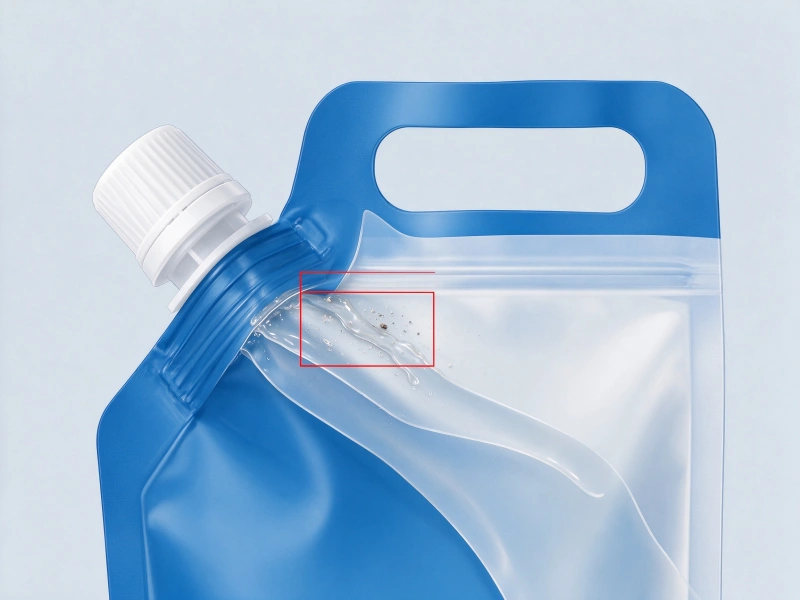
What You See
Leaks appear randomly along the side or top seals instead of around the spout.
When the failed seal is inspected, there may be visible residue, liquid trails, wrinkles or areas where the sealing layers have not fused consistently.
Why It Happens
During liquid pouch filling, the sealing area must remain clean enough for the heat-sealing process to work properly.
Common causes include:
- Nozzle dripping: Liquid remaining around the filling nozzle may enter the sealing area.
- Foaming products: Detergents, shampoos and other formulations can produce foam that reaches the top seal.
- Overfilling: Excessive filling volume reduces the available sealing area.
- Seal bar contamination: Residue on the sealing equipment can affect subsequent pouches.
- Unsuitable sealing conditions: Incorrect temperature, pressure or dwell time can result in inconsistent seals.
Even a well-designed pouch may leak if the filling process repeatedly contaminates the sealing zone.
How to Prevent Seal Contamination
The solution requires coordination between pouch design and filling-line conditions.
1. Provide sufficient sealing width
Liquid pouches may require different sealing specifications from dry-product packaging. The appropriate width depends on the pouch dimensions, material structure, fill weight and sealing process.
Wider seals can provide additional sealing area where required, but increasing seal width alone will not solve contamination problems.
2. Select an appropriate sealant layer
Materials such as metallocene LLDPE (mLLDPE) may offer useful heat-sealing characteristics in selected flexible packaging structures.
However, the correct sealant should be chosen according to the full film construction, product compatibility and sealing conditions. No sealant material can replace proper control of liquid or foam contamination.
3. Control filling conditions
Review nozzle positioning, drip-back, filling volume and foam generation. Where practical, the filling nozzle should be positioned to minimize contact between the liquid and the sealing area.
4. Validate the sealing process
Check sealing temperature, pressure and dwell time using the actual pouch structure. Sample testing should confirm that the finished seals remain consistent under the intended filling conditions.
4. Handle and Gusset Stress Failure: Common in Large Refill Pouches
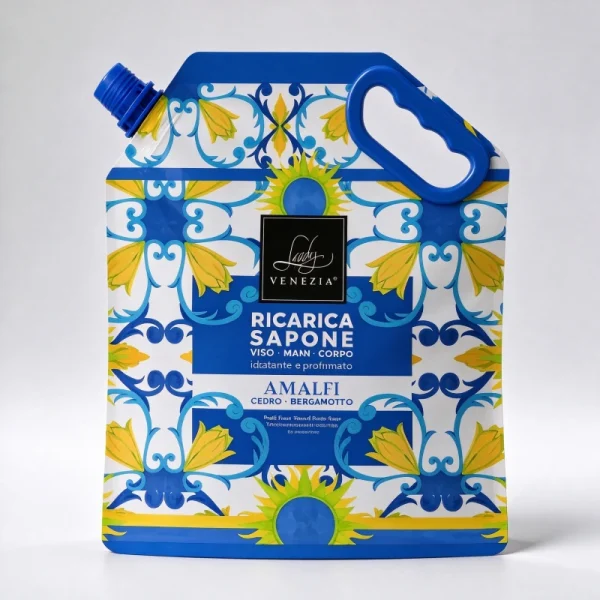
What You See
Leaks or tears appear around the bottom corners, gusset seals or handle edges, particularly in larger refill pouches.
The damage may occur after stacking, lifting, dropping or transportation.
Unlike a simple sealing defect, this problem is often related to structural stress concentrated around specific parts of the pouch.
Why It Happens
1. Insufficient gusset reinforcement
The bottom gusset supports the filled pouch and experiences additional stress when the package stands upright or is handled.
If the structure is not designed for the actual fill weight, stress may concentrate around the bottom corners.
2. Handle geometry creates stress points
A die-cut handle placed too close to a side seal or designed with sharp internal corners can create localized stress.
3. Film structure is unsuitable for the application
A film structure selected for a small refill pouch may not provide the required mechanical performance for a larger or heavier package.
4. Transportation impact
Drops, vibration and repeated handling can place additional stress on the pouch, especially around corners, gussets and handle openings.
How to Prevent Handle and Gusset Failure
For large refill pouches, the packaging structure should be evaluated according to the actual filled weight and handling conditions.
Consider the following design factors:
- Handle reinforcement: Use an appropriate handle design with rounded internal corners to reduce stress concentration.
- Seal positioning: Maintain suitable distance between handle cutouts and critical sealing areas.
- Film structure: Select a laminate based on tensile strength, puncture resistance and product requirements.
- Gusset construction: Evaluate the bottom structure and seal dimensions for the intended load.
- Filled-pouch testing: Check performance using representative product weight and realistic handling conditions.
For heavier liquid applications, PET/PA/PE structures may be considered where additional mechanical performance is required. The appropriate material combination should be determined by the product, pouch dimensions and transportation requirements.
For large refill formats, handle performance should be evaluated using the actual filled package rather than relying only on the film’s thickness or material name.
ASTM D5276 provides a free-fall drop test method for loaded containers, including bags and sacks. The test height, orientation and sequence should be defined according to the intended packaging and distribution conditions. ASTM D5276
5. Filling Line Damage: When the Packaging Equipment Causes Leaks
What You See
Several defective pouches show leakage or damage at almost exactly the same position.
For example, the same side seal may be creased or punctured on multiple bags, or the spout neck may show repeated impact marks.
When the defect follows a consistent pattern, the filling equipment should be investigated alongside the pouch itself.
Why It Happens
Filling and capping equipment can create mechanical damage if the pouch dimensions or positioning do not match the machine setup.
Common causes include:
- Gripper damage: Rotary filling equipment may repeatedly grip or crease the same area of the pouch.
- Misaligned capping heads: A capping head that approaches the spout off-axis may damage the closure or neck.
- Filling nozzle interference: Incorrect nozzle positioning can affect the spout opening or nearby structure.
- Worn machine components: Burrs, sharp edges and damaged guides may scratch or puncture the film.
- Incorrect pouch dimensions: A pouch that does not fit the equipment properly may experience unnecessary friction or tension.
How to Identify and Prevent Filling Line Damage
Start by comparing the locations of failed pouches.
If defects repeatedly occur at the same position, map them against the machine’s grippers, guides, filling nozzles and capping stations.
Before mass production:
- Run a controlled sample trial using the actual filling equipment.
- Inspect grippers, guide rails and contact surfaces for wear or sharp edges.
- Check spout positioning and capping-head alignment.
- Inspect pouches immediately after the filling and capping process.
- Compare samples from different production stages to identify recurring damage.
RBD Packaging can support pre-production pouch structure and dimension reviews to help identify potential compatibility issues. Where necessary, spout placement, seal positioning and header dimensions can be evaluated against the customer’s filling requirements.
A filling-line trial is particularly valuable when introducing a new pouch size, spout configuration or handle design.
How to Test Spout Pouches Before Bulk Production
A pouch that looks good when empty is not necessarily reliable after filling, transportation and repeated use.
Before placing a large order, buyers should evaluate the complete packaging system, including the film, spout, cap, seals and filling conditions.
The following tests and checks help identify potential leakage risks before mass production.
1. Spout-to-Film Weld Inspection
Check the welded area around the spout flange for incomplete bonding, visible gaps, uneven welding or signs of material damage.
Where applicable, conduct weld or seal-strength evaluation using suitable test specimens and defined acceptance criteria.
2. Seal Strength Testing
Seal strength testing helps assess the consistency and mechanical performance of the pouch’s sealed areas.
ASTM F88/F88M can be used to measure the force required to separate a test strip containing a seal. Results should be interpreted with the test configuration, material structure and failure mode in mind.
This test is useful for evaluating seal performance, but it should not be treated as a substitute for complete-package leakage testing.
3. Cap and Closure Compatibility Testing
Check that the cap fits the spout correctly and forms a reliable closure.
Evaluate:
- Thread engagement and alignment.
- Closing torque.
- Sealing interface condition.
- Leakage after opening and reclosing.
- Closure performance under intended storage conditions.
4. Filled-Pouch Leakage and Pressure Testing
Fill the pouch with the actual product or a suitable test liquid at the intended fill volume.
Inspect the spout connection, cap, side seals and bottom gusset for leakage.
For suitable applications, internal pressurization testing can provide additional information about package failure resistance.
ASTM F1140/F1140M describes burst and creep test methods for evaluating the ability of unrestrained packages to withstand internal pressurization. Test conditions must be selected according to the package structure and intended application. ASTM F1140/F1140M
5. Filled-Pouch Drop Testing
Transportation and handling can expose filled pouches to impact loads.
Drop testing helps evaluate whether the pouch can withstand defined impact conditions without leakage or structural damage.
For relevant applications, ASTM D5276 provides a recognized free-fall method for loaded containers, including bags and sacks.
The test plan should specify the fill condition, drop orientation, height and inspection criteria. A single test height should not be assumed suitable for every pouch size or distribution environment.
6. Filling-Line Trial
For brands using automated filling equipment, sample testing on the actual production line is essential.
A practical trial can help validate:
- Filling nozzle compatibility.
- Spout positioning.
- Capping torque.
- Seal contamination control.
- Gripper and guide-rail contact.
- Leakage after filling and handling.
A trial quantity of 50–100 sample pouches can be a useful starting point for some production evaluations. The actual sample size should depend on the machine setup, number of production cycles and validation requirements.
Samples should be collected at different stages of the trial to identify whether defects are associated with a particular machine position or production condition.
Frequently Asked Questions About Spout Pouch Leakage
Why Do Spout Pouches Leak Around the Spout?
Spout pouches commonly leak around the spout when the fitment-to-film weld is inconsistent, the spout is misaligned, or the flange and pouch sealant materials are incompatible. Inadequate welding conditions or contamination around the welding area can also weaken the connection.
How Do You Test a Spout Pouch for Leakage?
A spout pouch can be evaluated through filled-package leakage checks, seal-strength testing, internal pressure testing and drop testing. The appropriate method depends on the pouch structure and intended application. Testing should include the spout connection, cap, side seals and bottom gusset.
Can You Improve Leak Resistance Without Changing Pouch Dimensions?
In many cases, leakage performance can be improved without changing the overall pouch dimensions. Possible adjustments include selecting a more suitable spout flange, improving cap compatibility, optimizing the film structure or modifying seal specifications. The best solution depends on the actual failure location and should be confirmed through sample testing.
What Is the Best Material for Leak-Resistant Spout Pouches?
There is no single best material for every spout pouch. PET/PE, PET/PA/PE and other laminated structures may be suitable for different applications. Selection depends on liquid compatibility, mechanical requirements, barrier performance, filling temperature and transportation conditions.
The inner sealant layer must also be compatible with the spout material and welding process.
Does a Wider Seal Make a Spout Pouch More Leak-Proof?
A wider seal can provide additional bonding area, but it does not automatically guarantee better leakage resistance. Material compatibility, sealing temperature, pressure, dwell time and contamination control are equally important.
How Many Samples Are Needed for a Spout Pouch Filling Trial?
A trial quantity of 50–100 pouches can provide a useful initial assessment for some filling-line applications. However, the appropriate number depends on the equipment, pouch design, production speed and validation objectives. More samples may be required for complex filling systems or high-volume production.
Can RBD Packaging Provide Leak Test and Quality Inspection Reports?
Yes. RBD Packaging supports quality inspection and testing for spout pouch applications, including relevant seal-strength, leakage and drop-test evaluations. Applicable test reports and inspection records can be discussed according to the product specification and project requirements.
Get a Leak-Resistant Spout Pouch Specification for Your Product
Choosing the right spout pouch is not simply a matter of increasing film thickness or using a wider seal. Reliable liquid packaging requires the right combination of film structure, spout fitment, closure design, sealing conditions and pouch construction.
At RBD Packaging, we work with brands and businesses to develop customized spout pouch solutions for food, beverages, personal care products and liquid refill applications.
Our support includes:
- Customized pouch dimensions, structures and printing.
- Spout and cap selection based on product requirements.
- Handle and gusset design for different filling volumes.
- Material and seal specification evaluation.
- Quality inspection and applicable testing, with reports available upon request.
- Sample development and support for pre-production evaluation.
If you are experiencing leakage with your current packaging or developing a new liquid refill product, send us the following information:
- Liquid type and product characteristics.
- Required fill volume and approximate filled weight.
- Existing pouch dimensions or reference photos.
- Preferred spout size, cap type and handle requirements.
- Estimated order quantity and target market.
Our team can review your requirements and discuss a suitable customized packaging solution.
Contact RBD Packaging at [email protected] to discuss your spout pouch project.