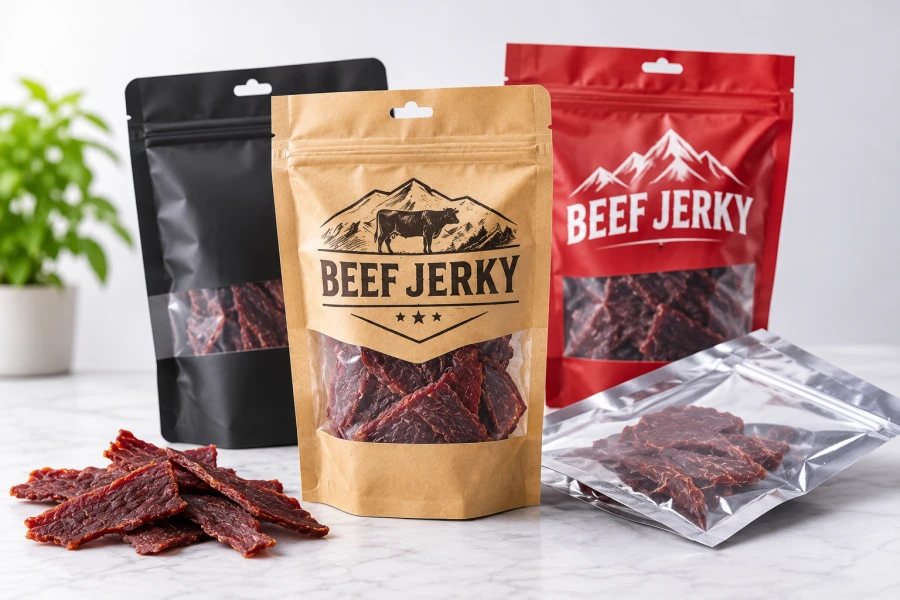
Choosing the right beef jerky packaging bags involves more than selecting a pouch that looks attractive on a retail shelf. The packaging must protect the product against oxygen exposure, moisture changes, and handling damage while remaining compatible with the filling and sealing process.
The right solution depends on several factors, including water activity (aw), fat content, target shelf life, storage conditions, and packaging equipment. Different products may require different barrier structures, pouch styles, and closure features.
This guide explains how to evaluate beef jerky packaging materials, compare common pouch formats, specify sealing requirements, and prepare an RFQ for a custom packaging supplier.
Quick Summary
The right beef jerky packaging depends on the product’s water activity, fat content, target shelf life, and filling process. PET/VMPET/PE and PET/AL/PE are common laminated structures for applications requiring enhanced barrier protection. Stand-up, pillow, and three-side-seal pouches serve different retail and production needs. Buyers should confirm barrier requirements, seal specifications, and filling-line compatibility before approving packaging for mass production.
What Should You Consider When Choosing Beef Jerky Packaging Bags?
Beef jerky packaging selection should start with the product’s water activity, fat content, and intended shelf life. These factors help determine the required barrier performance and whether additional oxygen-control measures are needed.
Water Activity and Product Moisture
Water activity (aw) measures the availability of water in a food product. It is different from total moisture content because not all water in a food is equally available for microbial growth.
For beef jerky manufacturers, water activity is an important part of product safety and shelf-stability evaluation. USDA FSIS guidance discusses different water activity limits for products stored under aerobic and specified oxygen-free conditions. Its guidance identifies aw of 0.85 or lower under aerobic conditions and up to 0.91 under specified oxygen-free packaging conditions.
These are food safety control limits within a broader validated process, not packaging specifications. Vacuum packaging alone does not make an inadequately processed product safe or shelf-stable. Products in the higher water activity range may also require refrigeration after opening.
For packaging buyers, the practical questions are:
- What is the measured water activity of the finished jerky?
- Is the product packed under normal air, vacuum, or modified atmosphere?
- What storage conditions are required?
- How long must the product maintain its intended quality?
Packaging should support the product’s validated preservation system rather than replace it.
Fat Content and Oxygen Exposure
Fat content is another important consideration when selecting beef jerky packaging materials.
Oxygen exposure can contribute to lipid oxidation, which may cause rancid odors, undesirable flavors, and reduced product quality. Products with higher fat content or greater sensitivity to oxidation may therefore require stronger oxygen barrier protection.
Two beef jerky products with similar water activity can have different packaging requirements if their fat content, ingredients, and target shelf life differ.
An oxygen absorber may be used as part of an appropriate packaging system to reduce residual oxygen inside the pouch. However, it does not replace proper processing, food safety controls, or suitable barrier packaging. Its performance also depends on the initial oxygen level, seal integrity, and oxygen transmission through the package.
Shelf Life and Storage Conditions
The target shelf life should be established before choosing a laminate structure.
A product intended for extended ambient storage may require different barrier performance from one designed for shorter distribution periods or refrigerated storage.
Buyers should also consider:
- Expected storage temperature and humidity
- Exposure to light during retail display
- Transportation and distribution conditions
- Product sensitivity to moisture and oxygen
- Whether the pouch will be vacuum sealed or gas flushed
The more clearly these requirements are defined, the easier it is for a packaging supplier to recommend an appropriate structure.
Which Materials Are Best for Beef Jerky Packaging?
There is no single best material for every beef jerky product. The appropriate laminate depends on the required oxygen and moisture barrier, product sensitivity, packaging process, and budget.
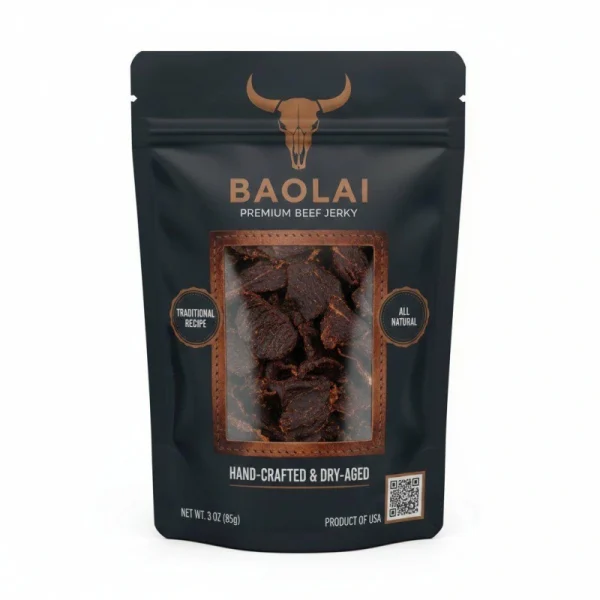
Most custom beef jerky pouches use laminated flexible films. These combine different layers to provide printing performance, mechanical protection, barrier properties, and heat sealability.
PET/PE Laminated Film
PET/PE combines an outer polyester layer with an inner polyethylene layer.
- PET provides a printable outer surface and contributes stiffness.
- PE provides a heat-sealable inner layer.
- The structure is suitable for applications where a dedicated high-barrier layer is not required.
PET/PE should not automatically be treated as sufficient for long-shelf-life beef jerky. Its suitability depends on the actual product requirements and verified package performance.
PET/VMPET/PE Metallized Structure
PET/VMPET/PE incorporates a metallized PET layer to improve barrier performance.
The metallized layer helps reduce oxygen, moisture, and light transmission compared with a basic PET/PE structure.
Potential advantages include:
- Enhanced barrier protection
- Improved light protection
- Suitable options for custom printed retail pouches
- A flexible alternative to foil-based structures for some applications
However, metallized film performance depends on the coating quality, laminate construction, and resistance to damage during converting and distribution.
It should be evaluated against the required barrier target rather than selected simply because it is described as high barrier.
PET/AL/PE Aluminum Foil Structure
PET/AL/PE uses a solid aluminum foil layer between the outer and inner films.
Aluminum foil provides a very high barrier against oxygen, moisture, and light when the laminate and finished pouch maintain their integrity.
Common considerations include:
- High barrier requirements
- Products sensitive to oxygen exposure
- Protection against light during storage and distribution
- Compatibility with the required filling and sealing process
Foil structures are not automatically necessary for every beef jerky product. Their use should be justified by the product’s preservation requirements and packaging performance.
EVOH-Based High-Barrier Structures
EVOH is an oxygen-barrier material used in certain multilayer packaging structures.
It can provide strong oxygen barrier properties while allowing transparent packaging designs. This makes it worth considering when product visibility is important.
However, EVOH barrier performance is affected by humidity. The complete structure must therefore be designed to protect the EVOH layer under the intended storage and use conditions.
Comparing Beef Jerky Packaging Materials
| Material Structure | Barrier Characteristics | Typical Application Considerations |
|---|---|---|
| PET/PE | Basic laminate without a dedicated high-barrier layer | Less demanding barrier requirements |
| PET/VMPET/PE | Metallized layer helps reduce oxygen, moisture, and light transmission | Enhanced barrier protection |
| PET/AL/PE | Aluminum foil provides a very high barrier | Demanding oxygen and moisture barrier requirements |
| EVOH-based | Transparent structure with oxygen-barrier properties | Applications requiring barrier performance and product visibility |
How to Compare OTR and WVTR
When comparing beef jerky packaging materials, buyers may encounter two important technical measurements:
OTR (Oxygen Transmission Rate) measures the rate at which oxygen passes through a packaging material under specified test conditions.
WVTR (Water Vapor Transmission Rate) measures the rate at which water vapor passes through a packaging material under specified test conditions.
Lower transmission rates generally indicate better barrier performance under comparable conditions.
Common test methods include:
- ASTM D3985 for oxygen transmission through plastic films and sheeting.
- ASTM F1249 for water vapor transmission through plastic films and sheeting.
When comparing supplier data, check the test method, temperature, relative humidity, specimen construction, and units. Results obtained under different conditions may not be directly comparable.
Also distinguish between film test results and finished pouch performance. A laminated film may show strong barrier properties, but the finished package can still be affected by seals, folds, flex damage, and handling.
The buying rule: Specify the required barrier performance where known. If you do not have established OTR or WVTR targets, provide your product details and shelf-life requirements so the supplier can recommend a suitable structure for evaluation. For a closer look at how these laminates compare on film thickness and sealant choice, see our stand-up pouch material selection guide.
Which Pouch Style Works Best for Beef Jerky?
The best beef jerky pouch style depends on fill weight, retail presentation, filling equipment, and whether the product needs to be resealable. A stand-up pouch is not always the most economical or production-friendly option.
Stand-Up Pouches
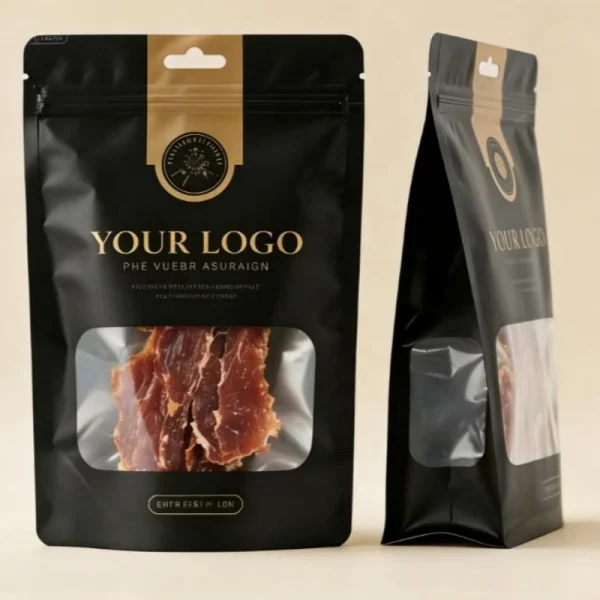
Stand-up pouches are widely used for retail meat snacks because they provide a stable shelf display and a large printable front panel.
They can be customized with:
- Resealable zippers
- Tear notches
- Matte or glossy finishes
- Hang holes
- Custom printed designs
Stand-up pouches are particularly suitable for brands that want a distinctive retail presentation or packaging that can be reopened after the initial seal is broken.
Buyers should check pouch dimensions, filled weight, bottom gusset construction, and compatibility with their filling equipment.
Three-Side-Seal Pouches
Three-side-seal pouches are flat bags sealed along three edges, with one side available for filling before final sealing.
They can be suitable for:
- Single-serving beef jerky
- Trial and sample packs
- Compact retail packaging
- Portion-controlled products
Their flat construction can simplify storage and packaging for certain applications. However, they do not stand independently on a shelf without additional support or display features.
Pillow Pouches
Pillow pouches are commonly produced from rollstock film and formed into bags during the packaging process.
They are frequently used in high-volume automated packaging operations, particularly where vertical form-fill-seal (VFFS) equipment is involved.
Potential advantages include:
- Compatibility with suitable automated filling lines
- Efficient rollstock handling
- Flexible pouch dimensions
- Options for high-barrier laminated films
A pillow pouch can use a high-barrier laminate just like a stand-up pouch. The difference is primarily the package format and production process, not necessarily the barrier performance.
Gusseted Pouches
Gusseted pouches include an expandable side or bottom section that provides additional capacity.
They may be considered for larger fill weights or packaging formats that require additional volume.
Buyers should evaluate the gusset dimensions, filled pouch stability, seal construction, and compatibility with the intended packaging line.
Pouch Style Comparison
| Pouch Style | Best Fit | What Buyers Should Check |
|---|---|---|
| Stand-up pouch | Retail display and resealable packaging | Shelf stability, zipper, fill weight |
| Three-side-seal pouch | Single-serve and compact packs | Dimensions, filling process, seal area |
| Pillow pouch | High-volume automated packaging | VFFS compatibility, rollstock requirements |
| Gusseted pouch | Larger fill volumes or specific display formats | Gusset dimensions, stability, seal construction |
The buying rule: Choose the pouch format based on your filling equipment and sales channel. Before approving a new design, confirm that the proposed pouch can run on your production line and perform as expected when filled.
What Closure and Sealing Features Should You Choose?
Beef jerky packaging needs reliable seals because product particles, oil, and wrinkles can interfere with the sealing area. A visually complete seal does not necessarily mean the package is leak-free.
Heat Seals and Seal Integrity
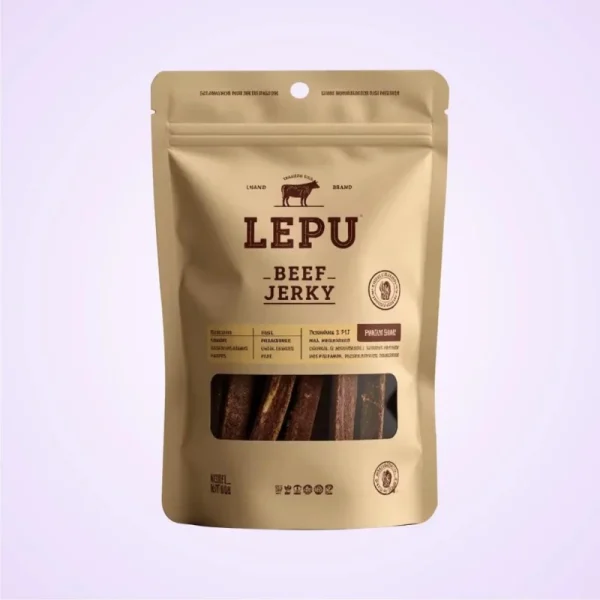
The heat seal creates the permanent closure that protects the product before the consumer opens the package.
Several factors influence heat seal performance:
- Sealant layer compatibility
- Sealing temperature
- Pressure and dwell time
- Product contamination in the seal area
- Film wrinkles and alignment
- Filling and sealing equipment
Oil or small product particles trapped between sealing surfaces can create channels that compromise package integrity.
Buyers should distinguish between two different properties:
Seal Strength measures the force required to separate a sealed area.
Seal Integrity concerns whether the sealed area is continuous and free from defects that could create a leakage path.
A pouch may show acceptable seal strength while still having a localized leak caused by contamination or incomplete sealing. For a closer look at how to evaluate these properties on a filled pouch, see our stand-up pouch seal integrity testing guide.
Resealable Zippers
A zipper provides convenience after the consumer opens the original package.
It is important to distinguish between the initial heat seal and the zipper:
- The permanent heat seal protects the unopened product.
- The zipper allows consumers to close the pouch again after opening.
- The zipper flange attachment must remain secure during filling, handling, and consumer use.
For beef jerky packaging, buyers should check zipper alignment, opening and closing function, flange attachment, and the seal areas around the zipper ends.
A zipper does not replace the initial hermetic or product-protective closure required by the packaging system.
Tear Notches and Easy-Open Features
Tear notches help consumers open the pouch without scissors.
Their position should be coordinated with the zipper and top seal to provide convenient opening without compromising the unopened package.
Other optional features may include hang holes for retail display and custom printing for brand recognition.
Which Seal Tests Should Buyers Consider?
Different tests evaluate different aspects of packaging performance.
| Test | What It Evaluates | Reference Method |
|---|---|---|
| Seal strength | Force required to separate a seal | ASTM F88/F88M |
| Burst or creep resistance | Package resistance to internal pressurization | ASTM F1140/F1140M |
| Oxygen transmission | Oxygen barrier performance of film | ASTM D3985 |
| Water vapor transmission | Moisture barrier performance of film | ASTM F1249 |
These methods are not interchangeable. For example, ASTM F1140 evaluates package resistance to internal pressurization and does not necessarily correlate with seal strength measured using ASTM F88.
The appropriate test and acceptance criteria should be agreed upon according to the packaging structure, product, filling conditions, and intended application.
How to Specify Beef Jerky Packaging Bags in an RFQ
A useful beef jerky packaging RFQ should describe the product, target packaging performance, pouch format, and production requirements. Buyers do not need to know every technical specification before contacting a supplier, but providing the following information makes recommendations and quotations more accurate.
Beef Jerky Packaging RFQ Checklist
| RFQ Field | Information to Provide | Why It Matters |
|---|---|---|
| Product Type | Beef jerky, beef sticks, or other meat snacks | Different products have different packaging requirements |
| Fill Weight | Target weight per pouch | Determines pouch dimensions and material requirements |
| Product Characteristics | Water activity, fat content, and product condition if available | Helps evaluate preservation and barrier needs |
| Target Shelf Life | Required shelf life and storage conditions | Helps establish packaging performance requirements |
| Pouch Style | Stand-up, pillow, three-side-seal, or gusseted | Determines package construction and filling compatibility |
| Pouch Dimensions | Width, height, and gusset if applicable | Required for design and quotation |
| Closure | Heat seal, zipper, tear notch, or hang hole | Determines functional features |
| Filling Method | Manual, VFFS, vacuum, or gas flush | Affects pouch format and sealing requirements |
| Printing | Artwork, colors, and finish preferences | Determines printing and appearance requirements |
| Order Quantity | Estimated quantity per design | Helps determine production options and pricing |
If you already have measured OTR, WVTR, or seal performance requirements, include them in your RFQ.
If you do not, that is not a reason to delay contacting a packaging supplier. Share your product characteristics, target shelf life, and filling process first. The supplier can then discuss suitable structures and the testing needed to evaluate them.
What Should Be Confirmed Before Mass Production?
Before approving custom beef jerky packaging, buyers should review:
- Material structure: Confirm the laminate layers and intended barrier function.
- Pouch dimensions: Check the pouch using the actual product or a representative fill.
- Filling compatibility: Confirm that the pouch works with the intended filling and sealing equipment.
- Closure performance: Check the heat seal, zipper, and opening features where applicable.
- Sample evaluation: Test filled samples under relevant handling and distribution conditions.
- Final specifications: Approve the material, dimensions, artwork, and agreed quality requirements before production.
This process helps reduce the risk of selecting packaging that looks suitable but does not work well in actual production.
Frequently Asked Questions
What Is the Best Material for Beef Jerky Packaging Bags?
There is no single best material for every beef jerky product. PET/VMPET/PE and PET/AL/PE are common options for applications requiring enhanced barrier protection. The appropriate choice depends on the product’s water activity, fat content, target shelf life, storage conditions, and required packaging performance.
Do Beef Jerky Bags Need High Oxygen Barrier Properties?
Many beef jerky products benefit from oxygen barrier protection because oxygen exposure can contribute to fat oxidation and rancidity. The required barrier level depends on the product formulation, fat content, shelf-life target, and whether oxygen-control measures such as vacuum packaging or oxygen absorbers are used.
Are Stand-Up Pouches Suitable for Beef Jerky?
Yes. Stand-up pouches are suitable for retail beef jerky packaging because they provide shelf stability, a large printable surface, and options for resealable zippers. However, pillow pouches and three-side-seal bags may be more suitable for certain filling operations or single-serving formats.
Can Beef Jerky Packaging Bags Be Resealable?
Yes. Custom beef jerky bags can include resealable zippers. The zipper allows consumers to close the pouch after opening, while the initial heat seal protects the product before first use. The zipper attachment and surrounding seal areas should be evaluated separately.
What Information Should I Provide When Ordering Custom Beef Jerky Bags?
Provide your product type, fill weight, pouch dimensions, target shelf life, storage conditions, preferred pouch style, filling method, and estimated order quantity. If available, include water activity and fat content. A packaging supplier can use these details to recommend suitable material structures and closure options.
Custom Beef Jerky Packaging Bags from RBD Packaging
RBD Packaging supplies custom laminated pouches for food and meat snack brands, with options including stand-up pouches, flat pouches, and custom printed packaging.
We can help review your product type, fill weight, target shelf life, and packaging requirements to recommend suitable material structures, pouch styles, and closure options. Physical samples are available for evaluation before mass production.
Looking for a custom beef jerky packaging supplier?
Send us your product details, pouch dimensions, estimated order quantity, and packaging requirements. Browse our custom beef jerky bags or request a packaging quote to discuss your project.