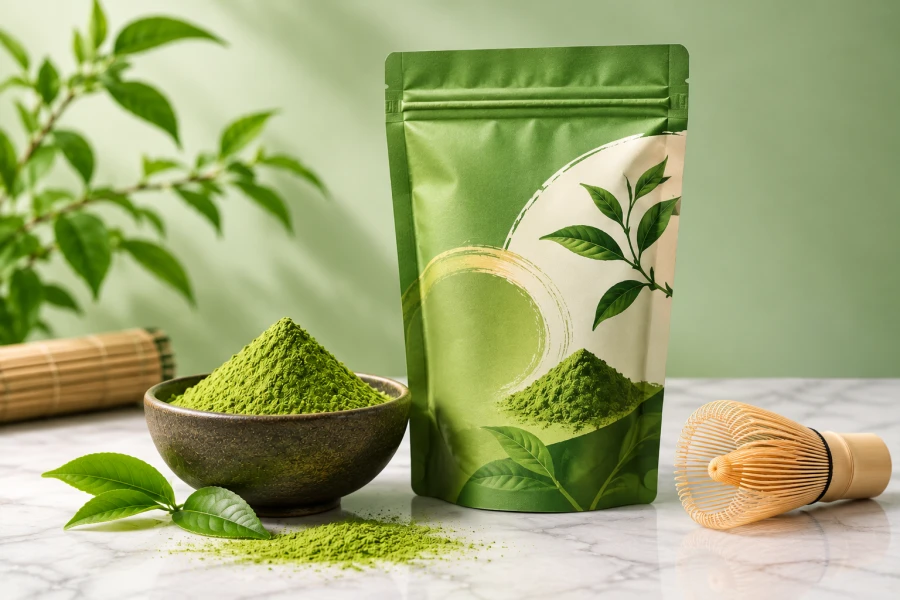
Matcha powder packaging must protect the product from light, oxygen and moisture while maintaining reliable seals and convenient handling after opening. The right solution depends on matcha grade, target shelf life, fill weight, storage conditions and filling process. This guide explains how buyers can compare packaging materials, choose pouch formats and prepare specifications for custom matcha packaging.
What Should Matcha Powder Packaging Protect Against?
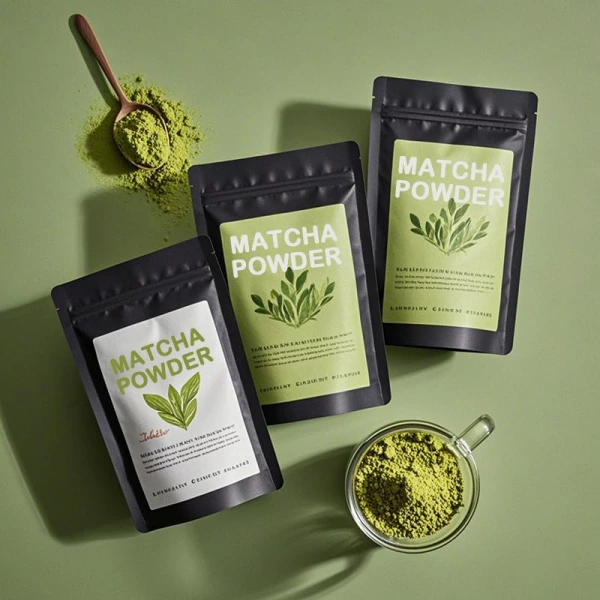
Matcha powder packaging needs to control three main quality risks: light exposure, oxygen ingress and moisture absorption. These factors affect the powder’s colour, aroma, flavour and handling quality during storage and distribution.
Light Protection and Colour Retention
Matcha’s bright green colour is an important quality indicator. Exposure to light can accelerate pigment degradation and cause the powder to lose its fresh green appearance. For this reason, an opaque pouch is generally a practical choice for quality-focused matcha products. A clear window may improve product visibility, but it also creates a pathway for light exposure.
If buyers want to show the product, they should consider whether the visual benefit is worth the potential trade-off in product protection. A fully opaque primary package is often the safer starting point for premium matcha.
Oxygen and Aroma Protection
Oxygen exposure can contribute to changes in matcha colour, aroma and flavour. Packaging selection should therefore consider both the oxygen barrier of the film and the amount of oxygen remaining inside the pouch after filling.
These are two different requirements:
- Oxygen transmission rate (OTR): Measures how readily oxygen passes through a packaging material under specified test conditions.
- Residual oxygen: Refers to the oxygen remaining inside the sealed package after filling.
A high-barrier laminate helps limit oxygen entering through the package over time. Nitrogen flushing or another suitable packaging process may help reduce oxygen present at the time of sealing. Neither replaces the other.
Moisture Protection and Powder Flow
Matcha powder can absorb moisture from its surroundings. Moisture exposure may cause clumping, affect powder flow and reduce product quality. Buyers should therefore consider the water vapor transmission rate (WVTR) of the packaging material, along with the storage environment and expected shelf life.
The zipper also matters after opening. Repeated exposure to humid air can affect the powder even when the unopened pouch has a suitable barrier structure.
Which Materials Are Suitable for Matcha Powder Packaging?
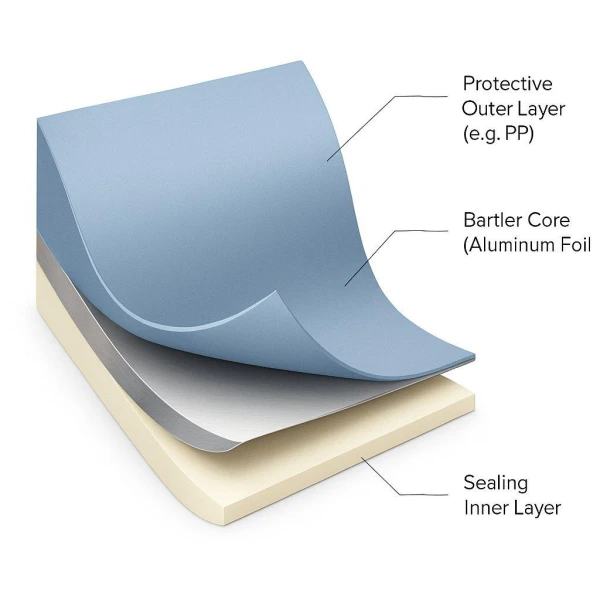
There is no single best material for every matcha product. The appropriate laminate depends on the product grade, shelf-life target, light protection requirement, filling process and budget.
Common flexible packaging structures include PET/AL/PE, PET/VMPET/PE and EVOH-based laminates. Their actual performance depends on the complete material construction and converting quality.
| Material structure | Main characteristics | Potential application |
|---|---|---|
| PET/AL/PE | Aluminium foil provides strong oxygen, moisture and light protection | Premium matcha and products requiring high barrier performance |
| PET/VMPET/PE | Metallised layer provides barrier properties and an opaque appearance | Retail matcha where the required protection is compatible with the laminate |
| EVOH-based laminate | Provides an oxygen barrier; performance depends on the complete structure and humidity conditions | Projects considering transparent or specific recyclable packaging designs |
| PET/PE | Basic printable and sealable structure without a dedicated high-barrier layer | Applications where barrier requirements are limited and clearly established |
How Should Buyers Compare OTR and WVTR?
OTR and WVTR are useful when comparing packaging materials, but the numbers should never be evaluated without their test conditions.
For a meaningful comparison, request:
- OTR test method, units, temperature and humidity conditions.
- WVTR test method, units, temperature and humidity conditions.
- Full laminate structure and total thickness.
- Whether the reported result applies to film material or the finished pouch.
ASTM D3985 is commonly used for oxygen transmission testing, while ASTM F1249 is used for water vapor transmission testing.
One important distinction: film test results do not automatically represent the performance of a finished pouch. Seals, folds, converting quality and handling can affect the performance of the complete package.
For a detailed explanation of flexible packaging structures, see our [stand-up pouch material selection guide].
How to Choose Matcha Pouch Sizes for Retail, Refill and Bulk Use
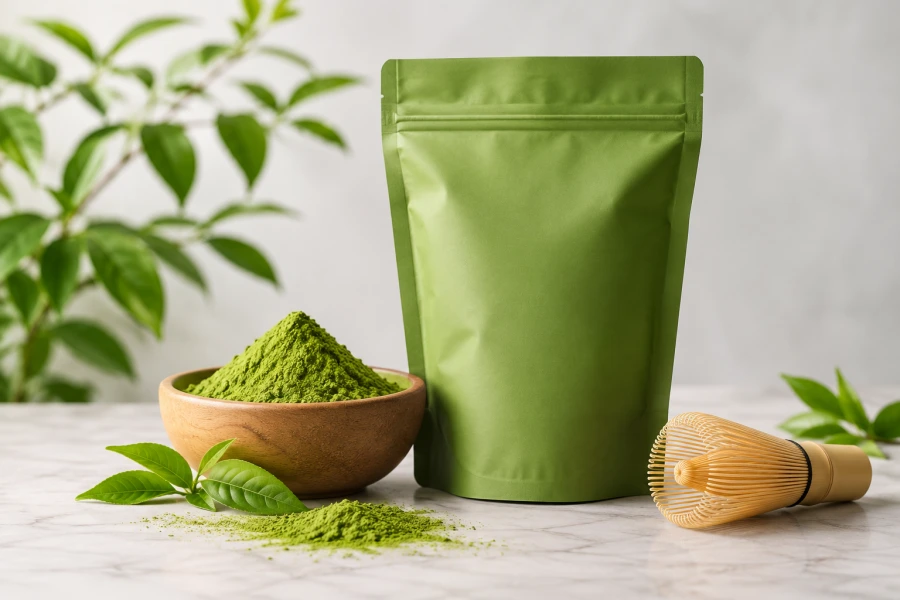
Pouch dimensions should not be determined by net weight alone. Matcha grade, powder density, filling method, headspace and opening requirements all influence the final pouch size.
| Application | Common pack format | Suitable pouch direction | Main consideration |
|---|---|---|---|
| Retail matcha | Small consumer packs | Stand-up pouch or flat pouch | Shelf presentation, opening convenience and resealability |
| Refill matcha | Larger household or café packs | Stand-up or flat pouch | Wider opening and convenient powder access |
| Bulk matcha | Foodservice or ingredient supply | Larger barrier bag, potentially packed in an outer carton | Fill weight, handling strength, storage and distribution |
Why Bulk Density Matters
Two matcha products with the same net weight may occupy different volumes because their grades, grind characteristics and packing behaviour differ.
Before confirming pouch dimensions, buyers should provide:
- Matcha grade and product type.
- Target net weight.
- Bulk density, if available.
- Filling method.
- Required headspace and opening width.
The supplier can then evaluate the pouch dimensions against the actual product and filling conditions. For bulk formats, buyers should also consider the weight carried by the pouch, puncture resistance, carton protection and handling during transportation.
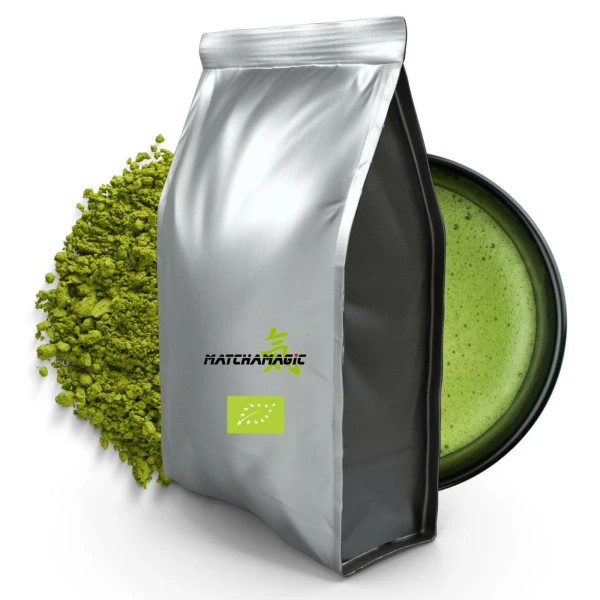
Which Pouch Styles and Closures Work Best for Matcha?
The pouch format and closure system should match the product’s application and how frequently the package will be opened.
Common options include:
- Stand-up pouches: Suitable for retail presentation and shelf display.
- Flat pouches: Useful where compact packaging or single-use formats are preferred.
- Larger bulk bags: Designed around higher fill weights and storage or distribution requirements.
Heat Seals and Resealable Zippers Serve Different Purposes
A matcha pouch with a zipper uses two separate closure systems:
- Permanent heat seal: Protects the unopened product. Its performance depends on sealing conditions, material compatibility and a clean sealing area.
- Resealable zipper: Allows consumers to close the pouch after opening. Its performance depends on zipper design, alignment and powder contamination.
Fine matcha powder can enter the sealing area or zipper track during filling and use. Powder contamination may interfere with the heat seal or prevent zipper profiles from closing properly.
A wide-track zipper may be worth evaluating for products that require repeated opening, but it should be tested with the actual powder and intended use conditions.
| Closure feature | Main purpose | What buyers should specify |
|---|---|---|
| Permanent heat seal | Protects the unopened package | Seal performance and filling-area cleanliness |
| Press-to-close zipper | Allows resealing after opening | Zipper type and compatibility with fine powder |
| Wide-track zipper | Provides a different resealing design | Track design and available pouch-top space |
| Tear notch | Makes initial opening easier | Position relative to the heat seal and zipper |
For a deeper look at pouch sealing and inspection, see our [stand-up pouch seal integrity testing guide].
Does Matcha Powder Packaging Need Nitrogen Flushing?
Nitrogen flushing may be useful for matcha products that require reduced oxygen inside the sealed package, but it is not automatically necessary for every project. The process introduces food-grade nitrogen before sealing to displace some of the air in the pouch. Its effectiveness depends on the filling equipment, package design, sealing process and the residual oxygen level that the project is intended to achieve.
Three points should be considered:
- The film still provides long-term protection. Nitrogen flushing does not replace an appropriate oxygen barrier. The laminate must limit oxygen transmission throughout the intended storage period.
- The filling line must support the process. Buyers should confirm whether the packing facility can perform nitrogen flushing and whether residual oxygen can be measured or verified.
- The package must retain its seal. A suitable initial atmosphere is not enough if the finished pouch has weak seals or leakage.
Vacuum packaging should not be assumed to be interchangeable with nitrogen flushing. For fine powders, buyers should evaluate the effects of compression, product handling and the filling process before selecting a method.
The buying rule: Treat material barrier performance, nitrogen flushing and seal integrity as separate specification items. A quote that simply says “nitrogen flushed” does not fully define the packaging performance.
How Should Buyers Evaluate Matcha Packaging Samples Before Production?
A sample should be evaluated with the actual matcha product and, where possible, the intended filling process. Reviewing an empty pouch alone cannot confirm how it will perform after filling.
A practical approval process includes four steps:
1. Check the material and construction
Confirm the laminate structure, total thickness, opacity, pouch dimensions and closure design against the approved specification.
2. Conduct a filling trial
Use the intended powder and filling method to check filling convenience, headspace, powder residue and contamination around the sealing area.
3. Evaluate sealing and closure performance
Check the permanent heat seal for consistency and inspect the zipper after repeated opening and closing. The test should reflect the product’s actual handling requirements.
4. Approve the final production sample
Confirm the final artwork, dimensions, material construction and closure details before mass production. Any change to the material or pouch design should be reviewed before approval.
What Should Buyers Include in a Matcha Packaging RFQ?
A complete RFQ helps suppliers recommend suitable matcha packaging and prepare a comparable quotation.
| RFQ requirement | Information to provide |
|---|---|
| Product type | Ceremonial, culinary or ingredient-grade matcha |
| Fill weight | Net weight per pouch |
| Target shelf life | Required storage period and conditions |
| Material preference | Foil, metallised or another proposed structure, if known |
| Barrier requirements | OTR and WVTR targets, test methods and conditions, if available |
| Opacity | Fully opaque or another specified appearance |
| Pouch style | Stand-up, flat or bulk bag |
| Closure | Zipper, tear notch or single-use heat seal |
| Filling process | Manual, semi-automatic or automated filling |
| Nitrogen flushing | Required, optional or not required |
| Printing and quantity | Artwork, printing requirements and estimated order quantity |
If the buyer does not know the exact material structure, that is not a problem. Providing the product grade, fill weight, shelf-life target and application gives the supplier a useful starting point for recommending options.
Frequently Asked Questions
What is the best packaging material for matcha powder?
A foil-containing laminate such as PET/AL/PE is a common option when strong oxygen, moisture and light protection are required. Metallised and EVOH-based structures may also be considered depending on the product, shelf-life target and packaging requirements.
Should matcha powder be packed in aluminium foil bags?
Aluminium foil provides a strong barrier against oxygen, moisture and light. It is worth evaluating for premium matcha and products with demanding storage requirements. The finished pouch construction and sealing quality should still be verified.
Are clear windows suitable for matcha packaging?
A clear window allows light to reach the powder, which may affect colour and product quality during storage. Buyers prioritising protection should generally consider opaque packaging or treat a window as a deliberate design trade-off.
Does matcha powder packaging need nitrogen flushing?
Not every matcha product requires nitrogen flushing. It may be useful when the project needs reduced residual oxygen, but the decision should consider the laminate barrier, filling equipment, sealing performance and shelf-life target.
How do I choose the right pouch size for 100 g of matcha?
There is no universal pouch dimension for 100 g of matcha. Product density, powder characteristics, filling method and required headspace all affect the size. Provide the net weight and product details so the supplier can recommend dimensions for a filling trial.
Are resealable pouches suitable for matcha powder?
Yes. Resealable pouches can be suitable, but fine powder may collect around the zipper track and affect closure performance. Buyers should evaluate the zipper with the actual product and expected opening frequency.
Custom Matcha Powder Packaging from RBD Packaging
Choosing matcha powder packaging involves more than selecting a pouch size or film name. Material structure, opacity, barrier requirements, filling conditions and closure performance all need to work together.
RBD Packaging works with buyers on custom packaging specifications based on product type, fill weight, pouch format, printing requirements and order quantity. If your material structure has not yet been confirmed, you can share your matcha application and target shelf life for a packaging review.