
A coffee bag usually puffs up because freshly roasted coffee releases carbon dioxide (CO₂) after roasting. If the gas builds up inside a sealed bag faster than it can escape, the package expands. A one-way degassing valve helps release CO₂ while limiting outside air from entering. However, a puffed bag does not automatically mean the valve is defective or the coffee has spoiled. The cause depends on the coffee, packaging design, valve performance and sealing conditions.
For coffee roasters and packaging buyers, understanding these factors helps prevent excessive swelling, package damage and inconsistent product quality.
Why Is My Coffee Bag Puffed Up?

The most common reason a roasted coffee bag becomes inflated is post-roast degassing. During roasting, chemical reactions generate carbon dioxide inside coffee beans. Some of this gas remains trapped in the beans and continues to escape after roasting.
When freshly roasted coffee is sealed in a package, the released CO₂ accumulates in the space around the product. If the package has no suitable way to release the gas, internal pressure can increase and make the bag expand.
The rate of degassing varies with roast profile, coffee characteristics, grinding, storage conditions and the time between roasting and packaging. Darker roasts often release gas more rapidly, although individual coffees can behave differently.
Is a Puffed-Up Coffee Bag Normal?
It can be normal for a bag containing freshly roasted whole-bean coffee to become slightly inflated, particularly when it has no degassing valve. However, the degree of swelling matters. A mildly expanded bag and a severely ballooned package are not necessarily the same situation.
| What you notice | Possible explanation | What to check |
|---|---|---|
| Slightly inflated bag without a valve | Normal CO₂ release after roasting | Roast date, packaging time and product condition |
| Strongly swollen bag without a valve | Gas accumulation in a sealed package | Packaging method and pressure-related damage |
| Puffed bag with a degassing valve | Valve may not be releasing gas effectively, or gas generation exceeds its venting capacity | Valve function and installation |
| Only some bags are inflated | Possible variation in valve application, sealing or filling conditions | Compare affected and unaffected packages |
| Bag swollen with damaged seams | Pressure combined with insufficient package integrity | Seal condition and film construction |
A swollen package containing dry roasted coffee should not automatically be treated as a food-safety problem. However, unusual odours, moisture, visible mould, damaged seals or other signs of deterioration require separate investigation. Do not assume that swelling in liquid coffee or ready-to-drink products has the same explanation as normal roasted-bean degassing.
Why Is My Coffee Bag Puffed Up Even With a Degassing Valve?
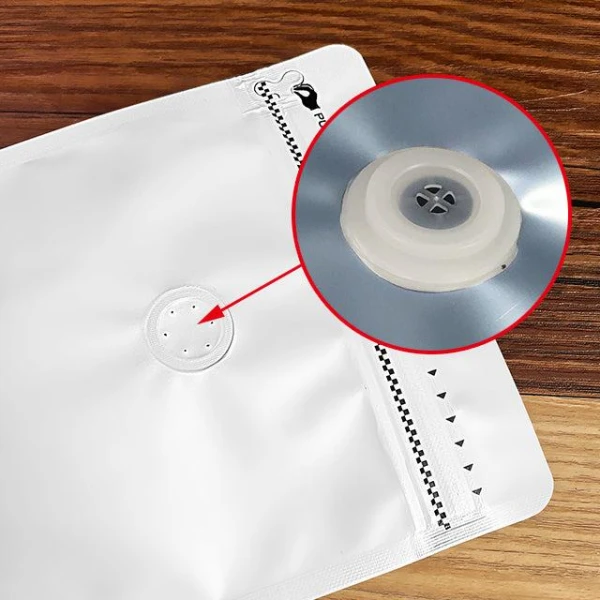
If a coffee bag has a one-way degassing valve but still becomes inflated, the valve may not be releasing gas effectively. A one-way degassing valve is designed to allow internal gas to escape when pressure reaches its operating condition, while limiting reverse airflow through the valve. It does not create the oxygen or moisture barrier provided by the packaging laminate and seals.
There are several possible reasons why a valved coffee bag may still puff up.
1. The Valve Is Not Opening Properly
Every valve has an opening-pressure range. If the pressure required to open the valve is too high for the application, CO₂ may accumulate before the valve releases enough gas.
The appropriate opening pressure and flow performance depend on the valve design and the coffee packaging application. Buyers should refer to the actual valve manufacturer’s technical data rather than assume that every degassing valve has the same specifications.
For example, Tungyi Hardware publishes different coffee valve models with their own opening and closing pressure specifications. This illustrates why the exact model matters when evaluating a supplier’s quotation.
2. The Valve Is Blocked by Coffee Particles
Fine coffee grounds and particles may interfere with the valve’s functional area, depending on the valve construction and its position inside the package.
This is particularly worth investigating when the package contains ground coffee rather than whole beans. A valve model with a suitable filter may help reduce particle contamination, but filter selection should be based on the product and valve manufacturer’s specifications. It should not be assumed that every filtered valve is suitable for every coffee grind.
3. The Valve Is Incorrectly Installed
A valve can be suitable as an individual component but still fail when it is incorrectly attached to the pouch.
Potential issues include:
- Incomplete bonding between the valve and packaging film.
- Damage to the valve during installation.
- Misalignment with the prepared opening in the film.
- Heat or pressure conditions that affect the valve or its attachment.
- Placement too close to a seal, fold or other structural feature.
These problems may not be obvious from a quick visual inspection. The finished pouch needs to be evaluated rather than relying only on the valve component’s specifications.
4. The Valve Cannot Keep Up With Gas Release
A valve’s performance must be considered alongside the coffee’s degassing behaviour. Roast profile, time between roasting and packaging, whole-bean or ground format, fill weight and available headspace can all influence the pressure inside a package.
A valve that performs adequately in one application may not be appropriate for another. This is why selecting a valve only by its diameter or general product description is insufficient.
Why Do Only Some Coffee Bags Puff Up in the Same Production Run?
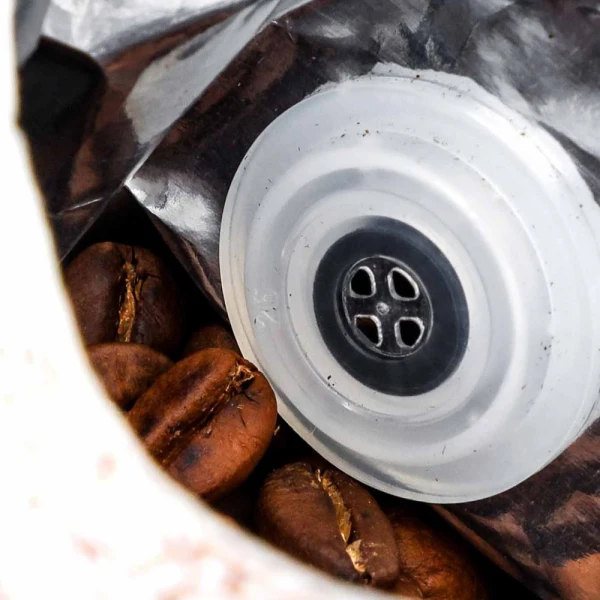
When some bags inflate while others remain normal, inconsistent packaging conditions should be investigated. The valve-to-film attachment is one important area to inspect. If the valve is not consistently bonded to the pouch, some packages may release gas differently from others.
Other possible causes include:
- Variation in valve placement or attachment.
- Differences in sealing temperature, pressure or dwell time.
- Coffee particles trapped in sealing areas.
- Inconsistent filling weight or headspace.
- Differences in the time between roasting and packaging.
- Damage during handling or transportation.
A practical troubleshooting approach is to compare affected and unaffected packages from the same production batch. Check the valve position, attachment area, top and side seals, product fill level and package condition. If the problem occurs repeatedly, review the production records and agreed process settings.
Do not assume that a small temperature change or a visually acceptable valve attachment is automatically the cause. Any suspected process deviation should be verified through inspection and testing.
Can a Puffed Coffee Bag Burst?
Yes. A package containing freshly roasted coffee can rupture if gas accumulates and the pressure exceeds what the package structure and seals can withstand.
The risk depends on several factors, including the amount of gas released, package volume, headspace, film construction, seal quality and whether a functioning degassing route is available.
A bag that expands but remains intact does not necessarily have the same problem as one that splits along a seam.
| Package condition | Main area to investigate |
|---|---|
| Bag expands but remains sealed | CO₂ release and degassing performance |
| Bag expands and the valve appears inactive | Valve opening, obstruction and attachment |
| Bag splits along a side or bottom seal | Seal integrity and internal pressure |
| Bag develops a leak near the valve | Valve-to-film attachment and local film condition |
| Package becomes soft or loses its shape unexpectedly | Possible leakage, seal damage or changes in internal pressure |
For flexible packaging, seal strength and package integrity are related but different considerations. A seal can have adequate strength under one test condition while a separate leak path remains elsewhere in the package.
ASTM F88/F88M is commonly used to measure seal strength in flexible barrier materials. The result helps assess the force required to separate a seal, but it does not by itself prove that the complete package is leak-free.
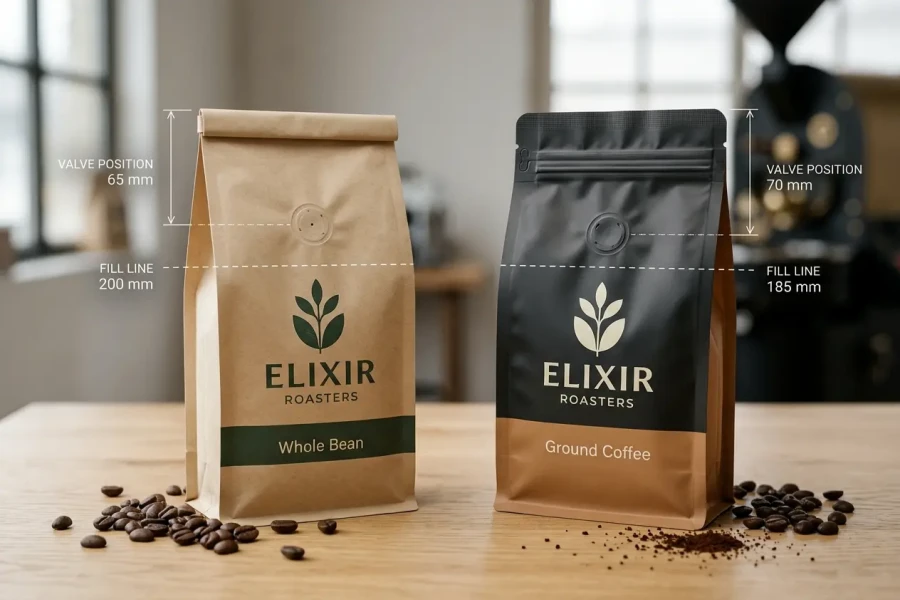
How Does a One-Way Degassing Valve Work?
A one-way degassing valve allows gas generated by roasted coffee to escape while helping limit oxygen from entering through the valve.
Although designs vary, a typical valve uses a flexible membrane or similar sealing element. When internal pressure reaches the valve’s opening condition, the element moves to allow gas to escape. When the pressure changes, it returns to its sealing position.
The valve performs two important functions:
- Gas release: CO₂ and other gases generated after roasting can leave the package.
- Reverse-flow control: The valve is designed to limit outside air from entering through the valve pathway after gas release.
However, the valve is only one part of the packaging system. The laminate and package seals provide the main barrier against oxygen and moisture transmission. A functioning valve therefore does not replace appropriate barrier materials, reliable heat seals or suitable storage conditions.
How Can Coffee Roasters Prevent Excessive Bag Swelling?
Preventing excessive swelling requires the coffee, packaging structure and filling process to be considered together.
1. Select a Suitable Degassing Method
A one-way valve is a common solution for packaging freshly roasted coffee. It allows gas to escape without requiring the bag to remain open.
Some roasters may also consider allowing coffee to degas before packaging, depending on their production schedule, product requirements and packaging design.
There is no universal waiting period that suits every coffee. The appropriate approach should be validated for the specific roast profile and intended distribution conditions.
2. Position the Valve in an Appropriate Area
The valve needs to remain functional after the bag is filled and handled.
Its position should account for:
- The maximum product fill level.
- Available headspace.
- Top and side sealing areas.
- Zippers and tear notches.
- Gusset folds and other structural features.
- The filling and converting process.
A valve that is correctly positioned on an empty pouch may become obstructed after the coffee settles. For this reason, placement should be checked using filled samples.
3. Match the Packaging Film to the Product
The packaging laminate protects roasted coffee from oxygen, moisture and external conditions. Its performance should be considered separately from the degassing valve.
Common flexible packaging structures may include PET/AL/PE, PET/VMPET/PE and other suitable barrier laminates, depending on the required performance and packaging design.
The best structure depends on the coffee product, shelf-life target, distribution conditions and applicable food-contact requirements.
4. Maintain Consistent Sealing Conditions
The valve attachment and pouch seals must be compatible with the packaging material and production process.
Buyers should confirm that the supplier has considered the relevant sealing conditions for the selected laminate and valve design.
A good-looking pouch is not sufficient evidence of reliable sealing. Filled samples and appropriate package-integrity checks are important before production approval.
How Do You Test a Coffee Bag Degassing Valve?
A valve should be evaluated in two separate ways: release performance and leak performance.
Ametek Mocon’s coffee packaging guide describes both valve release testing and valve leak testing as important quality-control checks.
1. Valve Release Test
A release test evaluates whether the valve opens and allows gas to escape under the intended pressure conditions.
The test measures pressure and gas flow to determine when the valve begins releasing gas and how its flow changes as pressure increases.
The results should be compared with the specifications for the actual valve model.
2. Valve Leak Test
A leak test checks whether the valve allows unwanted gas to enter through its sealing mechanism.
This is important because a valve may release CO₂ correctly but fail to reseal adequately.
A valve that does not control reverse airflow may compromise the package’s ability to protect coffee aroma and quality.
3. Finished-Pouch Evaluation
Testing the valve component alone cannot confirm the performance of the complete coffee bag.
A more useful evaluation includes representative filled pouches and checks:
- Valve attachment and position.
- Gas-release behaviour.
- Leakage around the valve.
- Heat-seal condition.
- Package appearance after storage.
- Performance under relevant distribution conditions.
The test method, acceptance criteria and sampling plan should be agreed with the packaging supplier and based on the product’s actual requirements. For additional information about flexible pouch seal testing, see our [stand-up pouch seal integrity testing guide].
What Should Buyers Include in a Coffee Bag with Valve RFQ?
A clear RFQ helps packaging suppliers evaluate the application and recommend a suitable pouch and degassing valve.
Instead of requesting only a “coffee bag with valve,” buyers should provide the information needed to assess the complete packaging design.
| RFQ specification | Information to provide | Why it matters |
|---|---|---|
| Coffee format | Whole bean or ground | Influences filling and potential particle contamination |
| Roast profile | Light, medium or dark | Helps assess expected degassing behaviour |
| Roast-to-pack timing | Time between roasting and sealing | Affects gas release after packaging |
| Fill weight | Grams per pouch | Helps determine package dimensions and volume |
| Pouch style | Flat-bottom, side-gusset or stand-up pouch | Influences structure and available valve placement area |
| Valve requirement | Valve model or proposed specification | Allows evaluation of opening and release performance |
| Valve position | Preferred location or approved dieline | Helps avoid folds, seals and product obstruction |
| Film structure | Preferred laminate or required barrier performance | Defines the package’s protective properties |
| Closure | Zipper, tear notch or other opening design | Affects the top area and consumer use |
| Testing | Required release, leak and seal checks | Defines how the finished package will be evaluated |
| Order quantity | Estimated quantity and purchasing schedule | Supports quotation and production planning |
If you do not know the exact valve model or film structure, provide the coffee type, fill weight, roast-to-pack timing and target shelf life first. The supplier can use these details to discuss suitable options.
Frequently Asked Questions
Why is my coffee bag puffed up after sealing?
Freshly roasted coffee releases CO₂ after roasting. If the gas accumulates inside a sealed bag faster than it can escape, the package expands. This is common with freshly roasted coffee, especially when no degassing valve is used.
Why is my coffee bag puffed up even though it has a valve?
The valve may be blocked, incorrectly installed, damaged or unsuitable for the coffee’s gas-release requirements. Check the valve attachment, position, opening performance and finished-package condition.
Does a puffed-up coffee bag mean the coffee is bad?
No. Swelling in a bag of dry roasted coffee can result from normal CO₂ release. However, swelling alone cannot confirm product quality. Check the roast date, package condition, smell and any signs of moisture or mould.
Do all coffee bags need a degassing valve?
Not necessarily. The decision depends on the coffee, roast-to-pack timing, package design, expected gas release and distribution conditions. A valve is a common solution for freshly roasted coffee, but the complete packaging application should be evaluated.
Can a degassing valve prevent coffee bags from bursting?
A suitable, correctly installed valve can reduce pressure accumulation by allowing gas to escape. However, it cannot guarantee that a package will never rupture. Film construction, seal integrity, valve performance and handling conditions also matter.
Does nitrogen flushing replace a coffee bag degassing valve?
No. Nitrogen flushing helps reduce oxygen in the package headspace, while a degassing valve allows CO₂ released after roasting to escape. They address different packaging requirements and should not be treated as interchangeable.
Custom Coffee Bags with Degassing Valves from RBD Packaging
A reliable coffee bag is more than a pouch with a valve. The packaging film, degassing valve, pouch dimensions, filling conditions and sealing performance need to work together.
RBD Packaging provides custom packaging solutions for food and beverage applications. For a coffee packaging project, share your product format, fill weight, preferred pouch style and packaging requirements so the team can review the appropriate options.