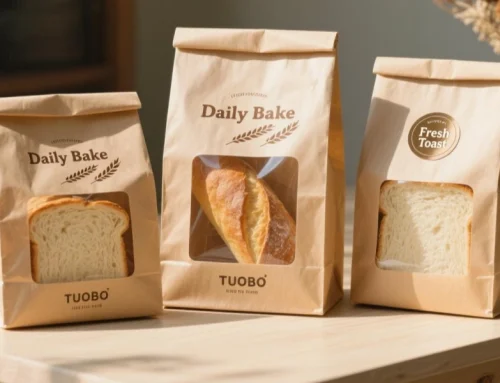
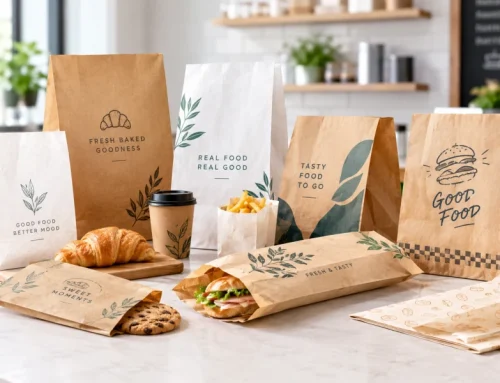
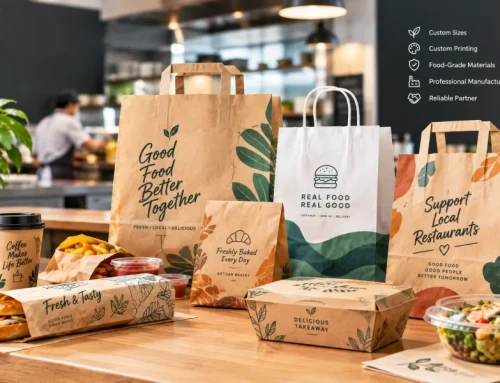
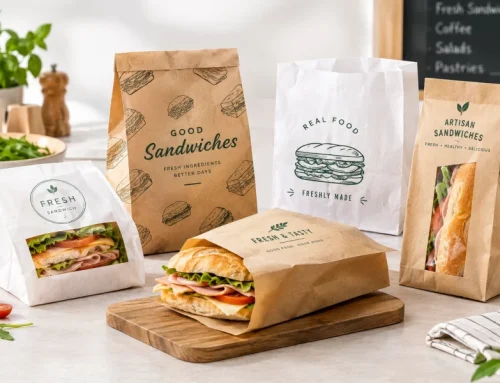
Baguette paper bags are designed for long, narrow bread such as French baguettes, artisan bread and long bread sticks. Compared with standard bakery bags, they usually need a longer bag length and a suitable gusset to make filling easier.
Whether you run an artisan bakery, a café chain, or a foodservice distribution company, this buying guide breaks down everything you need to know about purchasing baguette bread bags in plain, simple terms.
Key Takeaways
- Start with your baguette size — length and diameter are the most important information for choosing a bag.
- Choose the paper based on the product — kraft is common for fresh baguettes, while greaseproof paper can be used for oily or butter-rich products.
- Decide whether you need a window — a window is useful for bakeries and retail stores where product visibility matters.
- Custom printing is usually straightforward — provide your logo or artwork and confirm the supplier’s dieline before production.
- Compare suppliers using the same specifications — size, material, printing, window, quantity and shipping terms should be consistent.
- Always approve a sample before bulk production — test the actual baguette inside the bag before placing a large order.

What Are Baguette Paper Bags?
Baguette paper bags are long paper bags made specifically for baguettes and other long bakery products.
They are commonly made from kraft paper or white paper, and can be produced with different widths, lengths, gussets, windows and printing designs. Some suppliers also offer grease-resistant paper or lined structures for products that need additional protection.
The main difference from a standard bread bag is simple: the bag needs to fit the long shape of the baguette. For this reason, the first specification to confirm is usually the bag’s length and opening size.
What to Decide Before Contacting a Supplier
You do not need a complete packaging specification before asking for a quotation. However, having a few basic details ready will help the supplier give you a more accurate recommendation and price.
| Information | What You Need to Provide |
| Product | Baguette, French bread, long bread, etc. |
| Product size | Length and approximate width/diameter |
| Bag style | Flat or gusseted |
| Material | Kraft, white paper, greaseproof, etc. |
| Window | With or without window |
| Printing | Logo, artwork and number of colors |
| Quantity | Estimated order quantity |
| Market | USA, UK, Europe, Australia, etc. |
| Sample | Required before bulk production |
If you don’t know the exact baguette paper bag size or paper specification, simply provide your baguette measurements and ask the manufacturer for a recommendation.
That is often easier than trying to choose a specification yourself.

Measuring Your Loaf Before Ordering
To ensure a precise fit, measure your finished product accurately before contacting packaging suppliers. Provide the following core product measurements:
- Product Length: The maximum end-to-end length of the baguette.
- Maximum Width or Diameter: The widest cross-section of the loaf.
- Bread Format: Specify whether the bread is sold whole or cut.
- Packaging Environment: Indicate if baguettes are packed hot immediately post-baking or after cooling.
- Filling Clearance: Factor in extra opening room so bakery staff can pack bread quickly without tearing seams.
There is no single universal size for baguette paper bags. Commercial suppliers manufacture baguette packaging across a wide range of lengths (ranging from 500 mm to over 650 mm), widths, and gusset configurations. Sourcing decisions should always begin with your actual bread measurements rather than adjusting your product to fit a stock supplier dimension.
Selecting the Best Baguette Bag Structure
The physical design of your custom baguette paper bags dictates how easily bread is inserted, how well it is protected, and how it appears on store shelves.
| Bag Structure | Ideal Application | Core Advantage |
| Flat / Narrow Bag | Standard, uniform French baguettes | Lightweight, economical, and space-saving |
| Side-Gusseted Bag | Wide, crusty, or irregular artisan bread | Expands side walls for easy loaf insertion |
| Windowed Bag | Retail bakery counters & supermarket shelves | High product visibility without opening package |
| Custom Printed Bag | Branded bakery chains & franchise outlets | Maximizes brand recognition and shelf appeal |
| Grease-Resistant Bag | Garlic bread, buttered loaves, & cheesy breads | Prevents oil saturation and exterior staining |

Choosing the Right Paper Material & Substrate
Selecting paper for baguette bread bags comes down to one core question: What functional protection does your specific loaf require?
Natural Brown Kraft Paper
Natural kraft is the industry standard for traditional bakery packaging. It delivers a rustic, artisan visual appeal and offers excellent natural breathability, making it ideal for fresh baguettes sold shortly after baking.
White Kraft Paper
White paper provides a smooth, high-contrast surface for crisp graphic reproduction. It is recommended for bakery brands that utilize lighter color palettes, fine typography, or detailed custom artwork.
Grease-Resistant Paper
For bakery products containing butter, garlic spreads, or cheese, standard paper allows oil to bleed through. Grease-resistant papers or treated substrates block oil migration, keeping the exterior packaging clean during customer handling.
Lined vs. Unlined Paper Options
While inner coatings or film liners add moisture and grease barriers, they significantly alter bag breathability and recyclability. For freshly baked, crusty baguettes, unlined breathable kraft paper is generally preferred over heavy barrier films to prevent steam from softening the crust.
Evaluating Display Windows vs. Full-Paper Packaging
Integrating a clear window is primarily a visual merchandising decision designed to drive retail sales.
When to Choose Baguette Bags with Windows:
- Retail Merchandising: Essential when selling through self-serve supermarket displays, café counters, or farm markets where visual inspection drives purchasing decisions.
- Product Identification: Allows staff and consumers to distinguish between different loaf varieties (e.g., plain, sourdough, or seeded baguettes) instantly.
When Full-Paper Bags Are Better:
Over-the-Counter Takeaway: Ideal for quick-service bakeries where bread is packaged directly upon customer order.
- Cost Efficiency: Eliminates window film converting steps, lowering the overall unit cost.
- Simplified Recycling: Single-material paper structures are easier to process in standard curbside paper recycling streams.
Branding & Custom Printing Considerations
Custom printed baguette bags serve as mobile advertisements for your business. Because of the bag’s unique vertical proportions, graphics should be designed to suit long, narrow surfaces.
- Printing Coverage: Decide between minimalist 1-to-2 color logo placements or full-coverage, multi-color branding.
- Layout Orientation: Vertical logos and running brand text along the long edge align naturally with the baguette shape.
- Regulatory & Barcode Placement: Reserve flat back panels for mandatory food labeling, ingredient lists, and retail barcodes.
How to Compare Baguette Bag Suppliers
Price is important, but it should not be the first and only comparison point. A cheaper quotation is not necessarily cheaper after you account for poor fit, printing problems, weak bag construction, or repeated production issues.
When comparing suppliers, look at these areas:
| Factor | What to Check |
| Product fit | Can the supplier recommend the correct dimensions? |
| Material | Is the proposed paper suitable for your product? |
| Printing | Can they reproduce your artwork accurately? |
| Customization | Can they make your required size and structure? |
| Sample | Can you test a physical sample before production? |
| Production | Can they support your expected order volume? |
| Documentation | Can they provide relevant food-contact documentation? |
| Quality control | Is there a clear inspection process? |
| Delivery | Can the supplier meet your required schedule? |
How to Compare Baguette Bag Manufacturers
Evaluating a packaging partner requires looking beyond the initial unit price. A low unit quote can become costly if poor seam strength, incorrect paper grades, or production delays disrupt your bakery operations.
Key Evaluation Criteria for B2B Buyers
- Dimensional Precision: Can the supplier engineer custom sizes to fit your specific loaf dimensions?
- Substrate Performance: Does the proposed paper maintain structural integrity and oil resistance under real commercial conditions?
- Quality Assurance & Traceability: Does the manufacturer provide batch testing for food-contact compliance (e.g., FDA or EU regulations)?
- Sample Validation: Is the supplier willing to provide pre-production samples for physical filling tests?
- Production Consistency: Can the factory deliver identical dimensions, glue integrity, and print clarity on repeat orders?
Sourcing Economics: MOQ, Lead Times, and Unit Cost Mechanics
MOQ, lead time, and unit price are usually connected when sourcing custom baguette paper bags. A manufacturer may be able to produce a small quantity, but the cost per bag can become much higher because custom production involves setup, material preparation, printing, and quality control before the actual bags are produced.
Why Is the MOQ for Custom Bags Often Higher?
Manufacturers usually set a MOQ because every custom order has some upfront setup costs and production waste, regardless of order size.
For example, if a manufacturer needs to prepare a printing plate and run the machine for a custom order, these costs are relatively similar whether you produce 3,000 or 30,000 bags. With a larger order, these costs are spread across more bags, making the unit cost more reasonable.
There is also material and production loss during setup and manufacturing. Some paper is consumed during machine adjustment, color matching, cutting, and startup before the production process becomes stable. A very small order may not generate enough finished bags to make this process efficient.
This is why a manufacturer may require a higher MOQ for custom printed baguette bags, especially when the order involves special sizes, multiple colors, windows, or several SKUs.
How Should You Evaluate MOQ?
A low MOQ is not always the best option. A supplier accepting a very small order may need to charge a higher unit price to cover the same setup costs. Instead, compare the MOQ and total cost together. If your normal consumption supports a larger order, a higher MOQ may actually give you a lower cost per bag. If your initial demand is small, you can ask the manufacturer whether a simpler structure, fewer SKUs, or a standard material can reduce the MOQ or setup cost.
Typical Lead Times and What Extends Them
Design and proofing — artwork prep and signed proof approval.
Tooling / plates — cylinder or plate production (skipped entirely with digital).
Production — printing, lamination, slitting, and bag making.
Shipping — transit to your facility.
Common Mistakes When Buying Baguette Paper Bags
- Ordering Based Solely on Catalog Length: A bag long enough for your baguette may still be too narrow, causing seams to burst during packing.
- Using Standard Kraft for Oily Products: Packing garlic or buttered bread in standard brown kraft results in unsightly oil stains. Always specify grease-resistant papers for fat-containing recipes.
- Over-Engineering the Bag Structure: Adding unnecessary film liners, complex closures, or multi-layer barriers increases packaging costs and reduces natural paper breathability.
- Comparing Quotes with Mismatched Specs: Comparing a plain kraft bag quote to a windowed, custom-printed greaseproof quote leads to inaccurate financial projections.
- Skipping Physical Loaf Tests: Approving bulk production without testing real bread in physical samples is the leading cause of fit and operational failures.
Frequently Asked Questions
Which paper material is best for fresh baguette packaging?
Natural brown kraft paper (60 to 70 GSM) is the best material for fresh artisan baguettes because it combines tear resistance, eco-friendly appeal, and high air permeability. This natural breathability allows moisture steam to escape post-baking, ensuring the crust remains golden and crisp.
Are baguette paper bags recyclable and food-safe?
Plain, uncoated kraft and white paper baguette bags are 100% recyclable, compostable, and safe for direct food contact. If your bag features a clear plastic window, ensure your end-users separate the film panel from the paper bag before placing it into standard curbside recycling streams.
Why should I choose a side-gusseted baguette bag over a flat bag?
A side gusset expands the internal volume of the bag, allowing it to fit wider, thicker, or irregularly shaped artisan loaves without stressing the side seams. Flat bags work well for thin, uniform baguettes, but side gussets make rapid manual filling much easier in busy bakery environments.
What should I ask a baguette bag supplier?
At minimum, ask about material, dimensions, bag structure, window options, printing, sample availability, MOQ, production schedule, quality control, food-contact documentation, and shipping.
Source Baguette Paper Bags With the Right Specifications
The best baguette paper bags are not necessarily the most complicated ones. The right package is the one that fits your bread, works efficiently in your bakery, supports your branding, and meets the requirements of your target market.
For a custom order, start with the information that matters most: your baguette dimensions, preferred bag style, paper type, window requirement, printing, quantity, and application. A packaging manufacturer can then help you finalize the bag structure, prepare samples, and confirm the production specification before bulk manufacturing.
Looking for custom baguette paper bags for your bakery, café, supermarket, or food brand? Contact RBD Packaging to discuss your product dimensions, bag style, printing requirements, and order quantity.