Choosing the right bakery paper bag is not simply a matter of selecting a size. The bag structure, paper material, grease resistance, window, closure and filling method all affect how well the packaging fits the product and performs during handling.
For bakeries and food brands, the wrong bag can lead to poor product fit, grease stains, crushed pastries, difficult filling or unnecessary material costs. This guide explains the main types of bakery paper bags, how their structures differ, and which specifications buyers should confirm before ordering custom or wholesale packaging.
Key Takeaways
- Bakery paper bags can be divided by structure and function, including flat bags, gusseted bags, SOS/flat-bottom bags, V-bottom bags, window bags and resealable tin tie bags.
- Bag structure should follow the product shape and filling process, not simply the desired appearance or nominal bag size.
- Paper material is a performance decision. Standard kraft or white paper may work for dry bakery products, while oily or moisture-sensitive foods may require grease-resistant paper or an inner liner.
- Windows, closures and ventilation are application-specific features, not requirements for every bakery bag.
- A complete bakery bag specification should include product dimensions, bag structure, paper type, GSM, functional features, printing, quantity and delivery requirements.
- The best specification is the one that meets the product requirement without unnecessary material or feature costs.

What Is a Bakery Paper Bag?
A bakery paper bag is a specialized paper packaging solution engineered specifically for direct contact with baked goods, including artisan bread, baguettes, croissants, pastries, donuts, cookies, and sandwich items.
Unlike general-purpose paper merchandise bags, commercial bakery packaging is engineered around the specific physical and chemical characteristics of food products. Key technical variables in bakery bag manufacturing include:
- Structural Design: Flat, side-gusseted, bottom-gusseted, SOS (flat bottom), or V-bottom.
- Paper Substrate: Natural brown kraft, bleached white kraft, or greaseproof paper.
- Basis Weight (GSM): Standard density ranging from 30 GSM to 80+ GSM based on load requirements.
- Functional Barriers: Fluorochemical-free grease resistance, wax coatings, or polymer inner liners.
- Visual Presentation: Clear poly windows, micro-perforations, or full paper panels.
- Closure Systems: Open top, fold-over top, integrated tin ties, or adhesive strips.
- Atmospheric Control: Perforations or breathable paper structures for steam management.
- Custom Printing: Water-based flexographic or digital printing for brand messaging.
- Precision Dimensions: Custom height, width, and gusset depth tailored to loaf or pastry profiles.

Why Bakery Bag Structure Matters in B2B Procurement
The structural format of a paper bag dictates its opening efficiency, volumetric loading capacity, and operational filling speed during commercial packaging operations.
For example, a low-profile flat paper bag provides an economical solution for single cookies or flat pastries but lacks the internal volume required for a high-profile artisan bread loaf. Conversely, a side-gusseted bag expands to accommodate thicker profiles, while a self-opening system (SOS) bag stands flat to accelerate rapid packing in high-volume food service settings.
Critical Operational Factors Influenced by Bag Structure:
- Product Clearance & Fit: Prevents surface scuffing, broken crusts, or crushed toppings during insertion.
- Packing Line Speed: Directly impacts manual counter loading speeds or automated inline packing efficiency.
- Retail Merchandising: Influences upright stability, visual appeal, and branding visibility on store shelves.
- Logistics & Storage: Affects flat-pack bundle density, warehouse storage volume, and shipping pallet yields.
- Material Cost Efficiency: Optimizes paper consumption per package to minimize unit manufacturing costs.
Main Types of Bakery Paper Bags & Their Applications
1. Flat Bakery Paper Bags
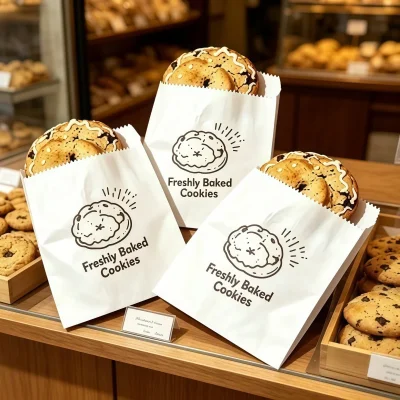
Flat paper bags represent the most straightforward packaging structure, manufactured from two flat paper panels joined by folded side seams and a sealed bottom edge.
- Ideal Applications: Cookies, biscuits, flat pastries, single slices, pre-packaged sandwiches, and dry takeaway snacks.
- Core Advantages: High material yield, low manufacturing complexity, minimal storage footprint, and maximum printable flat surface area.
- Sourcing Tip: Best deployed when the product exhibits a low depth profile and does not require a self-standing presentation.
2. Gusseted Bakery Paper Bags
Gusseted paper bags feature creased side or bottom panels that expand outward when a product is inserted, significantly increasing internal volume.
- Ideal Applications: Whole bread loaves, baguettes, multi-piece pastry orders, large croissants, and bulk takeaway bakery goods.
- Determining Gusset Dimensions: Always specify gusset depth based on maximum product thickness plus loading clearance. Requesting a “large bag” without defining gusset dimensions often results in torn side seams during packaging.
Formula for Custom Orders: Provide suppliers with: Length × Width × Thickness/Diameter alongside total product weight per bag.
3. SOS (Self-Opening System) & Flat-Bottom Paper Bags
SOS paper bags are constructed with a rigid, rectangular flat bottom that allows the package to stand upright independently prior to and during loading.
- Ideal Applications: Multi-item bakery takeaway, supermarket bread displays, bulk rolls, and high-volume food service operations.
- Operational Benefit: The self-standing structure drastically reduces manual packing time during peak retail service hours, optimizing workflow efficiency at check-out counters.
4. V-Bottom & Pinch-Bottom Paper Bags
V-bottom and pinch-bottom bags utilize a folded seam construction to form a tapered, narrow bottom profile.
- Ideal Applications: French baguettes, long breadsticks, artisan crusty rolls, and elongated takeaway baked items.
- Key Specification Factors: When ordering V-bottom bags, confirm total bag length, opening perimeter, paper tensile strength, and bottom fold integrity to handle long, heavy loaves without bottom blowout.
5. Windowed Bakery Paper Bags
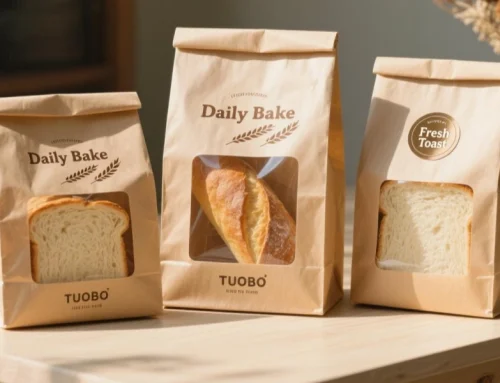
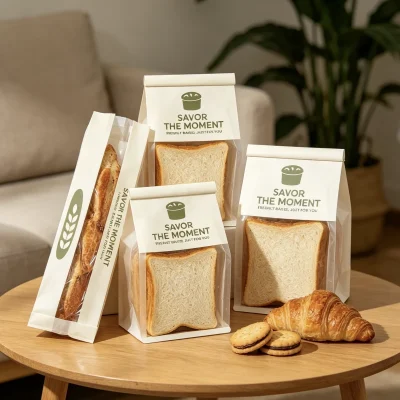
Windowed paper bags combine a structural paper body with a transparent film panel—such as BOPP, PLA, or glassine—to showcase the food inside.
- Ideal Applications: Specialty cookies, decorated donuts, crusty artisan bread, pastries, and retail supermarket shelf displays.
- When to Add a Window: Integrate a clear window when visual appearance drives purchasing decisions or when store staff must instantly identify product varieties without opening sealed packages.
6. Grease-Resistant Bakery Paper Bags
Grease-resistant paper bags are manufactured using specialized greaseproof paper or surface-treated substrates that block oil, butter, and fat penetration.
- Ideal Applications: Butter croissants, glazed donuts, Danish pastries, fried turnover pastries, and savory cheese breads.
- Material Performance: Grease resistance is a critical substrate specification. Using standard kraft for high-fat items leads to unsightly oil saturation, compromised package strength, and stained customer hands.
7. Tin Tie Resealable Paper Bags
Tin tie bags incorporate a flexible metal strip laminated near the top opening, allowing consumers to repeatedly open, roll down, and securely seal the package.
- Ideal Applications: Premium dry cookies, biscotti, specialty coffee cakes, hard rolls, and gift bakery items.
- Primary Advantage: Extends post-purchase product freshness for multi-serve baked goods while maintaining a classic packaging aesthetic.
Bakery Paper Bag Types at a Glance
| Bag Type | Best-Fit Applications | Main Advantage | Key Specification |
| Flat Bag | Cookies, biscuits, small pastries | Simple and economical | Bag width and length |
| Gusseted Bag | Bread, larger bakery products | Higher internal volume | Gusset depth |
| SOS Bag | Bread, takeaway, food service | Easy filling and standing | Bottom structure |
| V-Bottom Bag | Bread, baguettes, rolls | Efficient elongated structure | Length and opening |
| Window Bag | Cookies, pastries, retail bakery | Product visibility | Window size and position |
| Grease-Resistant Bag | Donuts, croissants, oily foods | Reduces grease penetration | Paper treatment/specification |
| Tin Tie Bag | Cookies, biscuits, dry bakery | Resealable | Closure position |
Important: These categories can overlap. For example, a bakery bag can be both gusseted + window + grease-resistant. Structure, material and functional features should therefore be specified separately.
Paper Materials for Bakery Bags
Natural Brown Kraft Paper
Characteristics: Unbleached, highly natural aesthetic, high tear resistance, and good air permeability.
Best Used For: Rustic artisan loaves, crusty baguettes, dry rolls, and eco-conscious brand positioning.
Bleached White Kraft Paper
Characteristics: Smooth, high-brightness surface offering vibrant color contrast for detailed flexographic artwork.
Best Used For: Premium retail packaging, franchise logos, high-definition branded graphics, and corporate chain bakeries.
Grease-Resistant & Greaseproof Paper
Characteristics: Treated or mechanically refined wood pulp fibers that block oil, butter, and fat migration.
Best Used For: High-fat croissants, butter-rich Danish pastries, fried donuts, and melted cheese sandwiches.
Poly-Lined & Coated Papers
Characteristics: Paper laminated with thin inner polymer coatings (such as PE or PLA) to deliver a moisture and grease barrier.
Considerations: While inner linings provide barrier protection, they alter steam breathability and impact standard paper recycling streams. Use lined paper only when extended shelf life or liquid resistance is required.
Functional Features: When to Include Optional Upgrades
Avoiding over-packaging requires selecting optional features based on demonstrated packaging needs:
- Clear Windows: Essential for retail supermarket displays where visual inspection drives consumer purchases. Unnecessary for direct counter takeaway bags.
- Grease Resistance: Required for oily, butter-rich, or fried baked items. Unnecessary for dry, low-fat artisan bread.
- Ventilation Micro-Perforations: Critical when packing freshly baked bread while hot to prevent steam condensation.
- Tin Tie Closures: Highly functional for multi-serve baked items intended for extended home storage. Unnecessary for single-serve immediate consumption items.
- Carrying Handles: Useful for multi-item takeaway bags or heavy bulk bread purchases.
Matching Bag Specifications to Specific Bakery Products
| Product Type | Recommended Bag Structure | Recommended Material / Features | Primary Operational Objective |
| Artisan Bread Loaves | Side-Gusseted or SOS Bag | Brown Kraft / Micro-Ventilated | Accommodates large loaf volume; allows steam to escape |
| French Baguettes | Elongated V-Bottom or Flat Bag | Kraft Paper / Optional Full Window | Fits long dimensions; protects crust structure |
| Butter Croissants | Flat or Gusseted Window Bag | Grease-Resistant Paper Substrate | Prevents oil leakage and exterior grease stains |
| Glazed Donuts | Flat-Bottom SOS or Window Bag | Greaseproof Paper / Wide Opening | Protects top icing from scuffing; handles surface oil |
| Dry Cookies & Biscuits | Flat or Gusseted Tin Tie Bag | White Kraft / Poly Window / Tin Tie | Retains crispness; allows repeated consumer resealing |
| Warm Takeaway Pastries | Flat Bag | Lightweight Grease-Resistant Kraft | Low-cost protection for immediate food consumption |
When Are Paper Bags the Wrong Packaging Format?
While versatile, standard paper bags are not suitable for all food packaging requirements. Consider alternative flexible or rigid packaging formats when your product requires:
Hermetic Gas Barriers: Modified atmosphere packaging (MAP) for extended multi-month shelf life.
High Moisture Containment: Wet food items containing liquid fillings, heavy sauces, or fresh creams.
High Puncture Resistance: Hard, sharp-edged bakery items that can tear thin paper panels.
Long-Distance Export Supply Chains: Products subjected to extreme humidity, temperature fluctuations, or rough handling over extended transit times.
Quick Selection Guide for Bakery Paper Bag Printing
| Printing Method | Recommended Order Volume | Best Use Case | Key Benefit |
|---|---|---|---|
| Flexographic | 5,000+ pieces | Standard kraft bakery bags, bulk production | Cost-effective, eco-friendly water-based inks, reliable color consistency |
| Digital | 50–5,000 pieces | Small runs, new product launches, seasonal packaging, multi-SKU | No plate fees, low MOQ, fast turnaround |
| Gravure | 100,000+ pieces | Premium brand image bags, large chain orders | Ultimate color quality, unbeatable long-run consistency |
Food-Contact Compliance for Bakery Paper Bags
Bakery bags intended for direct food contact should use materials and inks appropriate for the intended application and destination market.
When sourcing custom bakery bags, buyers should ask for relevant documentation rather than relying only on a general statement such as “food grade.”
Depending on the market and construction, documentation may include:
Food-contact compliance statement
Migration testing where applicable
Material specifications
Ink or adhesive compliance information
Applicable certification or test reports
For export orders, the destination market should be specified at the beginning of the project so the supplier can select appropriate materials from the start.
How to Source Custom Bakery Paper Bags
- Define Product Physical Parameters: Measure maximum loaf length, width, height/diameter, total unit weight, and fat/oil content.
- Identify Primary Functional Requirements: Determine whether your application requires grease resistance, steam ventilation, product visibility, or consumer resealability.
- Select Bag Structure: Match the loaf geometry with a flat, gusseted, SOS, or V-bottom bag design that complements your packing speed requirements.
- Determine Paper Substrate & GSM: Choose brown kraft, white kraft, or greaseproof paper at a weight (GSM) suitable for the product’s load requirements.
- Define Optional Upgrades: Specify window dimensions, micro-perforation density, tin tie placement, and flexographic artwork color counts.
- Request & Test Pre-Production Samples: Conduct physical filling, seam strength, grease bleed-through, and steam condensation tests with actual baked products prior to approving mass production.
Standard Bakery Paper Bag Specification Sheet
Provide suppliers with this standardized request format to receive clear, comparable factory quotes:
1. APPLICATION DETAILS:
– Target Food Product: [e.g., Artisan Sourdough Loaf / Glazed Donut] – Unit Weight per Bag: [e.g., 450 grams] – Packaging Environment: [e.g., Packed Hot / Counter Service / Retail Display]
2. BAG DIMENSIONS & STRUCTURE:
– Bag Structure Type: [e.g., Side-Gusseted / SOS Flat-Bottom / Flat]
– Internal Dimensions: Width: ___ mm | Gusset Depth: ___ mm | Length: ___ mm
– Top Opening Clearance: [e.g., 40 mm extra space above food]
3. MATERIAL SPECIFICATIONS:
– Paper Substrate: [e.g., Natural Brown Kraft / Bleached White / Greaseproof] – Target Basis Weight (GSM): [e.g., 60 GSM Kraft] – Barrier Requirements: [e.g., PFAS-Free Grease Resistance Kit 5 / Uncoated]
4. FUNCTIONAL FEATURES & UPGRADES:
– Display Window: [e.g., Yes (Polymer, 60 mm × 150 mm) / No Window] – Ventilation: [e.g., Micro-perforated strip / None] – Closure Type: [e.g., Open Top / Tin Tie Laminated]
5. PRINTING & BRANDING:
– Artwork Design: [e.g., 2-Color Water-Based Flexo / Unprinted Plain] – Print Coverage Area: [e.g., Front & Back Panel / Full Bleed]
6. COMMERCIAL & COMPLIANCE PARAMETERS:
– Order Quantity: [e.g., Initial 25,000 units / Annual 100,000 units] – Target Destination Market: [e.g., United States (FDA Compliant) / EU] – Outer Packaging: [e.g., Moisture-proof inner bag, 500 units/corrugated carton]
Cost Drivers in Custom Bakery Bag Manufacturing
Order Quantity & Production Runs: Larger production runs amortize fixed machine setup times and flexo plate prepress costs across higher unit volumes.
Paper Substrate & GSM: Higher paper basis weights and specialty greaseproof treatments carry higher raw material costs than standard kraft grades.
Structural Complexity: SOS flat-bottom bags and multi-panel gusseted bags require additional converting processes compared to simple flat bags.
Window Converting: Laminating clear film windows introduces secondary inline converting steps and multi-material costs.
Printing Color Count: Higher flexographic color counts require additional printing plates, ink setup channels, and precise registration alignment.
Resealable Hardware: Integrated tin ties or adhesive closure strips add physical hardware and secondary application assembly costs.
Common Bakery Paper Bag Sourcing Mistakes
Choosing the Bag Before Measuring the Product
A standard size may look close on paper, but slight dimensional mismatches can cause slow filling, poor sealing, or product damage during transit. Always provide your supplier with actual product dimensions and physical samples so they can recommend a properly fitted bag style and size.
Using the Same Paper for Every Bakery Product
Bread, croissants and donuts have different grease, moisture and breathability needs. Using one uniform paper stock can lead to grease bleed, sogginess, or premature staling. Always select paper grade, coating and barrier properties based on the specific product it will hold.
Adding a Window Without Considering Product Position
A poorly placed window will show empty bag space instead of your product on retail shelves, weakening shelf appeal. Always define the product’s resting position and orientation inside the bag first, then design the window size and location to showcase the product clearly.
Over-Specifying Paper GSM
Thicker paper is not always better. Unnecessarily high GSM drives up unit cost, can make bags stiff and hard to seal, and adds unnecessary shipping weight. State your required strength, handling scenario and application first, then let your manufacturer recommend the optimal GSM.
Ignoring the Filling Process
Bags designed for manual packing may fail on high-speed automated filling lines due to mismatched opening dimensions or poor stiffness. Tell your supplier upfront whether bags will be packed by hand or by machine, and at what production speed.
Approving Only an Empty Sample
An empty bag can look flawless, but fit, sealability and protection only become clear with product inside. Always test finished bag samples with your actual bakery product to verify fillability, closure and product protection before mass production.
Treating “Food Grade” as a Complete Specification
“Food grade” is a general term, not a guarantee of compliance with your target market’s regulations. Standards vary by region (FDA, LFGB, etc.). Always request full compliance documentation and test reports matching your destination market’s food-contact requirements.
Frequently Asked Questions
What are the most common types of bakery paper bags used in commercial food packaging?
The primary types of bakery paper bags include flat, side-gusseted, self-opening system (SOS) flat-bottom, V-bottom, windowed, grease-resistant, tin tie, and ventilated paper bags. These structures can be combined—such as a side-gusseted bag with a grease-resistant substrate and a transparent window—to satisfy specific food protection and retail display requirements.
How do I determine if my bakery products require grease-resistant paper bags?
Bakery items with high butter, fat, or oil content—such as croissants, Danish pastries, donuts, and melted-cheese items—require grease-resistant or greaseproof paper to prevent oil penetration and packaging stains. Conversely, dry goods like artisan sourdough loaves and hard biscuits perform well with standard food-grade kraft or white paper.
What essential specifications must be provided to get an accurate custom bakery bag quote?
To receive an accurate B2B quote, buyers must provide exact internal bag dimensions (width, gusset depth, length), total fill weight, bag structural format, paper material type and GSM, functional features (windows or closures), artwork color count, target order volume, and destination food-contact compliance requirements. Providing physical product samples or photos alongside these parameters ensures precise factory sizing and structural recommendations.
Is a self-opening (SOS) flat-bottom bag better than a flat or V-bottom bag for high-volume bakeries?
Self-opening system (SOS) bags feature a rigid flat bottom that allows the package to stand upright independently, significantly speeding up manual loading during high-volume counter service or assembly lines. While flat and V-bottom bags are more cost-effective and space-efficient for thin single items, SOS bags provide superior operational efficiency for multi-item takeaway orders and heavier bakery goods.
Matching the Right Bag to Your Next Production Run
There is no single bakery paper bag that works for every product. The right packaging starts with five questions:
What are you packaging? How large is it? What can damage the package or product? How will the bag be filled? How will the customer use it?
From there, the bag structure, paper, functional features, printing and final specifications can be selected logically.
For bakeries and food brands sourcing custom packaging, the goal is not to add the most features. It is to choose the simplest bag structure and material that provides the required product fit, handling performance and presentation.
Your Next Step
Send us the key details: your loaf/pastry dimensions (Length × Width × Height/Diameter), fat and moisture profile, packing workflow, target volume, and destination compliance standards. We will return an engineered structural recommendation, paper substrate specifications, and a physical sample kit to evaluate directly in your bakery.
RBD Packaging manufactures custom bakery paper bags and sustainable food packaging. Operating under certified food safety management systems with FDA and EU direct food-contact compliance, we supply complete documentation—including Declarations of Compliance (DoC), lab migration test reports, and PFAS-free certificates—with every custom order.
Pre-production sample sets and physical mock-ups are available before you commit to a bulk production run, because a paper bag that looks right on a digital proof still has to survive live counter filling, crust friction, and loaf steam. We would rather you test it with real baked goods first.
Reach our technical sourcing team at [email protected] with your RFQ specification sheet—or simply with your product details and the packaging problem you are trying to solve. Either way, you will get an actionable technical answer rather than a generic product catalog.
One last practical note: the fastest projects we run are the ones where the buyer provides 3D loaf dimensions, butter/fat profile, and realistic annual volume in their very first message. That single email typically removes a full week of back-and-forth from your procurement timeline.