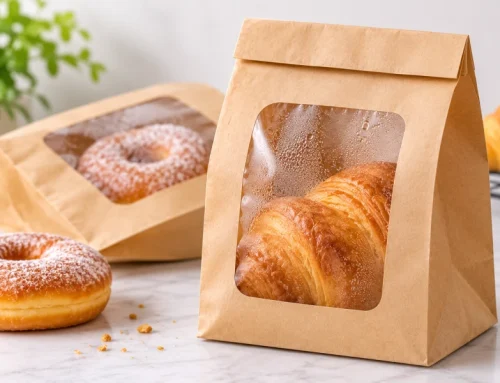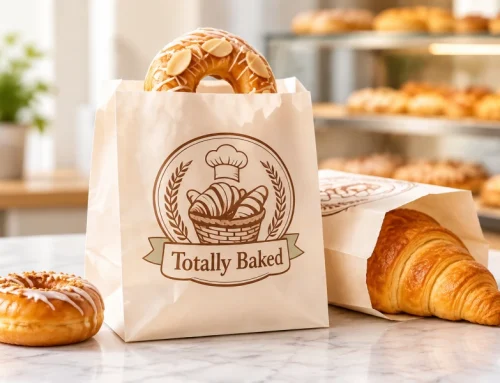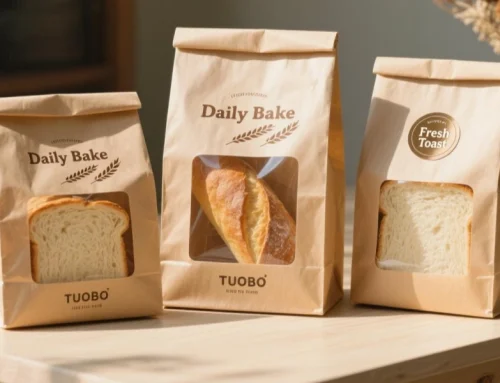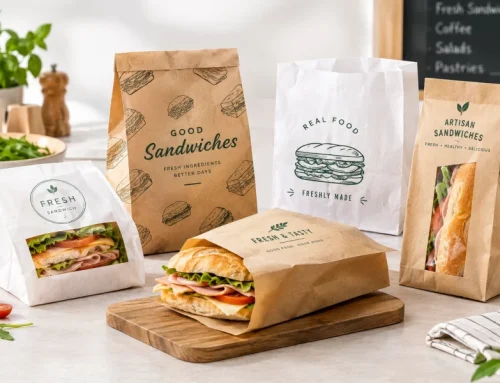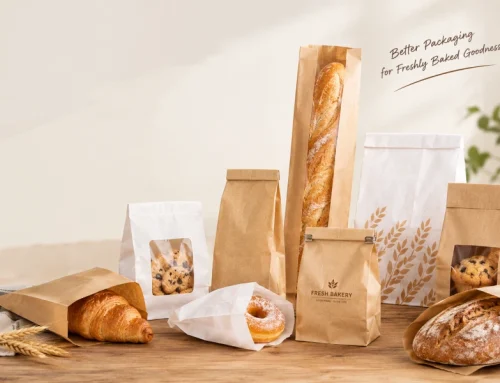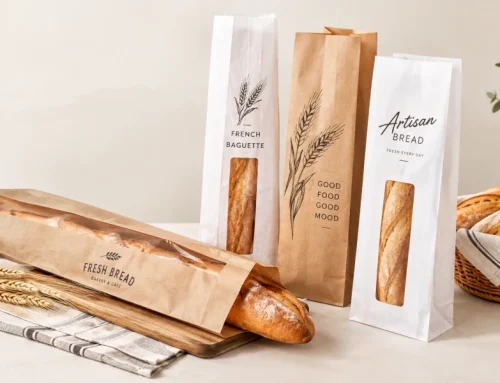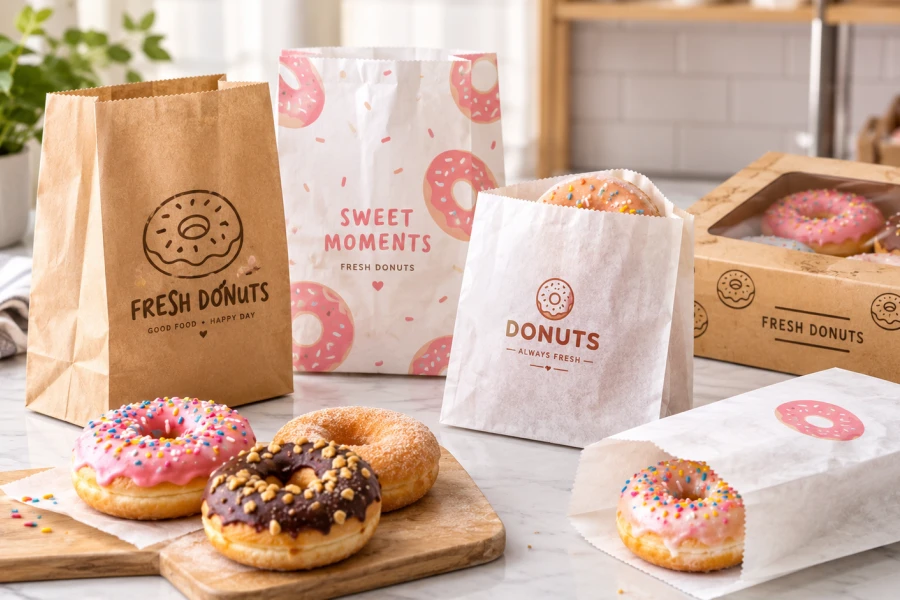
Choosing the right donut paper bag involves more than finding a bag that fits. Bakeries, donut shops, and food-service businesses need packaging that accommodates different donut sizes, helps manage grease, protects icing during handling, and presents the brand clearly.
For businesses ordering custom donut bags in bulk, the key decisions are bag dimensions, paper type, grease resistance, printing requirements, and order quantity. This guide explains how to evaluate these factors before selecting a packaging supplier.
What Type of Paper Bag Is Best for Donuts?
The right donut bag depends on how the donuts are sold, how much space they need, and how the packaging performs when it comes into contact with grease or icing.
| Bag type | Best suited for | Main consideration |
|---|---|---|
| Flat paper bags | Single donuts and simple takeaway orders | Opening width and ease of insertion |
| Grease-resistant paper bags | Fried donuts and products that may leave oil stains | Actual grease resistance under use conditions |
| Gusseted paper bags | Products needing extra depth or volume | Side or bottom expansion and bag stability |
| Glassine-lined or other lined paper bags | Applications requiring a smoother inner surface or additional barrier performance | Liner compatibility, food-contact requirements, and disposal considerations |
| Custom-printed donut bags | Bakeries and brands seeking consistent packaging | Print area, colors, artwork, and order quantity |
These formats can overlap. For example, a flat paper bag can also be made from grease-resistant paper and custom printed.
For a bakery selling individual donuts over the counter, a flat bag may be sufficient. For products with heavier oil residue or sticky toppings, the paper specification deserves more attention. Larger orders may require a different format entirely.
The best starting point is the donut itself: its dimensions, surface coating, serving temperature, and intended time in the package.
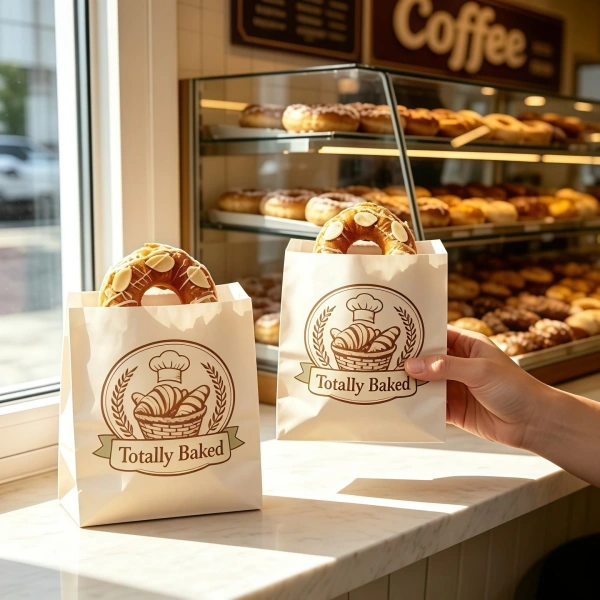
How to Choose the Right Donut Bag Size
Do not rely on nominal catalog sizes (e.g., 4″ x 6″ or 5″ x 7″). Catalog dimensions reflect flat paper sizes before insertion. When a three-dimensional donut enters a flat bag, the width expands, reducing available internal length and risking split seams or damaged icing.
Calculating Bag Dimensions
To ensure smooth insertion without scraping off delicate glazes, measure your finished product at serving temperature.
Use these formulas to establish minimum bag requirements:
Required Bag Width = Donut Diameter + Donut Height + 15 mm Clearance
Required Bag Height = Donut Diameter + Donut Height + 25 mm Clearance
For side-gusseted bags, the expanded gusset depth covers part of the required width allowance.
Sample Calculation
For a glazed ring donut measuring 100 mm Diameter 35 mm Height:
Minimum Bag Width: 100 mm + 35 mm + 15 mm = 150 mm
Minimum Bag Height: 100 mm + 35 mm + 25 mm = 160 mm
Recommended Specification: 150 mm × 160 mm
How to Prevent Grease Stains and Icing from Sticking
Grease resistance, moisture resistance, and resistance to icing adhesion are related but different performance requirements. Choosing a paper simply because it is described as “food grade” does not establish how it will perform against oil or sticky toppings.
Choose paper according to grease exposure
Ordinary kraft or white paper may be suitable for some products and short serving periods, but it can show oil stains when used with greasy donuts.
Grease-resistant paper is designed to reduce oil penetration. Its performance depends on the paper formulation, construction, grease exposure, and contact time.
For products with heavier grease exposure, ask the supplier to recommend a suitable paper grade and verify its performance using the actual donut.
Consider the inner surface
Glaze and sugar toppings can adhere to some paper surfaces, potentially damaging the product during removal.
A smoother paper surface or an appropriate liner may help, but the result depends on the topping and the packaging conditions. Test the bag with the actual product after the glaze has set to evaluate sticking, surface damage, and oil transfer.
Account for serving temperature
Packing very hot donuts can trap steam and affect the product’s surface and texture. Grease-resistant paper does not automatically prevent condensation.
Where the product and food-safety process allow, determine the appropriate cooling and packing conditions before finalizing the packaging specification. Test the bag under the intended serving conditions rather than assuming that one paper type will suit every donut.
What should buyers ask their supplier?
Before placing a bulk order, confirm:
- Whether the paper is suitable for the intended food-contact application.
- What grease-resistance performance can be documented or tested.
- Whether a liner or coating is necessary.
- Whether the paper is suitable for the intended serving temperature.
- What recycling or composting claims can be substantiated for the finished package.
These questions help prevent problems that may not be apparent from a product photograph or material name alone.
Kraft Paper vs. White Paper for Donut Bags
Kraft and white paper are both common choices for bakery packaging. The right option depends on brand presentation, print requirements, and the paper’s functional performance.
| Factor | Kraft paper | White paper |
|---|---|---|
| Appearance | Natural, understated look | Clean background for colorful designs |
| Branding | Works well with simple logos and limited-color printing | Offers greater visual contrast for many print designs |
| Color reproduction | The brown background influences printed colors | The lighter background can make colors appear more vivid |
| Grease resistance | Depends on the specific paper grade or treatment | Depends on the specific paper grade or treatment |
| Cost | Depends on paper grade, construction, and order quantity | Depends on paper grade, construction, and order quantity |
Neither color guarantees better grease resistance or environmental performance. Buyers should compare the actual paper specification rather than relying on color alone.
For a bakery with a natural brand identity, kraft paper may be a suitable starting point. A brand using bright colors or detailed artwork may prefer white paper.
If environmental claims matter to your business, confirm the actual material composition and local disposal requirements. A lined or coated paper bag may have different end-of-life characteristics from an unlined paper bag.
Custom Printed Donut Bags for Bakeries
Custom printing turns a functional takeaway bag into part of the customer experience. It can also help multi-location bakeries maintain consistent brand presentation.
Before ordering custom donut bags, define the following specifications.
Logo and artwork
Prepare a high-resolution logo or print-ready artwork. Vector artwork is generally useful for maintaining clean edges when designs are resized.
Confirm the print area and required clearances with the supplier before finalizing the design. Artwork positioned too close to a fold, seam, or opening may not reproduce as intended.
Printing colors
The number of colors and the printing method can affect production cost and appearance. A simple one- or two-color logo may be sufficient for a minimalist design, while a more detailed brand identity may require a different printing setup.
Ask for an artwork proof and review the placement, dimensions, colors, and legibility before approving production.
Custom dimensions and construction
A custom bag may be necessary when standard formats do not accommodate the product properly. The supplier should confirm whether the requested dimensions and construction are feasible for the selected paper and production method.
Food-contact and material requirements
Tell the supplier whether the bag will directly contact the donut and whether the product will be packed warm. Request relevant documentation for the intended application.
If grease resistance or a liner is required, confirm the complete bag construction rather than specifying only the outer paper.
What Affects the Cost of Custom Donut Bags?
There is no single price that applies to every custom donut bag. The quotation depends on the finished specification and the production requirements.
| Cost factor | How it affects the quote |
|---|---|
| Bag dimensions | Larger bags may require more paper |
| Paper grade and weight | Material choice affects paper consumption and performance |
| Liner or coating | Additional materials or processing may increase cost |
| Printing | Color count, artwork, and printing method influence setup and production |
| Order quantity | Production volume can affect the unit cost |
| Sampling and proofing | Physical samples or special development may add cost |
| Packing and shipping | Carton requirements, delivery destination, and shipping method affect the landed cost |
When comparing supplier quotations, make sure the specifications are equivalent. A lower unit price is not a useful comparison if the paper grade, bag dimensions, printing, or packing arrangement differs.
For a more accurate quote, provide the expected order quantity and ask the supplier to identify any differences between the quoted options.
How to Order Custom Donut Bags from a Manufacturer
A clear specification helps reduce unnecessary revisions and makes supplier quotations easier to compare.
Step 1: Define the product
Identify the donut type, maximum dimensions, surface toppings, serving temperature, and number of pieces per bag.
Step 2: Select the bag format
Decide whether a flat bag, gusseted bag, or another construction is suitable for the serving format. If the order contains several donut types, check whether one bag size can accommodate them without compromising product presentation.
Step 3: Confirm paper and performance requirements
Describe the expected grease exposure and any liner requirements. Ask the supplier to recommend a suitable specification and explain how it can be tested.
Step 4: Provide artwork and quantity
Send the logo or print file, preferred paper color, number of print colors, estimated order quantity, and delivery destination.
Step 5: Approve the sample or proof
Check dimensions, print placement, bag construction, and performance with the actual donut before authorizing mass production.
Step 6: Confirm the production and delivery terms
Confirm the final specification, MOQ, production lead time, packing method, shipping terms, and required documentation in writing.
For repeat orders, retain the approved artwork and specification so that future orders can be checked against the original requirements.
Frequently Asked Questions
What size paper bag fits a standard donut?
There is no single size that fits every standard donut. Measure the donut’s diameter and height, then allow sufficient room for insertion and removal. Confirm the fit with a sample before ordering in bulk.
Do donut bags need to be grease-resistant?
Not every donut requires the same level of grease resistance. The appropriate paper depends on the donut’s oil content, serving temperature, contact time, and presentation requirements. Test the selected paper with the actual product.
Can donut paper bags be custom printed with a logo?
Yes, custom printing may be available depending on the supplier’s production capabilities, bag construction, paper specification, and order quantity. Provide the artwork and intended dimensions so the supplier can confirm the available options.
Are kraft donut bags better than white donut bags?
Neither is automatically better. Kraft paper offers a natural appearance, while white paper provides a light background for many colorful designs. Grease resistance depends on the specific paper grade and construction, not simply the paper color.
Can paper donut bags keep donuts fresh for a long time?
Paper bags are generally intended for short-term handling, takeaway, or presentation rather than providing an extended shelf-life barrier. The actual result depends on the donut, the paper construction, storage conditions, and time in the package.
What information is needed for a bulk donut bag quote?
Provide the donut dimensions, number of pieces per bag, preferred bag style, paper and grease-resistance requirements, print artwork, estimated quantity, destination, and target delivery date. If the exact specification is not known, share a product photo and sample dimensions for an initial recommendation.
Request a Custom Donut Bag Quote
Looking for paper bags for a donut shop, bakery chain, or food-service business? The right specification starts with the product you need to package.
Share your donut dimensions, preferred paper, printing requirements, estimated order quantity, and delivery destination. RBD Packaging can review the requirements and help determine whether a standard or custom bag specification is appropriate. A clearly defined specification makes it easier to evaluate material options, confirm suitability, and compare bulk quotations.